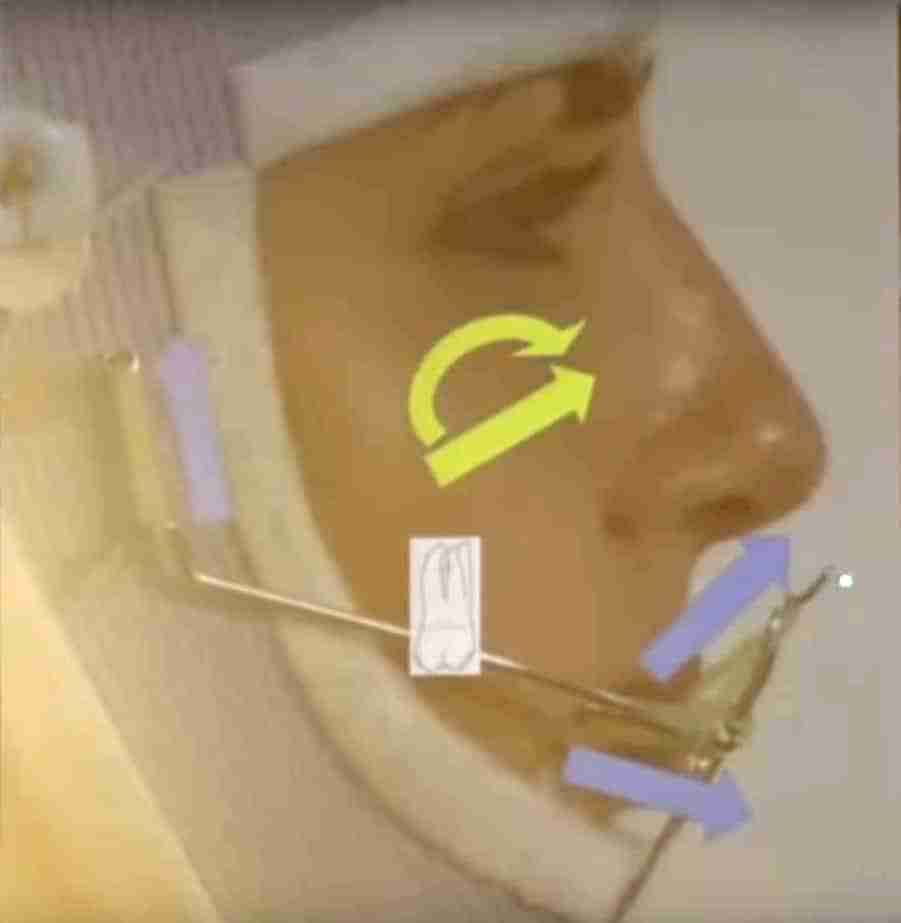

The problem with many oral appliances is that they do not provide the right upward/forward forces nor sufficient force due to lack of anchoring points. From an engineering perspective this should be very easy to solve, right?
Excuse the crappy drawing.


I think the problem with that kind of headgear is the potential for downward rotation of the maxilla in the back

I think the problem with that kind of headgear is the potential for downward rotation of the maxilla in the back
Correct.
From what I understand you do not necessarily need an upwards-directed force, and doing so can often result in excessive anterior ccw tipping of the maxilla (or downward rotation of the posterior maxilla like @Achilles1 said) without a large enough component of forward displacement to make up for this change. Relatively pure orthopedic forward displacement of the maxilla in clinical settings is achieved with a small component of downward force (usually between -15 and -30 degrees to the occlusal plane), which may seem counterintuitive, but keep in mind that there are sutures in the skull connecting to the maxilla (exerting their own opposing forces against this downward component of force) which work to prevent downward growth as well as excessive ccw rotation, given this direction of force application.
EDIT: to clarify, the above applies to mesofacial patients with favorable vertical positioning of the maxilla (most cases of maxilla retrusion). Exceptions willy apply based on the specific phenotype being treated.

I think the problem with that kind of headgear is the potential for downward rotation of the maxilla in the back
This is why I used a facebow attached to the headgear tubes of my expander with 2 posterior attachment points pulling up, 1 anterior attachment point pulling up and 2 anterior attachment points pulling forward (modeled after the MewVector system on the orthotropics youtube channel).

I think the problem with that kind of headgear is the potential for downward rotation of the maxilla in the back
I'm happy that we are talking about the rotations of the maxilla here. This is something I've been contemplating for quite a while. If we actually look at the way 'Craniofacial Dystrophy' happens and the changes to the maxilla/ mandible, as illustrated in this video ( https://youtu.be/VtrJWHjma1o?t=594), we can see that the actual midface seems to move backwards, with some slight clockwise rotation centered around the nasion area, but it is mostly a sagittal movement. We can also see how the posterior part of the maxilla moves a little up. But it seems to me that most of the vertical downward component seems to come from the 'anterior collapse', or the collapse of the premaxillary region rather than that of the regions above. In other words, it seems to me that the orbital and zygomatic processes of the maxilla simply move backwards rather than downwards, while the premaxillary region is what gives most of the downward component.
Thoughts??
Here are a couple threads about angulation of the maxilla:
/community/community/main-forum/expansion-equals-recession-wait-what-pics/#
/community/community/main-forum/will-face-pulling-really-cause-counterclockwise-mandible-rotation/#
@eddiemoney talks about this a lot and there are also insights within the AGGA thread, like this post:
Another AGGA reponse. I asked:
When the maxilla normally grows (due to both displacement and active growth) it both moves forward and also seems to rotate counter-clockwise (anterior moves superiorly, posterior moves inferiorly).
As the goal of of the AGGA is 3D remodelling to proper growth, does it also cause this rotation? In cases such as that of Ronny Ead, is it a possibility that rather than incisors/front teeth tipping, the bone is actually moving into its proper superior position but tips in relation to the back molars which are fixed in place by the device? Are some posterior open bites caused by the maxilla not having fully rotated as it did not grow to its potential ?
In short: If the maxilla is deficient in growth, and counter clockwise rotation is part of that growth, then does restoring the growth include this rotation?
Doctor David Buck answered:
The face must grow out from underneath the cranium which is largely complete by around age 6 or so. The preferred path of growth of the Nasomaxillary complex would be 70% forward and 30% down. The net vector of growth is thus down, but more forward. When growth is corrupted there is some degree of excess vertical growth of the Nasomaxillary complex, and not enough forward growth. This is the norm for our society (85+%) due to a number of factors. Since the face has no direct genetic blueprint it is totally responsive to the soft tissues acting on it during breathing, swallowing, eating and resting, and so on. During stimulation from the AGGA the remodeling is 3 dimensional and may include forward and upward development that failed to develop during growth. The back molars are not fixed in place, and in fact the AGGA has no restrictive qualities about it other then to hold the front six teeth so that cortical drift can take place. The body is free to correct all kinds of distortions in the corrupted Maxilla including passive transverse molar width; yaw in the Maxilla; roll and pitch in the Maxilla; superior movements and so on. Further, while in AGGA treatment I have an osteopath/craniopath who works in my office to see patients who have cranial strain patterns which further reduces pain and symptoms I deal with in my patient population. The AGGA allows for profound cranial releases to occur. These strains impact the dura and create tension and inadequate movements of fluid around the brain and spinal cord creating a myriad of symptoms. The body knows where things are supposed to be, for example I often see impacted teeth drop into place after growth appliance treatment that creates room for them to erupt. This is unlike the results with any other type of "expansion" appliance. I say this because of the true growth/remodeling activity of the AGGA is superior. By the way,the actual terms we use are correct facial growth is counter clockwise and corrupted growth would be clockwise.
@peterparker sounds spot on
It is interesting that you have linked these posts. But having the center of rotation of the maxilla be at the zygomatic buttresses would seem counterintuitive. If that were really the case, during maxillary protraction, the part above the zygomatic process would be pushed in (making the infraorbital rim even more deficient), while the part below the zygomatic process would be pushed forward. If the component of maxillary movement is mostly upwards rather than forwards, this would disrupt the eyeball.
I still hold the belief that the center of rotation is around the nasion/ frontomaxillary suture point, that is if the force vector is straight forward. If the force vector had a more downward component, like I believe varbrah mentioned, we can expect pure forward movement without any rotation. During orthotropic treatment i believe it is the premaxilla that does most of the upward moving, while the whole maxilla rotates/ grows mostly forwards.
I understand what I am explaining here is probably hard to visualize so I have created a visual representation gif file and attached it. (There is a 5 second gap between each frame)
FRAME 1: Original, no changes
FRAME 2: Entire maxilla moved forward with pivot point in nasion area
FRAME 3: Premaxilla moved upwards, slightly forwards
FRAME 4: Mandible grows forward with Bjork Type 2 Forward Rotation (Better Illustrated here:  ?cb=1506335210)
I believe chapter 3 of John Mew's book (that chapter is available on his website for free) illustrates something very similar to what I am saying on page 48, Figure III/9:

I still hold the belief that the center of rotation is around the nasion/ frontomaxillary suture point
I agree that outlines of profile changes show the kind of hinging forward of everything below the glabella as you described. Although, it's probably not quite that simple, involving both remodeling and repositioning along suture lines. For example the sphenoid bone in the diagrams you posted drastically changes shape. Perhaps the "axis of rotation" is deeper than the nasion and hinges around the conformation of the sphenoid?

where did you get the facebow and headgear?
I made the headgear as a hybrid of Plato's helmet and the MewVector designs. Facebows can be purchased online through places like ebay, aliexpress, etc. They come in a range of sizes depending how wide apart your headgear tubes are. I stopped using this system because I felt it was loading too much of the force onto my teeth and not enough onto my palate.
This may be the case. I remember that John Mew mentioned that the sphenoid bone moves up and down within the skull when the maxilla and mandible are moved forward, and the cranial base also changes. He mentions that this is why the SN plane is unreliable as a stable plane/ x-ray superimposition point. He explains that he uses a different plane called FN which takes the nasion point and then goes 40mm above it to create the point F, and states that this is best for superimposition.
I think this is also where osteopathy and other practices of that nature come in. I don't know enough about osteopathy to form a valid opinion of it.
I think this is also where osteopathy and other practices of that nature come in. I don't know enough about osteopathy to form a valid opinion of it.
The concept of ncr or endonasal release is to adjust/release the sphenoid.
where did you get the facebow and headgear?
I made the headgear as a hybrid of Plato's helmet and the MewVector designs. Facebows can be purchased online through places like ebay, aliexpress, etc. They come in a range of sizes depending how wide apart your headgear tubes are. I stopped using this system because I felt it was loading too much of the force onto my teeth and not enough onto my palate.
My plan is to buy a y-plate to expand my palate more, and to start face pulling. I believe in light forces over a long period of time. Do you think the headgear you made is the best alternative to homemade facepulling @apollo?
Im not that god in cunstructing stuff but this type of headgear should be relative easy to make I hope.
Like I said, I abandoned extra-oral traction because the headgear tubes on my expander loaded the force on my teeth rather than the palate. Pushing up on the expander with my tongue or thumbs gave a very different feeling than pulling on the facebow attached to the expander on the buccal side of my teeth. The wires between the teeth just didn't do a good job of transferring the force to the acrylic framework. Maybe it was helping, but it was uncomfortable to sleep in, so I was only completing a few hours per day in the headgear. I decided that I wanted to come up with a different system if I was going to try it again. You can read more about this decision in the thread about my routine. If you still want to try, it was relatively easy to put together.