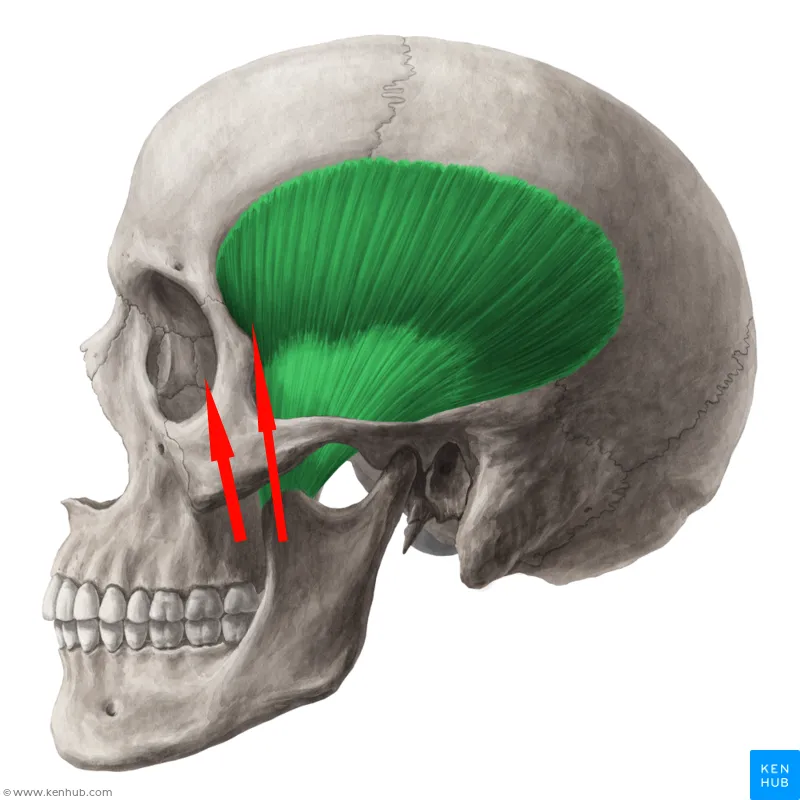
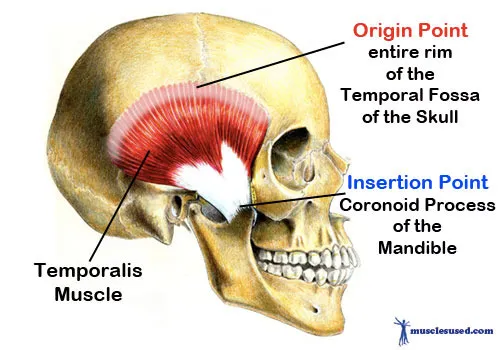
If you look at this picture, you can see that Temporalis has the potential to push the mandible upwards and even slightly forwards. In other threads, it was assumed that temporalis only had backwards and upwards action on the mandible, however based on this picture it's obvious that some fibers can create either forward and upward or upward only movement.
I said before that the tongue can't push the maxilla because everything it's attached to is connected to the maxilla, however I was wrong as looking at this picture of the temporalis muscle it's obvious that the tongue can use it to move the palate upwards.
Especially if the mandible is positioned backwards from craniofacial dystrophy, the temporalis would have an even stronger ability to push it forward and upwards.
My mandible is set back considerably from CFD. I have always clenched my teeth. When I do this I can feel activation of both the temporalis and masseters. My skull is widest around the temporalis.
My mandible is set back considerably from CFD. I have always clenched my teeth. When I do this I can feel activation of both the temporalis and masseters. My skull is widest around the temporalis.
In theory, wouldn't usage and hypertrophy of this muscle, at the front fibers, be able to pull the coronoid upwards, decrease gonial angle, make the whole ramus longer, make zygos wider and push zygos forward, push maxilla forward and upwards.
Its a habit thats been around since I was 5 years old. With mewing I no longer do it. But it feels really nice to clench my teeth with medium force. Maybe my childhood instinct knew my maxilla was dropping and clenched to try and keep it up.
In theory, wouldn't usage and hypertrophy of this muscle, at the front fibers, be able to pull the coronoid upwards, decrease gonial angle, make the whole ramus longer, make zygos wider and push zygos forward, push maxilla forward and upwards.
How would you use this muscle, by chewing? Teeth in contact?
In theory, wouldn't usage and hypertrophy of this muscle, at the front fibers, be able to pull the coronoid upwards, decrease gonial angle, make the whole ramus longer, make zygos wider and push zygos forward, push maxilla forward and upwards.
How would you use this muscle, by chewing? Teeth in contact?
Did you not read the OP? The tongue pushes, the tongue is attached to mandible, the mandible is attached to temporalis.
looking at this picture of the temporalis muscle it's obvious that the tongue can use it to move the palate upwards.
You are right. The ability of the temporalis to provide a maxilla-independent functional foundation for the tongue is likely why of the two main masticatory muscles only temporalis is also regarded as a postural muscle.
looking at this picture of the temporalis muscle it's obvious that the tongue can use it to move the palate upwards.
You are right. The ability of the temporalis to provide a maxilla-independent functional foundation for the tongue is likely why of the two main masticatory muscles only temporalis is also regarded as a postural muscle.
I can mew and then my temporalis tenses, but it's hard to say if it's tensing because of counter-force or if it's tensing just because I'm tensing it.
looking at this picture of the temporalis muscle it's obvious that the tongue can use it to move the palate upwards.
You are right. The ability of the temporalis to provide a maxilla-independent functional foundation for the tongue is likely why of the two main masticatory muscles only temporalis is also regarded as a postural muscle.
I can mew and then my temporalis tenses, but it's hard to say if it's tensing because of counter-force or if it's tensing just because I'm tensing it.
It's complementary in a sense, rather than contrary. At least this is how it feels with the suction hold. When pushing only, the link between the tongue and the temporalii may not be as easy to establish.
looking at this picture of the temporalis muscle it's obvious that the tongue can use it to move the palate upwards.
You are right. The ability of the temporalis to provide a maxilla-independent functional foundation for the tongue is likely why of the two main masticatory muscles only temporalis is also regarded as a postural muscle.
I can mew and then my temporalis tenses, but it's hard to say if it's tensing because of counter-force or if it's tensing just because I'm tensing it.
It's complementary in a sense, rather than contrary. At least this is how it feels with the suction hold. When pushing only, the link between the tongue and the temporalii may not be as easy to establish.
I think if I put my teeth first in contact with temporalis activation at the front and then mew, then I can use it as counter-force, at least pushing harder makes the muscle contract harder as well.
The way I see it, tensing the tongue and the genioglossus pushes the front maxilla forward, however because the jaw is freely moveable, it also pushes the mandible downward and backwards, then once the jaw is slightly open the coronoid process is further away from the temporal, the temporalis muscke gets stretched and in that position it can tense up and give the tongue support to push on the maxilla. Of course the stretch isn't needed, but it's just an explanation.
Also if someone's mandible is recessed, the mandible will shift relative to the temporalis muscle more backwards, allowing it to actually be able to move the mandible forward even. If that's how recession works...
Are there any excerises to activate the temporalis muscle?
What do you mean exercise? Temporalis is a muscle used in mastication and possibly in keeping the teeth closed as @Progress said it's the only postural muscle controlling the mandible. If you just put your hand on the side of your temples, you should feel movement when you tense the temporalis.
I mean as to get more activation of the temporalis than the masseter muscles. Since I have more a masseter chewing pattern than the temporalis muscle.
Try a sideways grinding motion with your molars. Masseters are more expressed as an up-down motion.
Yeah this.
Also @Basim I wouldn't recommend clenching with temporalis, I think it's very important to only use the muscle when it's stretched out, I think overuse easily leads to TMJ. I got like pops, noises, pain, all kinds of that crap from temporalis. The worst from masseter was bloated look and slight headache, temporalis has insane potential for TMJ if you're not careful.
Posted : 12/05/2020 3:49 pm
Leave a reply
Skull and Jaw Correction
Free Classes
Join hundreds who are Tensegrity Mewing, enhancing the good results of mewing and reversing damage. Free Newsletter and Classes