

Changing the relative position/rotation of the maxilla isn't the goal, the goal is to grow it to its full potential size.
In my opinion, the idea of up/down swing isn't correct - what an underdeveloped maxilla really means is a lack of anterior-posterior depth in the maxilla and nasal passages, and underdevelopment of the sinuses.
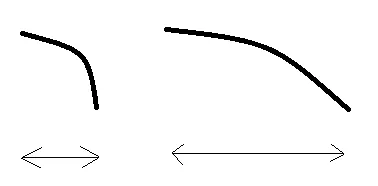
This is an illustration of the upper palate/bottom of the maxilla. It can be extrapolated to the entire nasomaxillary complex. The upper palate does naturally slope downward from the throat to the front teeth.
You can see that the amount of growth/size in the inferior/downward direction is virtually the same. The difference is just the amount of depth, how much the nasomaxillary complex has grown forward.
An underdeveloped nasomaxillary complex looks downward grown because it's got more of it's downward development completed, and the forward development that needs to accompany it hasn't happened.
The maxilla doesn't need to move forward or swing up, the nasomaxillary complex needs to GROW forward. Its position doesn't need to change, its size needs to increase. And as the size of the nasal breathing passages increases, the size of the sinuses which shape the face also increase.
But that's just my new opinion, it's up for debate
This doesn't preclude the possibility that the nasomaxillary complex also rotates upwards as it grows. Both happen, but the rotation goes with the anterior-posterior growth
So basically we can visualize an underdeveloped maxilla by the steepness of it, and to fix it and needs to grow forward, gradually making it less steep?
I think so. And, like my post script comment says, the upward rotation is a part of the forward growth.

As simplified as this sounds, it depends. Yes to the entire complex has to grow. In some cases it May rotate clockwise or clockwise depending on where the deficiency was.
I always had the view that forward movement made no sense. In many cases, I have seen maxillary progress result in a higher Mew line or the maxilla even moving DOWN slightly (especially in the cases of severe overbites) lengthening the face but creating a better aesthetic nonetheless

The best way to increase this is to increase IMW?

How about people with good lower maxilla but have bad upper maxilla? Should you push your posterior 3rd more?
How about people with good lower maxilla but have bad upper maxilla? Should you push your posterior 3rd more?
Examples? What is a bad upper maxilla?
Mew lines honestly mean nothing. People with deep bites often have short Mew lines already. Any expansion they get will be 1-2mm. And longer faced people can simply expand to appear shorter faved via widening the midface and allowing the mandible to swing up. But notice the mandible would also adjust. Short faced people have their mandible tucked in and pronounced mentolabial angles. The face sometimes has to grow longer or shorter. It really isn't all about facial shortening or much forward movement of the maxilla at all.
A Class 2 Div 2 can benefit from the maxilla LOWERING itself from a jammed up position due to overactive masseters. These people would either need to STOP chewing or chew differently. But the maxilla can swing DOWN and make their face more aesthetic by exposing soft tissue. This downswing of the soft palate would cause a minor upswing of the alveolar ridge which would effectively move the incisors forward and the bite more open. In turn the face would lengthen, pushing out the soft tissue around it. The more open bite would push lips out making a short face into a forward face. But the maxilla would still come DOWN in the posterior so as to shift forces of the mandible into the alveolar ridge, which would open the bite via mandible clockwise rotation.
Now in terms of incompetent lip/bimax cases, the Mew line would LENGTHEN, moving the maxilla away from the nose. The lips would hold the teeth back and the mandible would slide forward to pull the tongue back against the soft palate, pulling it down the same way as in the Class 2 Div 2. Except in a Class 2 Div 1 the downward palate allows the mandible to swing forward to maintain occlusion. In both cases of Class 2 the mandible is back. The difference is the Class 2 Div 1 Lip incompetence means the alveolar ridge must come back while the mandible slides forward, changing the alignment of the maxillary teeth to a slight retrocline while the mandibular teeth do the exact same thing (because the lips push them back). So this open bite clockwise closes on the alveolar ridge and counterclockwise rotates on the soft palate to allow the mandible to slide forward in its condyle. All the while a lip seal closes the bite.
In both Class 2 Cases, the maxilla must come down. But one results in forward movement of the alveolar ridge while the other results in backward movement. But in both cases the soft palate is pushed down.
Class 2 Div 2 and Class 2 Div 1 can both benefit from expansion. In either case they carry with them a more protracted mandible position. But in both cases downward movement helped to free mandible motion. One just involves a greater lip seal (Div 1) while the other a decreased usage of the masseters and less usage of the molars. Both cases can benefit from BETTER chewing habits, not necessarily more.
The common denominator is that forward movement may not happen. But it doesn't matter in the long run if the relationship of the mandible has changed relative to the maxilla. All of this allows for more muscle activation and better soft tissue support. I doubt my Mew line has moved much. But the facial gains have outweighed the expectation of making my face shorter.
My maxilla may have never moved significantly. But the expansion has allowed for greater mandibular range of motion. My underbite is almost gone. All but 3 of my incisors are over my mandible now. I have a functional frostbite but it is soon to be a regular human overbite just by a few millimeters. In all of this I doubt my Mew line decreased much. But my mandible can position itself much more comfortably. My soft tissue is so well supported. My face has maybe lengthened a bit but it looks all the more healthy and balanced. My eyes seem more lifted. My cheeks more robust. My lip seal has gotten near excellent. My resting face now looks more "alive" than ever before. But I doubt my maxilla ever moved at all.

@admin What you're saying about the downward component of growth being there, but the anteroposterior(front-back) component not being there, makes sense, especially when we consider palatal vault and how it's helped with palate expansion...Like, the steepness of the palate will decrease with lateral expansion, although the overall downward component stays the same, just because the slope is decreasing as the transverse dimension increases in length. Seems like there could be a very similar mechanism.
@admin What do you think about Harvold's experiments where the maxilla changed shape/position unfavorably in growing and nongrowing monkeys(at the same rate) after correct tongue posture was blocked? How would that be explained by your theory of the fascia?

There is probably truth to this. As it was said earlier, AGGA operates on the same premise too. Moreover, this idea forces us to ask how important the posterior tongue even is in the first place, besides mere lateral expansion? It would seem that the anterior tongue has prime importance in allowing the jaws to advance by developing the alveolar ridge forward.
There is probably truth to this. As it was said earlier, AGGA operates on the same premise too. Moreover, this idea forces us to ask how important the posterior tongue even is in the first place, besides mere lateral expansion? It would seem that the anterior tongue has prime importance in allowing the jaws to advance by developing the alveolar ridge forward.
In the case of someone with bimax, the tongue has pushed the alveolar ridge further than it needs to go. But expanding it laterally via posterior engagement is definitely still needed since the stretched out maxilla becomes more wide, giving the teeth room to occlude ideally without excessive overjet.
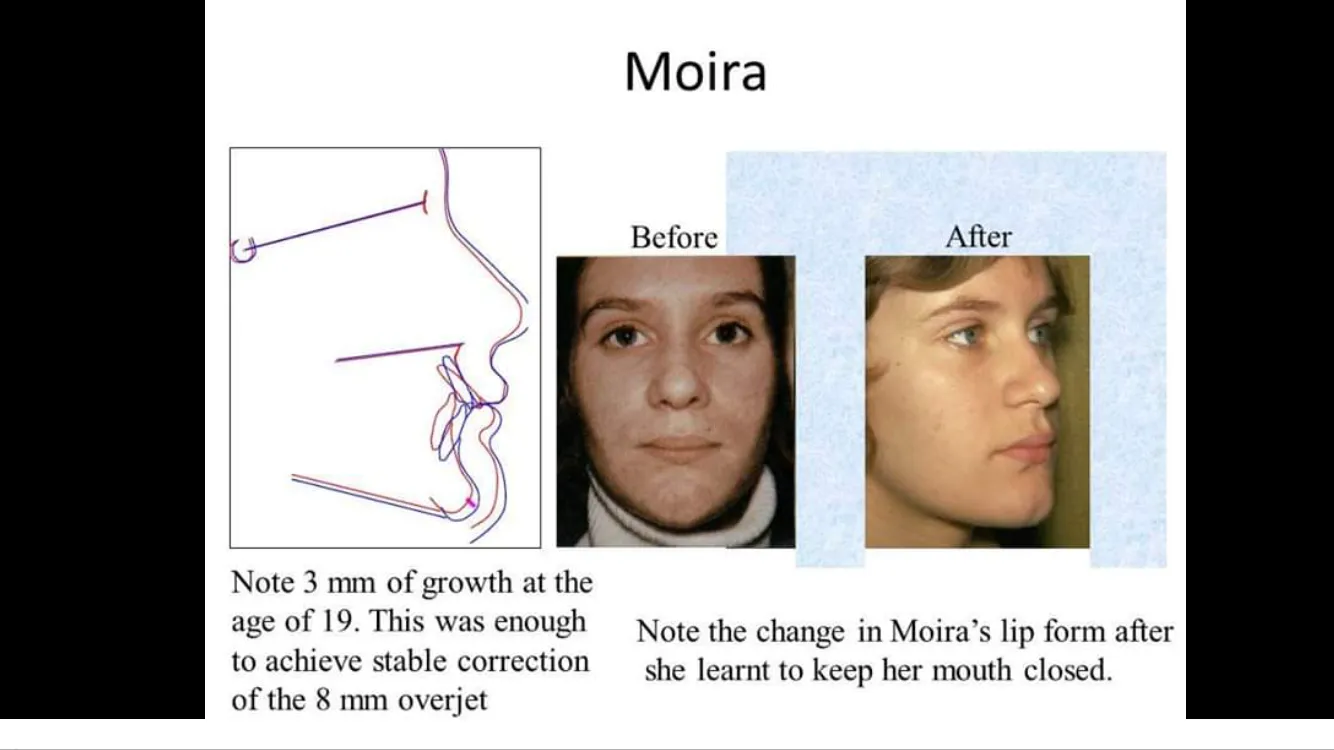
The maxilla didn't go anywhere, but the alveolar bones did move further back. Yet the lateral expansion allowed the mandible to come forward.
So in this particular case, lateral expansion + lip seal brought more balance to the face.

There is no new thought here. If the empty space grows that means the container must grow. Whichever way you want to say it, its the same thing.

Without first reading through the replies, I wanted to point out, that this is kind of similar to a thread I opened a few months back:
(Thread merged with this one): the-great-work(dot)org/community/main-forum/high-arched-palate-and-maxillary-growth/
Not to claim ownership, just happy that the idea got picked up eventually. 🙃
@admin What do you think about Harvold's experiments where the maxilla changed shape/position unfavorably in growing and nongrowing monkeys(at the same rate) after correct tongue posture was blocked? How would that be explained by your theory of the fascia?
@qwerty135
The group of muscles forming the tongue can't really be functionally separated from muscles attaching to the hyoid, the pterygoid muscles, masseter - really no muscles can really be considered independent or separate, they're all work as a single functional unit. In a similar way to how stroke patient faces collapse from muscles being inactive, I think forcing the tongue out of its proper positioning (possibly very uncomfortably) causes a collapse in all the muscle systems surrounding it. Other muscles need to take up the slack in ways that they aren't meant to function, and these improper forces/lack of supporting forces cause the bones to reshape in accordance with Wolff's law.
There is no new thought here. If the empty space grows that means the container must grow. Whichever way you want to say it, its the same thing.
@CaptainT, @Fiver can attest that this isn't a new idea. I just meant to clear up the idea that rotation of the maxilla isn't really the point. I saw conversation in the chat about pushing up at the front of the palate to rotate the maxilla, so I posted this to clarify that the rotation is just a secondary effect of growth - not something that is achieved by itself.
TGW Moderation note: Originally posted July 2019, merged with this topic Nov 2019
Just some thoughts/ideas, that are probably wrong and most likely nothing new:
It is always assumed (as far as I know/understood) that the vertical growth of the face is the result of a downward shift of the entire maxilla.
But what about the people with high arched palates, which seems to be quite common in people with "adenoid shaped" faces?
Maybe its not the palate that is unnaturally high, but the rest of the palate which bent/curved downward due to the lack of forces in axial directions (I mean the horizontal plane).
And if thats the case, then to reverse the damage would mean to straighten out / unbend the palate rather than only applying an upward force.
Here is an illustration of what I mean: 
Notice how the middle part of the palate does not change the position but the total vertical height decreased and through the "unwrapping / unbending" as seen in the lower right picture there is forward growth.
Which could mean, that we dont necessarily need to relocate the maxilla as a whole, but only decrease the downward curvature to receive forward and upward growth.

That was my idea as well these last few weeks. I wonder what others think about that, especially @wardellstephencurry @Progress and @neveragain , since they experienced increase in IMW and/or reduced face height.

Wise thoughts.

Can someone clear this up a bit, this is how I understood it:
1. Bone remodelling only takes existing bone material and places it somewhere else - no new bone material is added.
2. Then you have appositional growth, which only increases the diameter of the bones. It is triggered by exerting force on the bone (Wolffs Law)
3. Then you have interstitial growth, the growth that comes from the sutures, which actually lengthens the bone.
Edit: Actually 1 and 2 are more or less the same, I think.
1 and 2 is accepted by mainstream orthodontics (but they don´t think it has a big enough effect to make a difference).
3 is not commonly accepted, because it is assumed the sutures are closed already in adults. However this is what @TGW says needs to happen.
Is this correct? If so, is there any scientific publication that shows that interstitial growth in adults is still possible in theory or that the sutures in the skull never fuse?

Is it posible then to get progress without changes in your palate?
I think this is my case, my palate has not expanded a single mm yet I can observe slight changes in my photos and a shortening of the face.
Btw, I think pressing the soft palate is cruicial since it is the pressure in that area which incides on the maxilla. I can feel after hard mewing for quite a while how just by folding my tongue and pressing with the tip in my soft palate my maxilla "burns".

I think how you illustrate expansion is exactly how it occurs and it explains how expansion can reduce a vaulted palate.
Does facial recession always go hand in hand with a vaulted palate or are there cases where the palate isn´t vaulted and just too small?
Does facial recession always go hand in hand with a vaulted palate or are there cases where the palate isn´t vaulted and just too small?
Yes, my case is like that. Class 3 Maloclussion usually means the upper arch is much smaller than the lower one. But it usually isn't vaulted, or at least not in my case
Yessss that picture makes so much sense. A wider palate decreases the height of the maxilla, making the midface dropdown. Rather than trying to cause facial upswing!
Yessss that picture makes so much sense. A wider palate decreases the height of the maxilla, making the midface dropdown. Rather than trying to cause facial upswing!
Not necessarily. On some occasions the added width increases the height.