

Hi everyone, I'm 18 years old and I've been mewing for 5 months with moderate results. I live in Italy and unfortunately I don't have the opportunity to try devices like FAGGA or ALF because they are not yet available in Italy.
But I've seen that the ALT-RAMEC protocol is available, what do you think? Does anyone know him?
I leave you a link where explains this protocol, a 23 year old adult patient has gained 1 cm in expansion. Unfortunately the link is in Italian.
https://www.orteam.it/caso-clinico/espansione-rapida-del-mascellare-secondo-lalt-ramec-protocol/

How narrow is your intermolar width? This is a variation of rapid palate expansion with the expander anchored into the palate using mini screws. You would have to decide if the invasiveness of the anchorage screws is worth avoiding side effects of removable expanders like gingival recession, teeth tipping, mucosal ulcers, etc. Also, you are relatively young, but I still think a semi-rapid expansion rate would be less traumatic than the rapid rate of this treatment. Since you say that you've had some progress from mewing alone, your case might not be severe enough to warrant such a drastic approach.

ABSTRACT
The use of the "Alt-RAMEC" protocol (Alternate Rapid Maxillary Expansion and Constriction) by Dr. Eric Liou using a Hyrax expander on Benefit's skeletal anchors allows the use of orthopedic forces on the maxilla that combined with multiple micro-osteoperforations on the alveolar ridge (to induce the phenomenon of RAP-Regional Acceleratory Phenomenon) allow to obtain important clinical results avoiding the risks of traditional methods (gingival recessions, bony fenestrations), with good tolerance by young adult patients who keep their motivation high thanks to the shorter treatment duration.alternatively I decide instead to use the protocol of Dr. Eric Liou associating a true osteogenic distraction with a direct bone anchoring device that "disorganizes" the maxillary sutures without corticotomic intervention. To reduce the total duration of the treatment, a periodontally accelerated osteoporosis orthodontics (PAOO) technique was also used, practicing cortical micro-perforations (MOPs) to accentuate the biological effect of the treatment that in the adult no longer has the osteogenic potential of the phases. of growth. (see my case report on the subject published on www.orteam.it/caso-clinico/uso-mops-cross-bite-monolaterale ).
[...]
In this case, the benefits of these techniques and this protocol are due to direct expander bone anchoring, through the Tads "Benefit", which assumes the role of a true osteogenic distractor without the biological cost of the surgical procedure, which provides for the elevation of more or less extensive flaps for corticotomies.
Your introduction of a new device here is greatly appreciated. We seem to have a fragmented global medical community who are not on the same page about treatments/causes.
This device avoids surgery (other than anchoring, which is minor in comparison to jaw surgery) so it deserves to be discussed and researched.
Though getting the ALF is a better idea in my opinion, considering the ability to travel freely in the EU to find a provider if it is cheaper than this procedure.
Be wary of the fact that the dentist may recommend a surgery for advancement after expansion.

You would have to decide if the invasiveness of the anchorage screws is worth avoiding side effects of removable expanders like gingival recession, teeth tipping, mucosal ulcers, etc.
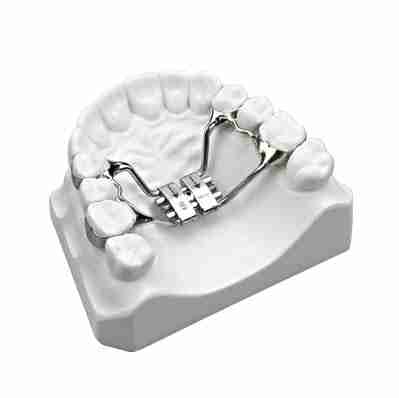
Do all palate expanders run the risk of causing those two things (highlighted in bold) or is it just the acrylic ones? I think the one in the picture below don't cause this except for the potential for teeth tipping.

my story: http://www.aljabri.com/blog/my-story/
How narrow is your intermolar width? This is a variation of rapid palate expansion with the expander anchored into the palate using mini screws. You would have to decide if the invasiveness of the anchorage screws is worth avoiding side effects of removable expanders like gingival recession, teeth tipping, mucosal ulcers, etc. Also, you are relatively young, but I still think a semi-rapid expansion rate would be less traumatic than the rapid rate of this treatment. Since you say that you've had some progress from mewing alone, your case might not be severe enough to warrant such a drastic approach.
Do all palate expanders run the risk of causing those two things (highlighted) or is it just the acrylic ones? I think the one in the picture below don't cause this except for the potential for teeth tipping.
I suspect that this type of expander, pushing only on the teeth, would be more likely to cause dental flaring (especially at slower rates) than the acrylic type, which also puts pressure on the alveolar ridge. However, this should make it less likely to cause mucosal ulcers since the pressure isn't on the gums. There might be some cause for gingival recession from the teeth tipping and the metal rings cemented at the gingival margins causing inflammation.
My side effects from expanding almost 6mm with a removable acrylic expander were pretty minimal. I developed an ulcer on the gums above a first molar and had to take a break for about a week to heal, and wound the expander back about 1mm. I had some very minor dental tipping, especially of my first bicuspids, and gingival recession on one first molar, but both of these issues seem to have resolved soon after completing my expansion.
I suspect that this type of expander, pushing only on the teeth, would be more likely to cause dental flaring (especially at slower rates) than the acrylic type, which also puts pressure on the alveolar ridge. However, this should make it less likely to cause mucosal ulcers since the pressure isn't on the gums. There might be some cause for gingival recession from the teeth tipping and the metal rings cemented at the gingival margins causing inflammation.
Yes, those require a rapid rate, hence their name "rapid palatel expander". My orthodontist explained to me the process but I could not catch the important phrases because it was in Arabic. Basically he explained that when the teeth are pressed hard and rapidly they enter into a glassy state and become rigid along with the bone, effectively functioning as an extension of the maxilla and enabling expansion at the suture.
my story: http://www.aljabri.com/blog/my-story/
Any opinions?
Reminds me of the maxilla method lol
This type of device is pretty well recognized, not a fringe amateur experiment. Mike Mew makes it seem like Won Moon is its major proponent, citing a 2016 article in the Dental Press Journal of Orthodontics titled "Miniscrew-assisted rapid palatal expander (MARPE): the quest for pure orthopedic movement." Dr. Mew himself describes attempting his own version of this type of bone-anchored expander in an adult patient in this series of videos ( https://youtu.be/WqqirRw_8bw ), with seemingly limited success. In contrast, the secret Neymar "Maxilla Method" from Claimingpower was suspected to use anchorage screws for extra-oral forward traction rather than lateral expansion. This was just conjecture from the clue that it required minor surgery.
I was looking at the pre and post treatment and the results on a 23-year-old subject and look very good.
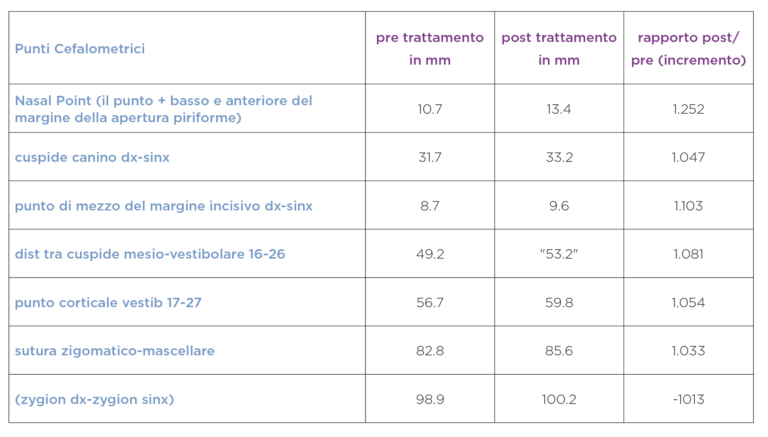
Sorry but is in italian.
ABSTRACT
The use of the "Alt-RAMEC" protocol (Alternate Rapid Maxillary Expansion and Constriction) by Dr. Eric Liou using a Hyrax expander on Benefit's skeletal anchors allows the use of orthopedic forces on the maxilla that combined with multiple micro-osteoperforations on the alveolar ridge (to induce the phenomenon of RAP-Regional Acceleratory Phenomenon) allow to obtain important clinical results avoiding the risks of traditional methods (gingival recessions, bony fenestrations), with good tolerance by young adult patients who keep their motivation high thanks to the shorter treatment duration.alternatively I decide instead to use the protocol of Dr. Eric Liou associating a true osteogenic distraction with a direct bone anchoring device that "disorganizes" the maxillary sutures without corticotomic intervention. To reduce the total duration of the treatment, a periodontally accelerated osteoporosis orthodontics (PAOO) technique was also used, practicing cortical micro-perforations (MOPs) to accentuate the biological effect of the treatment that in the adult no longer has the osteogenic potential of the phases. of growth. (see my case report on the subject published on www.orteam.it/caso-clinico/uso-mops-cross-bite-monolaterale ).
[...]
In this case, the benefits of these techniques and this protocol are due to direct expander bone anchoring, through the Tads "Benefit", which assumes the role of a true osteogenic distractor without the biological cost of the surgical procedure, which provides for the elevation of more or less extensive flaps for corticotomies.
Your introduction of a new device here is greatly appreciated. We seem to have a fragmented global medical community who are not on the same page about treatments/causes.
This device avoids surgery (other than anchoring, which is minor in comparison to jaw surgery) so it deserves to be discussed and researched.
Though getting the ALF is a better idea in my opinion, considering the ability to travel freely in the EU to find a provider if it is cheaper than this procedure.
Be wary of the fact that the dentist may recommend a surgery for advancement after expansion.
Why "Be wary of the fact that the dentist may recommend a surgery for advancement after expansion"?
