

Hi,
I'm currently living in the Philippines. I'm 34 years old. And my biological dentist (hard to find a good one) is only offering this appliance (also affordable for me less than $350) because it's the only bpa free, silicone free, and metal free appliance that she knows of and she doesn't want her patients to use anything with metal. She suggested this to help open my airways and correct my high arch.
http://www.orthotain.com/what-is-ortho-tain/
https://www.thehealthystart.com/list/how-it-works
From what I understand looking it up online is it basically works by putting the tongue in the proper position without any added tension other than the natural tension from your own tongue I assume. It doesn't seem the ones who advocate it are too optimistic with the results for adults other than correcting the alignment of the teeth. Their philosophy is soon after puberty starts, you won't reap the major benefits and you'll have to continue wearing it from time to time as an adult because the results won't be permanent (relapse). I was thinking that maybe they just haven't done much research on adults and focused more on children in their studies.
I was curious to know what others thought about devices like this. Do you think it's still possible to get some expansion and some maxillary/mandible growth with a device such as this over the age of 30?

Honestly after 30 don't waste more time and go surgery asap , this device is basically a myobrace but different material for 350$....waste of cash

/community/community/main-forum/myobrace-effect-and-treatment-time/#
/community/community/main-forum/acom-splint-activator-better-than-palate-expander/#
/community/community/case-discussions/your-success-story/#post-6013
/community/community/main-forum/where-to-buy-myobrace-online/#
/community/community/case-discussions/43-year-old-male-frenectomy-myobrace/#
/community/community/main-forum/trouble-with-myobrace-and-my-bite/#
I wasn't familiar with Ortho-tain specifically, so thanks for sharing the link. It's nice to see some additional before and after pictures on their site!
It's interesting how all of the splint activator brands have different recommendations for use. For example, all of the myobrace literature says "do not chew on your myobrace" whereas other splint activators recommend to exercise by "nibbling" on their mouthpieces and still others suggest biting down and holding it for a duration of time. There's also discrepancy in how many months of use are recommended and what is required after treatment is complete. Here are the instructions on the Ortho-tain website:
Daytime active wear for ideal adult orthodontics consists of a simple exercise: bite down and hold for about five minutes, and then relax for one minute. Repeat this exercise for a minimum of 20 minutes at a time, totaling 1 to 2 hours per day.
Ortho-T® can be worn during the commute to work or school, while reading, browsing the web or watching television.
Approximately once a month, your Ortho-Tain® doctor will schedule you for a progress check. During this time, any overbite and overjet can be measured to track progress. What results should you expect at each check up? Each month, at least one half millimeter of improvement is seen. Crowding of the lower teeth is usually corrected within just the first month!
As you see the dramatic changes in your smile with your appliance for adult orthodontics, your doctor will let you know how often you should be wearing the appliance. For about six months, the appliance is actively worn every other day for about an hour, and every night. Gradually, wearing your appliance will be reduced to every third night, and then to only one or two nights a week as your retainer.
Honestly after 30 don't waste more time and go surgery asap , this device is basically a myobrace but different material for 350$....waste of cash
Thanks for the input Fiora, but I prefer to try to go the more natural and less invasive route.
I also appreciate the information, and I'm glad I was able to offer some new information as well.
I was thinking that the device will at least get the ball rolling in the right direction ,and I could always try another device afterwards for further expansion.
What would you say is considered minimal expansion? Do you think it would help open up the airways a little even in an adult? Because I had another dentist offer a type of plastic splint with an expander before who mentioned she would try to expand 3mm to 5mm at the most to avoid the possibility of tipping and she considered herself being conservative with those numbers.
The intermolar width of my large size myobrace is about the same as my current intermolar width so it's not going to give me any expansion. I suppose if you were able to get an activator that was about 3mm wider than your current intermolar width, it would probably be flexible enough to fit and might eventually expand your arch to its size. Depending on the rigidity, any more than a few millimeters wider than your current size is likely to cause discomfort and be difficult to fit in your mouth.
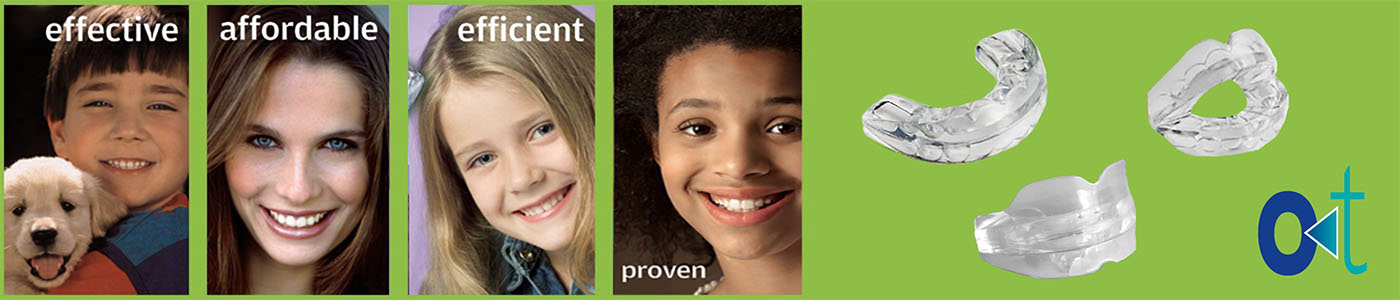
I was assuming that we were talking about a basic splint activator like the bottom one of the three appliances in this picture. However, the brochure for adult Ortho-Tain treatment has a picture like the upper left appliance. This appears to have grooves for the individual teeth, and is different than the adult myobrace that I'm using. I guess this could give more refined adjustment to alignment. For example, I've gone from having crowding of my lower incisors to having a small diastema between my lower central incisors. I suppose the grooves for the individual teeth could have prevented or closed such a gap. However, I don't know if it would be as effective in adjusting the overall shape of the arches.
Thanks. The information has been very helpful. 🙂 It's surprising that ortho-tain has been around much longer than myobrace, but there's not as much info or reviews about it in comparison.
I'm glad to hear it is possible to get some results with myobrace for adults even if it's minimal, so results are probably similar with ortho-tain. I have an appointment soon, so I'll try to update on what's happening from time to time. Thanks again

and metal free appliance
I am just curious to ask why she does not want any metal in the appliance?
my story: http://www.aljabri.com/blog/my-story/
and metal free appliance
I am just curious to ask why she does not want any metal in the appliance?
It has to do with metal not being bio-compatible. Some people maybe more sensitive to metallic materials than others, so she doesn't want to take any chances with me especially because I already have digestion problems.
Here's a link that may explain it better as possible problems with having metal in the mouth: https://www.fremontnaturaldentistry.com/blog/mixed-metals-in-the-mouth-can-be-trouble-oral-galvanism/
General definition of Bio-compatibility:
"Biocompatibility is a general term describing the property of a material being compatible with living tissue. Biocompatible materials do not produce a toxic or immunological response when exposed to the body or bodily fluids.
Biocompatible materials are central for use in medical implants and prosthetics to avoid rejection by the body tissue and to support harmonious biological functioning."
It has to do with metal not being bio-compatible. Some people maybe more sensitive to metallic materials than others, so she doesn't want to take any chances with me especially because I already have digestion problems.
Here's a link that may explain it better as possible problems with having metal in the mouth: https://www.fremontnaturaldentistry.com/blog/mixed-metals-in-the-mouth-can-be-trouble-oral-galvanism/
General definition of Bio-compatibility:
"Biocompatibility is a general term describing the property of a material being compatible with living tissue. Biocompatible materials do not produce a toxic or immunological response when exposed to the body or bodily fluids.
Biocompatible materials are central for use in medical implants and prosthetics to avoid rejection by the body tissue and to support harmonious biological functioning."
Thanks for the link. I never heard of this condition before and never noticed it with all the different metal types in my mouth from braces.
my story: http://www.aljabri.com/blog/my-story/
You're welcome @Abdulrahman.
I'm just giving a little update. It took much longer than expected to get an answer regarding my order for the healthystart appliance through my dentist. I guess because of the holidays and my dentist has to order it overseas (also dealing with customs). Anyways, the company rejected my order because they said based on my tongue placement looking at my mold, they said my case was too sensitive because they can tell my adenoids are swollen, so it was hard for them to find a right fit. And they believe the appliance would be useless if I have some type of nasal obstruction, so they decided to just refund me.
My dentist now wants to have my adenoids checked by another doctor to see what may be the root causes or if there are any other issues just as a precaution. If everything is ok like it being only related to allergies then we may go with another appliance that does focus more on expansion, but we're not sure which one yet.
Is anyone familiar with adults having swollen adenoids being common with narrow palates?
Is anyone familiar with adults having swollen adenoids being common with narrow palates?
Yes, the two are related. People with narrow palate usually have nose congestion and this leads to mouth breathing which leads to swollen adenoids.
my story: http://www.aljabri.com/blog/my-story/

Narrow arch and higher palatal vault go hand in hand. Glad to hear that they at least were acknowledging of the complicating factors! Don’t want to shut off airway in mouth if nasal area is insufficient. I’m not sure I buy the anti-metal stuff. I suppose it depends on the quality of suppliers. I have heard of this and know someone with an implant where the body is rejecting it... the metal. It does happen... though I wouldn’t be so concerned personally. Sounds like a sales pitch... because it is not being inserted into the body. In my friend’s case it was drilled in and it was misdirected... so it may have been rejecting it for that reason. I could be wrong... but personally never heard of that in relation to braces or appliances. That is not like Mercury fillings... they don’t do mercury anymore from what I see.
It looks like it would help an anterior deep bite. Not sure it widens, though. It seems unlikely to help with TMD, as claimed. If there is a skeletal open bite... sometimes splints are used to address TMD... worn at night. However... if a bite is good... sometimes putting stuff between teeth for long periods can cause TMD.