Like I said in my first topic: Choosing Doctor for MSE + FM for Class III Bite, whoever made and has contributed to this board, thank you. I have created 2 topics today for 2 different issues. This one is less urgent if that's relevant.
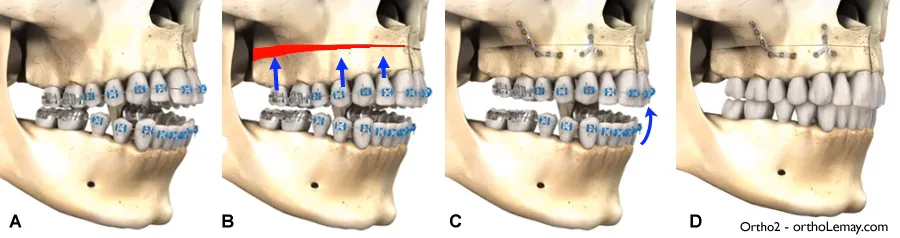
1. I'm not sure, but it seems to be the case that Counter Clockwise Rotation is preferred. Why is that exactly? And if it's not preferred, then in what cases is it indicated? Does CCW Rotation require maxillary impaction?
2. I saw that this article generated quite a bit of buzz here:
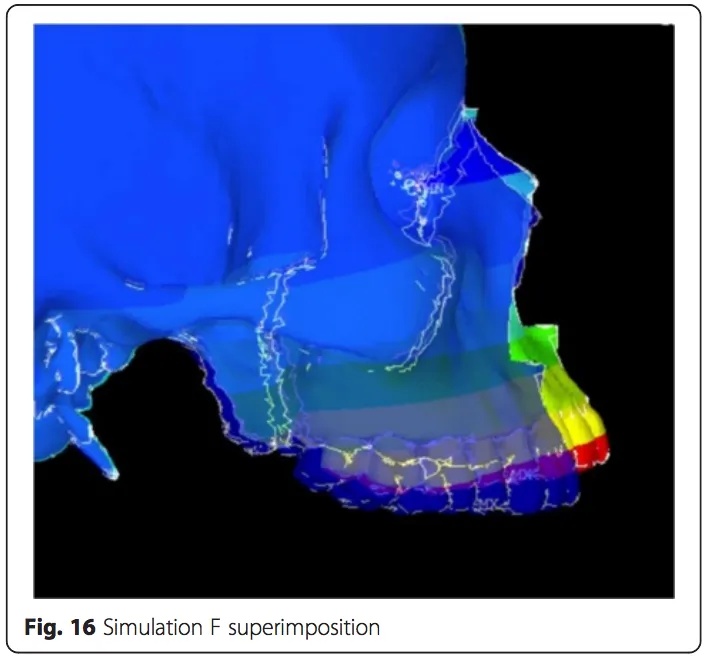
This mainly seemed to be because it suggests that with the correct angle of protraction, a forward AND upward swing of maxilla can be achieved. My question is...how would upwards swing with maxillary impaction (most illustrated by simulation F in figure 16 page 12 and simulation F in table 2 page 13) be possible? Where would the vertical excess of the maxilla/midface go in order for the upper jaw to physically go up?
The article states "However, it is important to note that upward and posterior displacement will restrict maxillary growth, but will not necessarily impact it, since growth cannot be reversed or undone".
Anyone? I'd think this is a relevant question to ask. If it's been answered before I didn't find anything, so can someone show me where?
-Melius
Very interesting read. Can you elaborate on ""However, it is important to note that upward and posterior displacement will restrict maxillary growth, but will not necessarily impact it, since growth cannot be reversed or undone".
Im reading through the article and understand every word, but for some reason i dont understand what they are trying to say in that quote.
Anyways, what i got from this how important the angle of the rubberbands in the facemask are. If you place them at a too low angle, the maxilla rotates clockwise (bad) and grows downwards.
"Interestingly, Ant-MIFM [−45°], which simulates facemask protraction from anterior micro-implants, displaces the maxillary complex significantly downward and backwards, which is counterintuitive, given that the goal of maxillary protraction is to move the maxilla forward"
It also shows that if the rubberbands are placed at such an angle, that they force is directed to the premolars or canines, force is still applied upwards and forwards on the maxilla.
Also if i understood correctly, its better if the rubberbands pull from the posterior part of the MARPE to achieve counter-clock wise rotation of the maxilla. While its better to pull from the anterior part of the maxilla (front teeth) if the facemask is pulling with your teeth.
-30° with posterior pulling achieves the most protraction of the maxilla, but with minimal upswing. While +30° achieves the most counter-clock wise rotation of the maxilla.
"Where would the vertical excess of the maxilla/midface go in order for the upper jaw to physically go up? "
Are you implying we would need "space" to make room for the upswing/rotation of the maxilla?
Very interesting read. Can you elaborate on ""However, it is important to note that upward and posterior displacement will restrict maxillary growth, but will not necessarily impact it, since growth cannot be reversed or undone".
Im reading through the article and understand every word, but for some reason i dont understand what they are trying to say in that quote.
This quote:
"However, it is important to note that upward and posterior displacement will restrict maxillary growth, but will not necessarily impact it, since growth cannot be reversed or undone"
is regarding simulation F in figure 16 page 12 and simulation F in table 2 page 13 (I'll try to post below).
Obviously, the maxilla has been moved upwards and the mid-face has been vertically decreased. For most people this is what we want.
HOWEVER: When this is done surgically, it is done through maxillary impaction, i.e. breaking the maxilla and physically removing some of the bone and then reattaching it (I'll try to post below).
So now that you understand what is needed to vertically shorten the mid-face through surgery (i.e. removal of bone). My question that I've attached below should make more sense to you.
Posted by: bundfalke
"Where would the vertical excess of the maxilla/midface go in order for the upper jaw to physically go up? "
Are you implying we would need "space" to make room for the upswing/rotation of the maxilla?
When you say "Are you implying we would need "space" to make room for the upswing/rotation of the maxilla?"
I'm not sure what you mean by "space". IF you mean that the space where the maxilla would have to move up to is currently being occupied by excess bone growth, then yes, we would need that bone to be gone.
Just think about it logically. And when you understand that, then this:
"However, it is important to note that upward and posterior displacement will restrict maxillary growth, but will not necessarily impact it, since growth cannot be reversed or undone"
Makes a lot more sense.
So my WHOLE point, is that the author seems to suggest that even though in a case like Simulation F, the maxilla is moved upwards...in a REAL, ADULT patient. the excess growth cannot be reversed or undone. So while the mid-face/maxilla may not be vertically shortened, vertical lengthening (which is a negative side effect of a lot of treatments, including some of these simulations like simulation H) can be restricted.
I just wanted to know if there is any way for bone to somehow be impacted through the use of a face mask (or even relevantly enough, mewing). Because based on the logic, and most importantly what the paper suggests, shortening of the maxilla cannot be done non-surgically, at most, any more vertical lengthening can be controlled for.
Yeah that makes sense now. I didnt know "impact" means removal of bone. Let me add to that:
- I really doubt the use of a facemask would impact (remove) bone mass of the midface in order to achieve vertical shortening/upswing of the maxilla (if we assume the facemask is capable of shortening the midface)
-"growth cannot be reversed" well shouldnt that apply to children with long midfaces too? In my mind, it does. And we know that mewing and facemasks can achieve forward and upward movement of the maxilla. I know that children have more malleable bones, but growth is growth ("and it cannot be reversed or undone). Correct me if i have flawed logic.
-Isnt this Won moon guy doing this procdure with the facemask all the time in adults with excellent results? Im sure i saw several cases
- So your idea is that in order to shorten the midface, somewhere bone needs to be removed one way or another (as the study states). But what if we dont actually shorten the vertical length of the midface. What if bone isnt changing in its mass/length/width. Its very easy to imagine that your midface becomes shorter if we simply rotate the maxilla counter-clock wise. Rotating the maxilla CCW is guaranteed to shorten the midface vertically, and even lengthen it horizontally. We know after all that "collapsed" maxillas are not rotated properly. We know that the position and rotation of the maxilla effects the entire shape of your skull, including your forehead. So really if we move the maxilla through facemask -> all premaxillary bones move accordingly. They move with it to open the desired "space". In other words, we dont need to make "space" for the maxilla with removal of bone. Nearly your entire skull just moves with it.
This whole study assumes that we need impaction in order to achieve results. It assumes that the facemask achieves results through impaction of the maxilla. But i just do not think thats true, or rather i dont think thats whats happening.
Its happening in the simulation because it cannot accurately represent the movement of premaxillary bones when the maxilla is being moved and rotated.
"So while the mid-face/maxilla may not be vertically shortened, vertical lengthening (which is a negative side effect of a lot of treatments, including some of these simulations like simulation H) can be restricted."
If the entire point of the facemask is to restrict vertical lengthening, you can just close your jaw and mew instead.
I dont see the point of this study if it assumes the midface cannot be shorten or moved upwards. Or are there orthodontics in the world who want their patients face to melt down even further?
Im also dissapointed no ones participating in these kind of threads. In my opinion they are of high interest to the "mewing" community because the use of a facemask is most likely effective in adults, and may speed up the process of "mewing" if we assume it works in adults.
EDIT: I read some case studies of the Facemask used in adults. Unfortunately, so far maxillary protraction was always forward AND DOWNWARDS, meaning the length of the mid-face always increased. But then, the force angle of the facemask was always less than the neutral horizontal line. Thats the case so far in all 3 case studies i have read. I wonder why that is?
I'm very busy with school and work at the moment but to try to answer the questions/points you've made:
Posted by: bundfalke
Yeah that makes sense now. I didnt know "impact" means removal of bone. Let me add to that:
-I'm not sure impaction is exactly defined as "bone removed", what I was asking, was whether or not it necessitates bone removal. the quote you were initially confused with, seems to imply that, as does, like you mentioned, the case studies you found.
Posted by: bundfalke
-"growth cannot be reversed" well shouldnt that apply to children with long midfaces too? In my mind, it does. And we know that mewing and facemasks can achieve forward and upward movement of the maxilla. I know that children have more malleable bones, but growth is growth ("and it cannot be reversed or undone). Correct me if i have flawed logic.
-I'm just guessing here, but I believe when using "mewing"/orthotropic/dentofacial orthopedic treatments in children (especially the youngest ones), it's not so much that the growth itself is reversed, but any overgrowth, such as vertical maxillary excess, is constrained, while the rest of the face grows to compensate.
For example, for children with underbites, reverse pull headgear is used to:
a.) pull the maxilla forward
b.) simultaneously hold back the chin to prevent the mandible from overgrowing
(don't know how exactly that second part works, as maybe Wolf's Law would say otherwise?)
Posted by: bundfalke
- I really doubt the use of a facemask would impact (remove) bone mass of the midface in order to achieve vertical shortening/upswing of the maxilla (if we assume the facemask is capable of shortening the midface)
Posted by: bundfalke
- So your idea is that in order to shorten the midface, somewhere bone needs to be removed one way or another (as the study states). But what if we dont actually shorten the vertical length of the midface. What if bone isnt changing in its mass/length/width. Its very easy to imagine that your midface becomes shorter if we simply rotate the maxilla counter-clock wise. Rotating the maxilla CCW is guaranteed to shorten the midface vertically, and even lengthen it horizontally. We know after all that "collapsed" maxillas are not rotated properly. We know that the position and rotation of the maxilla effects the entire shape of your skull, including your forehead. So really if we move the maxilla through facemask -> all premaxillary bones move accordingly. They move with it to open the desired "space". In other words, we dont need to make "space" for the maxilla with removal of bone. Nearly your entire skull just moves with it.
This whole study assumes that we need impaction in order to achieve results. It assumes that the facemask achieves results through impaction of the maxilla. But i just do not think thats true, or rather i dont think thats whats happening.
Its happening in the simulation because it cannot accurately represent the movement of premaxillary bones when the maxilla is being moved and rotated.
-I don't think the face mask in adults would make the vertical excess of the maxilla just disappear either. However, please note I was never postulating that we need to remove bone was "my idea" that was just the impression I got from the study itself
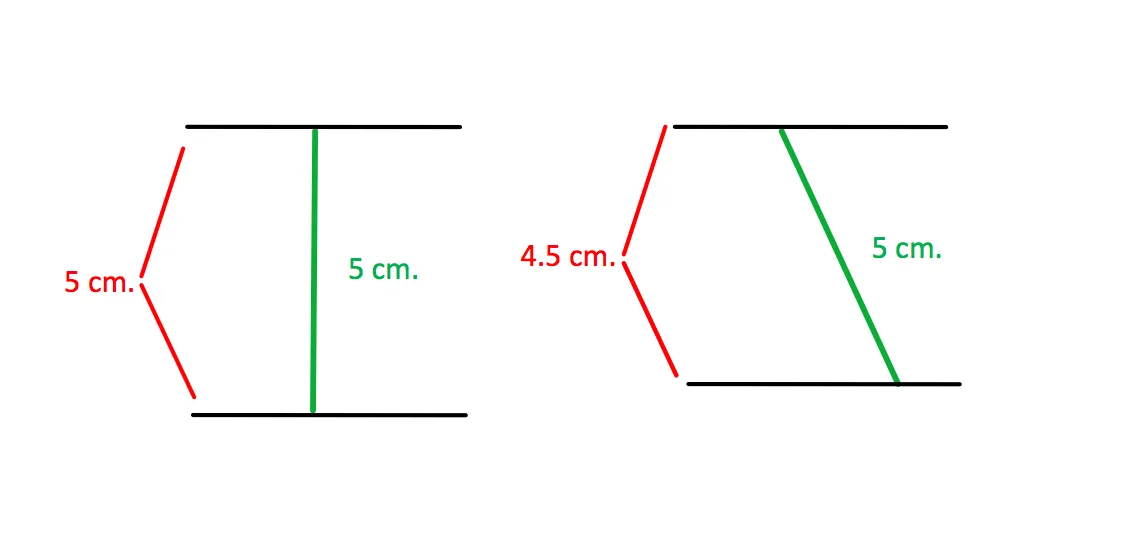
-I'm not sure what you mean in the block paragraph, I'll re-read tomorrow and try to unpack it, but perhaps the maxilla can appear to be vertically shortened if it is brought upwards and forwards with CCW rotation, even if it's the same vertical length.
-What I mean by this^ is:
-imagine a straight vertical line with a length of 3 centimeters. The length (green) is equal to the vertical length (red)
-now imagine giving this line a CCW rotation so it becomes a bit diagonal. The length (green) is unchanged, but the vertical length (red) is now shorter.
Posted by: bundfalke
-If the entire point of the facemask is to restrict vertical lengthening, you can just close your jaw and mew instead.
-The point of the face mask is to PROTRACT the maxilla, especially needed for cases with underbites. HOWEVER, when the maxilla is protracted, there seems to be downward growth (usually not wanted and a bad thing). Thus, this study attempted to address these concerns, see below.
Posted by: bundfalke
- I dont see the point of this study if it assumes the midface cannot be shorten or moved upwards. Or are there orthodontics in the world who want their patients face to melt down even further?
-The point of the study is rather explicit, to show how, theoretically, the anchorage points and vectors affect facial change when using a bone-anchored face mask in adults.
-It shows EVEN if the maxilla cannot be vertically shortened through use of a face mask, any extra vertical growth can be limited/restrained if the correct angle and anchorage point is used.
-Believe it or not, there are actual people who NEED vertical lengthening of the maxilla, lucky them, as lengthening is easier than shortening, and definitely doesn't require bone removal.
Posted by: bundfalke
- Isnt this Won moon guy doing this procdure with the facemask all the time in adults with excellent results? Im sure i saw several cases
EDIT: I read some case studies of the Facemask used in adults. Unfortunately, so far maxillary protraction was always forward AND DOWNWARDS, meaning the length of the mid-face always increased. But then, the force angle of the facemask was always less than the neutral horizontal line. Thats the case so far in all 3 case studies i have read. I wonder why that is?
-Maxillary Skeletal Expansion on it's own has excellent results as far as widening the maxilla and the zygomatic complex in adults.
-Maxillary Skeletal Expansion with a Face Mask has excellent results as far as widening the maxilla and the zygomatic complex AND protracting the maxilla in adults.
-The question is, can downward growth with a facemask and MSE in adults, be controlled for? Can it be reduced or nonexistant in a real life adult case? I don't know, I haven't read all the studies.
-I'm planning to be a patient for MSE + Face Mask very soon, so I will definitely make a thread detailing my journey.
-If you don't mind, reply or PM me with all the studies you have found, some for me are pay-walled.
Posted by: bundfalke
- Im also dissapointed no ones participating in these kind of threads. In my opinion they are of high interest to the "mewing" community because the use of a facemask is most likely effective in adults, and may speed up the process of "mewing" if we assume it works in adults.
-Agreed, I thought this community was more active, seems to have a lot of members way more knowledgeable than me and I'd love their thoughts.
-imagine a straight vertical line with a length of 3 centimeters. The length (green) is equal to the vertical length (red)
-now imagine giving this line a CCW rotation so it becomes a bit diagonal. The length (green) is unchanged, but the vertical length (red) is now shorter.
Yes thats precisely what im talking about. That a facemask doesnt need to shorten the length of the maxilla, but rather just rotate it CCW.
Posted by: bundfalke
- Isnt this Won moon guy doing this procdure with the facemask all the time in adults with excellent results? Im sure i saw several cases
EDIT: I read some case studies of the Facemask used in adults. Unfortunately, so far maxillary protraction was always forward AND DOWNWARDS, meaning the length of the mid-face always increased. But then, the force angle of the facemask was always less than the neutral horizontal line. Thats the case so far in all 3 case studies i have read. I wonder why that is?
-Maxillary Skeletal Expansion on it's own has excellent results as far as widening the maxilla and the zygomatic complex in adults.
-Maxillary Skeletal Expansion with a Face Mask has excellent results as far as widening the maxilla and the zygomatic complex AND protracting the maxilla in adults.
-The question is, can downward growth with a facemask and MSE in adults, be controlled for? Can it be reduced or nonexistant in a real life adult case? I don't know, I haven't read all the studies.
-I'm planning to be a patient for MSE + Face Mask very soon, so I will definitely make a thread detailing my journey.
-If you don't mind, reply or PM me with all the studies you have found, some for me are pay-walled.
Found 2 of them, they arent actual studies though:
2: In the second study it says "All patients in this study were treated with elastic traction attached in the area of the canine, with the direction of pull predominantly downward (30° to 40°) from the horizontal."
So they were intentionally pulling downwards with the rubberbands. I wonder why? Maybe because they know/think that shortening of the maxilla is not possible?
3: What i find really amazing is that appereantly (correct me if im wrong), they achieved protraction of the maxilla without palatal expansion. So they only used a facemask. Thats contrary to what varbrah and you are doing. MSE and THEN Facemask. How is that possible? Im surprised
4: "observed *significant rotation of the palatal plane with maxillary protraction treatment*, in agreement with our findings. This rotation may be affected by many factors, including side of the force application, direction of elastic traction, and the facial pattern of the patient."
Even though that rotation was clockwise, im thinking: If we can rotate palate (and therefore the maxilla) in a clockwise direction, then why shouldnt we be able to rotate it in a counter-clock wise direction (which is what we want). If the maxilla rotated clockwise, it means all the other bones its anchored to, moved with it, no?
5: Then again, they were pulling at an angle of -30/40° compared to a neutral horizontal line. Lets assume moving the maxilla upwards is not possible with those rubber bands. Atleast we should be able to use the facemask at an angle where only FORWARD movement and not DOWNWARD movement of the maxilla is happening. So most likely at a neutral horizontal angle of 0°. Im so damn curious why they are pulling at such a low angle.
Even if the use of a facemask can only achieve forward movement of the maxilla with no (or very minimal) downward movement, that would still result in a huge, huge improvement of the facial profile and and facial asthetics in general.
As you said yourself "-The question is, can downward growth with a facemask and MSE in adults, be controlled for? Can it be reduced or nonexistant in a real life adult case? I don't know, I haven't read all the studies."
I really dont see why that shouldnt be the case aslong as the facemask isnt pulling at a low angle
Do you know how much you have to pay for your treatment with MSE + FM?
excellent point about changing the angle to make it counter-clockwise rotation. This article (at the end) discusses exactly that: which angle is best for counter clockwise rotation, which for clockwise rotation.... Counterclockwise is parallel with the "occlusional plane"
and one question about the fear of a chin cup: yes it causes the mandible to grow clockwise and back in a CHILD. But what could it possibly do in adult? Already grown mandible. Even if it temporarily goes down and back, all you need to do is move it up again: it seems like it is posture that is at stake.