

Imagine the upper maxilla coming up because the tongue pushes on the palate roof. A sort of clockwise rotation happens because as tongue forces are applied the palate vault gets higher which then puts pressure on the area around the eyes and cheeks to go away from the face.
In my own case my palate vault was shallow and this is why the eye area was weakly supported. The tongue pushing against it then drove it upwards.
As my palate and IMW has been raising/expanding my tongue has had more room to move away from my bulge area making it less prominent.pls forgive my shocking diagram, I found it hard to describe with wordsalso, I think that chewing/skin stretching exercises + drinking a lot of water and losing weight help dramatically in making this under-chin area taut
Is your palate vault shallow? Because as I have progressed in mewing my vault height has increased. But this was because I know for a fact my upper maxillary region was collapsed inward toward my oral cavity. My gingival exposure at the front was near non existent despite my recession. But as the elastics tipped my incisors negatively, I got a lot of gum exposure. This would make people believe my palate was high vaulted even though it wasn't.
Not that I am complaining my maxilla became higher vaulted. Pushing the upper wall meant but cheekbones came forward as did the tissue around my nose making my nose look more "in" my face. The pushing of my vault upwards also pushed the bone around my eyes up thus increasing my support . And all without counterclockwise rotation.
Posted by: Apollo
I think my palate vault started out deeper than average, except for a moderate sized torus palatinus protruding in the center. During expansion, I feel like the areas along side my torus have come down closer to the level of my torus making the roof of my mouth a little shallower overall, but it's still pretty vaulted.
I have seen a few recent posts like those above suggesting that correct oral posture should raise the palate vault. This totally opposes my understanding of the objective. Yes, the classic dystrophic growth pattern positions the maxilla too far down and back, so the average palate likely needs to move up and forward. However, the roof of the mouth shouldn't move up in relation to the occlusal plane. In fact, palate expansion should have the opposite effect, raising the level of occlusion up closer to level of the palate, and making the slope of the alveolar ridge less steep. If you look at prehistoric skulls, the palate is broad and shallow. If you look at people with connective tissue disorders, their palates are characteristically narrow and vaulted. Palate expanders require adjustments that remove acrylic from the top of the framework during the course of expansion as the palate becomes less vaulted. In the diagram above, increased tongue space should come from expanding the palate both transversely and sagittally, not from making the roof of the mouth deeper. Ideally the tongue should lie out flat against the roof of the mouth. The tongue or appliances exerting a transverse force should make the palate less vaulted. The tongue or facepulling should move all of the palate up and forward, not just the roof of the mouth. In other words, if the palate becomes more vaulted (i.e. moves up in relation to the teeth), it is a sign that your dystrophy is getting worse not better. Right?

Your own thread answers it in the first post
/community/community/main-forum/elements-of-smile-aesthetics-and-craniofacial-dystrophy/
But what about those of us who don't have a gummy smile? Does that indicate our maxillas are positioned high enough? I don't think it is that simple because the soft tissue drops down with the underlying bony structure.
And truthfully, narrow palates don't have high vaults. What they have is a tongue that is prevented from reaching the vault due to narrow intermolar
I also believe that my vault going higher is what has given me better cheekbones and more eye support. The vault basically pushed up the bones of the cheeks and the soft tissue.
With time I believe my palate will flatten out as the intermolar increases more. I doubt this is my final form as I have been only at it 7 months
When you say "truthfully, narrow palates don't have high vaults," it reflects the need to clarify what me mean by "high." Don't narrow palates tend to be vaulted so that the roof is "high" in relation to the level of the teeth, but not "high" in relation to the rest of the skull? So improvement would make the alveolar ridge less steep, increasing the intermolar width, making the palate less vaulted ("lower" relative to the teeth), but also raising the whole maxilla ("higher" relative to the rest of the skull). I'm not sure how my post that you quoted relates to this distinction. Do you think the distance from your occlusal plane to the roof of your mouth has increased as you have seen these improvements in cheekbones, eye support, etc?
I don't think their distance from the occlusal plane is necessarily more than average but no way of really telling.
I know for me the distance ffrom occlusal plane to roof of mouth seems to have increased. But again, I think my palate roof was collapsed inward and was the reason my eye support sucked and my cheeks non existent. Pushing this up made my cheeks go out and eye support increase.
But what happened to me isn't what people with triangulated palates have. Those people's vaults seems high simply because the tongue is obstructed by the narrowness of the palate . Mine isn't. And it isn't as if their vault gets lower but rather the increase in width flattens out the roof because the outer walls are spread apart . In other words it goes from an apex shape to a more arch shape (the vault itself).
I think my tongue pushed my vault away from the occlusal plane as it was collapsed. But with time the extra intermolar expansion would create a more flattened arch. I just know that what I needed first was my vault to be raised for my upper midface to be well supported.
Edit: I wish I could locate the pic you posted of a guy with 0 gingival exposure next to his X ray showing his collapsed palate vault . He had black hair and squinty eyes and a longer nose. That is how my palate vault was essentially but with retroclined incisors
It makes sense that I am over-simplifying things, and there might be cases like yours that would benefit from increasing the height of the palate vault (relative to the occlusal plane), but as you mentioned if you succeed at increasing your intermolar width it would probably become less vaulted again. Is this the picture you referenced ( /community/community/main-forum/elements-of-smile-aesthetics-and-craniofacial-dystrophy/#post-1663 )?
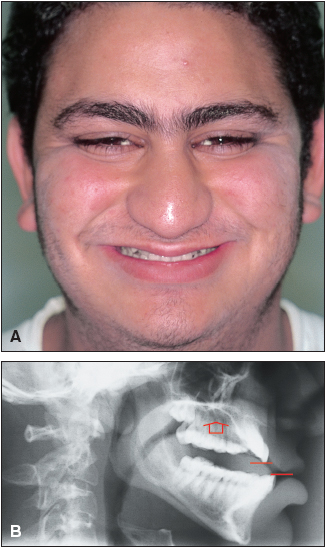
This guy is said to be an example of "vertical maxillary deficiency," so the vertical height of his maxilla is too short, resulting in decreased incisal display. Can you clarify what you mean about his palate being collapsed?
I don't think their distance from the occlusal plane is necessarily more than average but no way of really telling.
I know for me the distance ffrom occlusal plane to roof of mouth seems to have increased. But again, I think my palate roof was collapsed inward and was the reason my eye support sucked and my cheeks non existent. Pushing this up made my cheeks go out and eye support increase.
But what happened to me isn't what people with triangulated palates have. Those people's vaults seems high simply because the tongue is obstructed by the narrowness of the palate . Mine isn't. And it isn't as if their vault gets lower but rather the increase in width flattens out the roof because the outer walls are spread apart . In other words it goes from an apex shape to a more arch shape (the vault itself).
I think my tongue pushed my vault away from the occlusal plane as it was collapsed. But with time the extra intermolar expansion would create a more flattened arch. I just know that what I needed first was my vault to be raised for my upper midface to be well supported.
Edit: I wish I could locate the pic you posted of a guy with 0 gingival exposure next to his X ray showing his collapsed palate vault . He had black hair and squinty eyes and a longer nose. That is how my palate vault was essentially but with retroclined incisors
It makes sense that I am over-simplifying things, and there might be cases like yours that would benefit from increasing the height of the palate vault (relative to the occlusal plane), but as you mentioned if you succeed at increasing your intermolar width it would probably become less vaulted again. Is this the picture you referenced ( /community/community/main-forum/elements-of-smile-aesthetics-and-craniofacial-dystrophy/#post-1663 )?
This guy is said to be an example of "vertical maxillary deficiency," so the vertical height of his maxilla is too short, resulting in decreased incisal display. Can you clarify what you mean about his palate being collapsed?
Thank you. That is exactly what I had. Vertical maxillary deficiency. My x ray practically was the same before braces.
So basically the vertical maxillary deficiency = roof of the mouth being collapsed inward. Because I had this same condition, mewing has increased my vertical maxillary height thus my vault is further from the occlusal plane.
Only difference between me and this guy is the ortho retroclined my incisors so my gingival display increased. Matter of fact before braces I had 0 gingival display and now I have too much.
My theory is my palate vault needed to elevate to rid me of the deficiency. But as my palate gets more broad I bet it will become flatter and my gingival display will also decrease.
Basically I have a lot of work to do and nowhere near done. I had cfd and braces made it much worse as it is

Maybe the flat palates your talking about happen our whole palates become vaulted until they flatten out evenly

