

Apologies for the lack of writeup, but I highly recommend everyone give this video a watch and try to experience the movements being discussed.
Martin is a top bloke, if you have questions or comments he is likely to respond to YouTube comments;
This is a very practical application of craniosacral theory, and is directly in line with my thinking/experience that craniosacral therapy is best conducted on the self through the breathing.
If you have studied Eastern Medicine / Qi Gong / Mantak Chia, this may ring bells regarding the Microcosmic orbit path.

Thank you The Great work for posting my video. if you are interested in working with the cranial pelvic movement with the breath its good to learn Holographic Breathing which opens up this motion. you can learn Holographic Breathing from videos on this link below. there are also meditations to work with all the bones of the skull in this video. I also have a free webinar on the solstice to learn all of this here is a link where you can join and see further videos - https://www.holographic-breathing.com/1/index.php/free-webinars-meditations

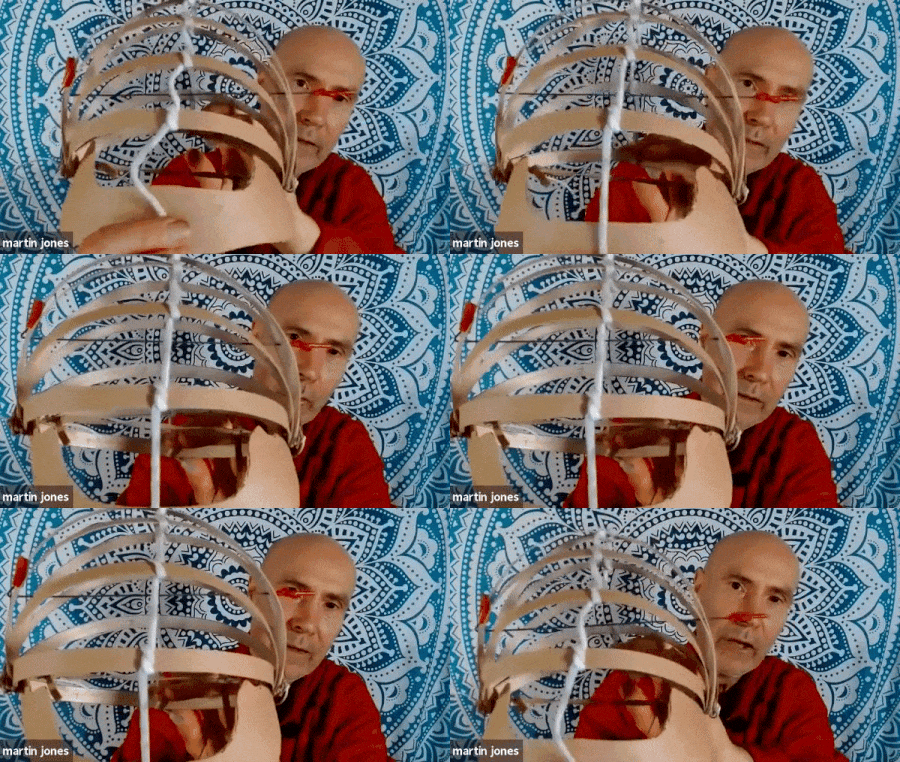
The description and model of the skull movements during breathing (click above) starting at around the 3:30 mark in the video reminded me of this gif
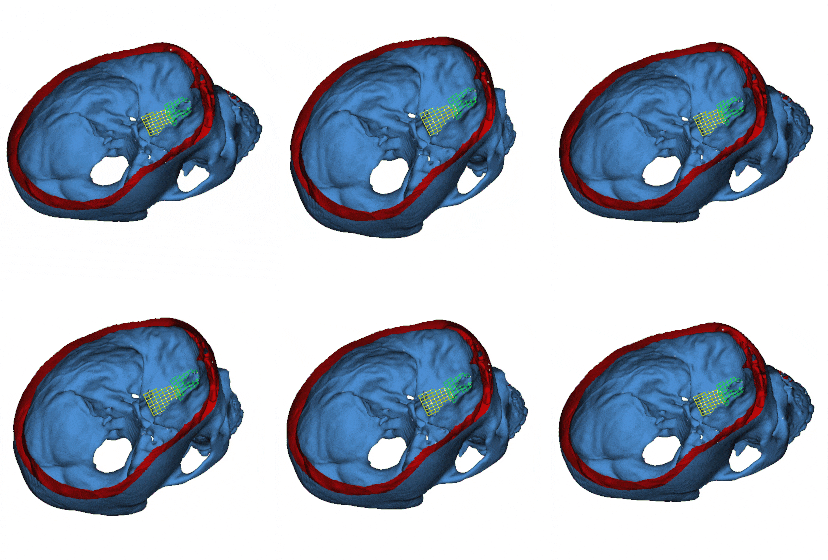
from this article ( https://www.sciencedirect.com/science/article/abs/pii/S0047248415002675?via%3Dihub ) comparing the craniofacial morphology of prehistoric and modern humans. The movement in the article's gif is not supposed to show mobility within one skull, but rather to depict how evolutionary changes in the shape of the average basicranium correlate with changes in the average face. Still, it's interesting to think that the narrower, more prognathic shape correlates to both the exhaled conformation of the skull and our ancestral norm (right), while the wider, retrognathic shape correlates with inhalation and average modern skulls (left).
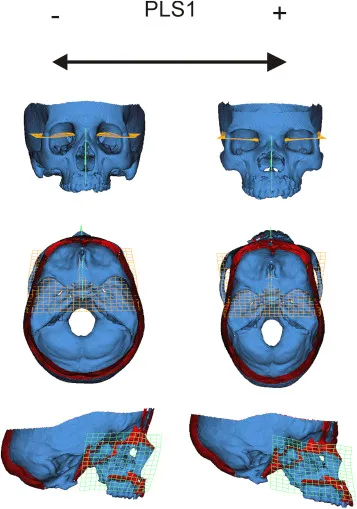
Could this have anything to do with the Buteyko philosophy that modern humans tend to hyperventilate, spending more time on inspiration? @lotusmoon says "There's a [sagittal] pressure toward the middle and that causes the middle to expand [transversely] on the inbreath." The article says "the characteristic of modern human facial architecture, is in fact the combined result of i) an elongation of the bilateral middle cranial fossae and temporal lobes with ii) an elongation of the anterior sphenoid, both of which define the cranial reference of the PM plane, and iii) an elongation of the posterior base together with iv) a counterclockwise rotation of the entire base."
Hi thank you Apollo for your replies.
In this video, I teach holographic Breathing. This starts that breathing motion described in the top video and also shown in the reply above.
Holographic Breathing does not give exactly the same motion as described in craniosacral therapy but it is very close.
In this video, you can learn Holographic Breathing, and then in the 2nd meditation, we use that to work through all the bones of the face and cranium and their combined energies and movement.
This video is more about the actual energies of the different bones but you will also feel the movement included - https://youtu.be/lF8RjbODT4g
Hi thank you Apollo for your replies.
In this video, I teach holographic Breathing. This starts that breathing motion described in the top video and also shown in the reply above.
Holographic Breathing does not give exactly the same motion as described in craniosacral therapy but it is very close.
In this video, you can learn Holographic Breathing, and then in the 2nd meditation, we use that to work through all the bones of the face and cranium and their combined energies and movement.
This video is more about the actual energies of the different bones but you will also feel the movement included - https://youtu.be/lF8RjbODT4g
I watched the video on holographic breathing. I practiced the slight opening and closing of the jaw with the lips closed, and tongue on the palate, while breathing through the nose. I can't say that I felt the movement of other cranial bones during the meditation. However, the motion reminded me of the way fish open and close their gill plates to breathe, and the notion that the mandible evolved from the gill arches in early fish to allow them to adapt from filtering small food particles out of the water to catching and eating larger prey ( http://portlandtmjclinic.com/etiology/chapter-1 ). This seems to validate the idea that this breathing pattern feels intuitive.

Thank you apollo You may be interested in the free webinar next week where we will be taking that process deeper and first with the breathing of the gills become fish, then dolphins and whales. https://www.holographic-breathing.com/1/index.php/free-webinars-meditations