

We all know that the purpose of mewing is to remodel the maxilla to its optimal position. Bone remodelling occurs in a manner which preserves the volume of the bone but changes its shape to demands, especially when these are light and sustained for long periods of time. Think of it like a clay model that when squished in a certain way, it changes shape but maintains its volume.
As we know, two great and reliable indicators of maxillary position are the indicator line (upper incisors to nose distance which measures the incisors relative position to cranial vault) and the cheek line (which measures the forward position of the infraorbital rim relative to the stable upper nasal bone), credits to John Mew.
The posterior part of the tongue and front part must work in synergy. If one focuses too much on the front part, they get counterclockwise rotation, and possibly an open bite, because the molars in the back come down, while the incisal and nasal base portion of the maxilla move up and forward. If one focuses too much on the posterior third, they get clockwise rotation and a long midface, potentially a deep bite. We have cases throughout the internet especially of the latter happening.
When the anterior and posterior work in synergy, the posterior brings the infraorbital rim forward while the front brings the nose base and incisors up and forward. Keeping the teeth gently together ensures occlusion and support for the maxilla. Of course when the posterior and anterior get squished together, there is excess bone mass as a resultant, and since the middle of the tongue exists this goes to the increasing the intermolar width while preserving the palatal shape. This will also correct the indicator line and cheek line.
Any change in ramus comes from the cranial base angle itself changing, bringing the entirety of the mandible with it.
This also explains the forces behind Mike Mew's Mew Vector Headgear.
In my opinion a short maxilla only looks bad if it lacks saggital projection, or if it is too clockwise rotated, or if the teeth are too retruded and intruded.
The point of the tongue is to apply a gentle force, not to push extremely hard.
Please see my illustrations and others I have provided, one is a gif another is an explaination and another details cranial base (Note that the gif does not show the resulting widening of the maxilla due to the "shortening" due to the displaced "extra" mass)
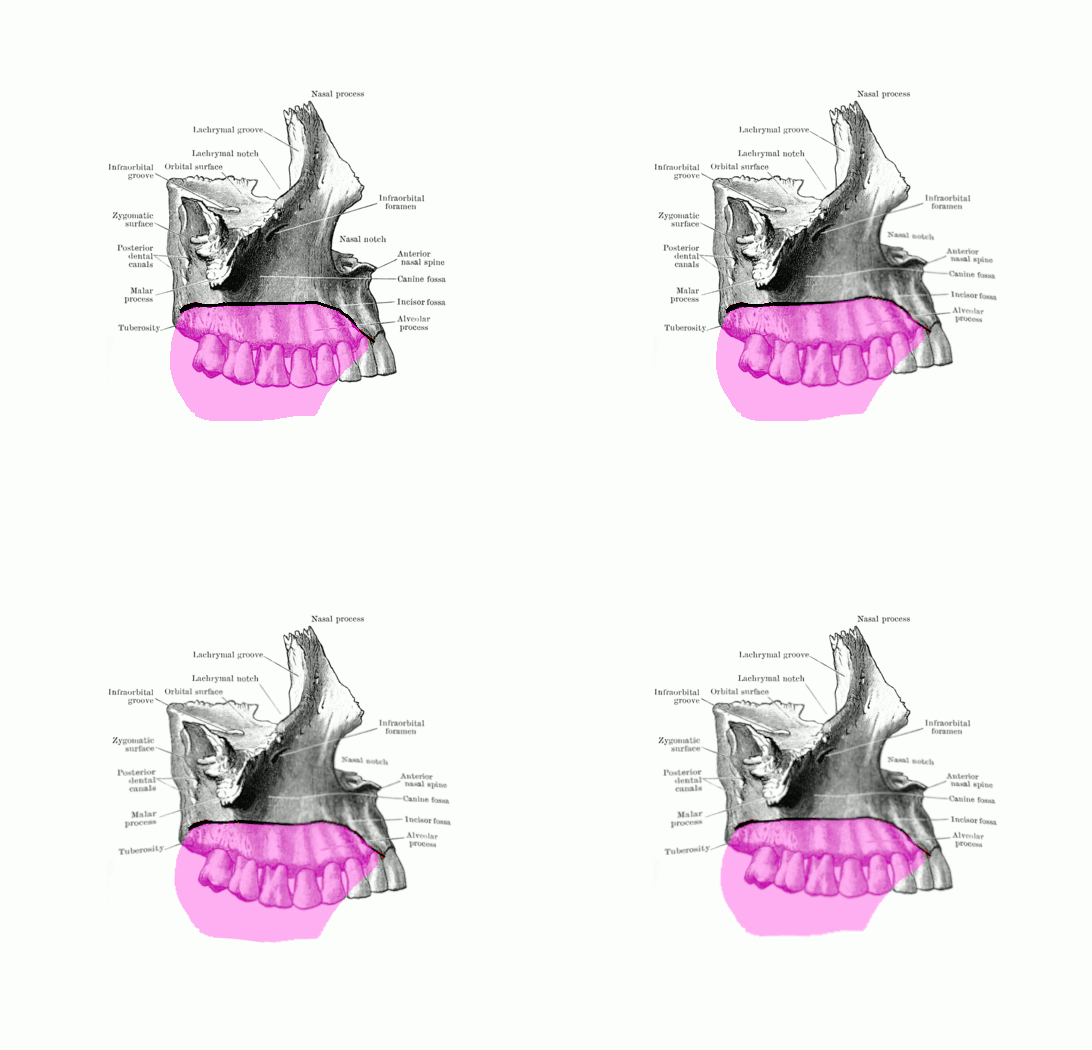
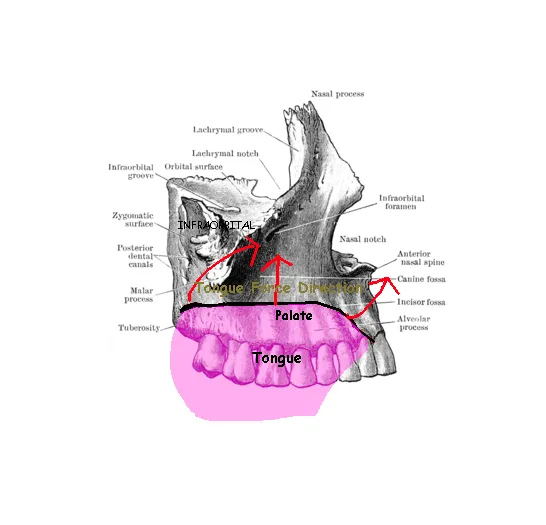
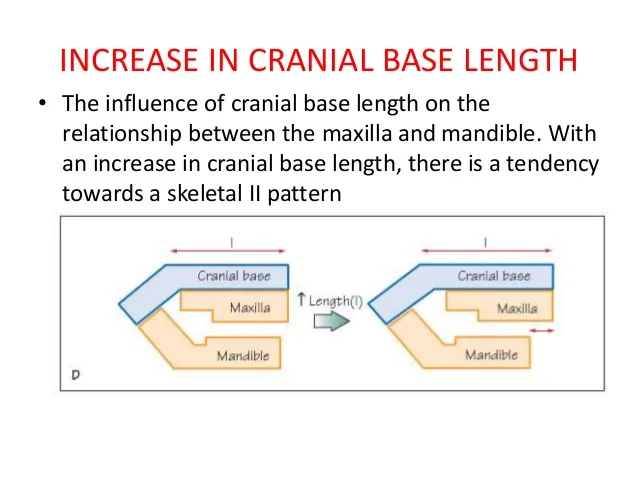

On the topic of back third - John Mew refers more to the part of the tongue which is deep in the throat, even past the palate, as the back third.
Mike uses "back third" referring to the area that touches the soft palate. John uses "back third" referring to the area even further back and into the throat.
Hope that contributes somehow to everyone's own understanding - the Mews are teaching the same basic theory but with variations in their individual understandings.
The posterior part of the tongue and front part must work in synergy.
I agree with this as an entire concept. Everything must work together, that is the only way anything happens. Imbalance in function is imbalance in form

Interestingly, this Vivos DNA patient specifically commented that after 10 months she finally felt like she could get the "back third" of her tongue to the roof of her mouth - - https://www.youtube.com/watch?v=mTCODopIC6g
And once she was able to do that, it was almost as if her body naturally wanted to start keeping things there again. Almost as if there was an instinctual habit which was now able to emerge again given that there was room.
She also noted that it was about the same time when she felt like she could get a "greater quantity of air" into her nose.
@ThaGangsta "If one focuses too much on the front part, they get counterclockwise rotation, and possibly an open bite, because the molars in the back come down"
This will actually be good for me, because I had bad TMJ and my mandible was retruded and my discs were displaced. Through an orthotic splint we were able to get my joints re-centered, but that brought my mandible forward 3-4mm which thus opened up a posterior open-bite. So we're going to be using a Schwartz for sagittal only for a few months (run in the same protocol as a DNA - 12-16 hours wear, acrylic ground down so that it is not making contact with the roof of the mouth) to close that up ... then we switch over to DNA to do the simultaneous lateral and sagittal expansion work.
Looking forward to having my entire tongue able to be on the entire roof of my mouth!

@toomer The problem with info about tongue posture is that unless you're in a professional's office, we basically have to interpret would somebody is saying and then try and imitate their description based on how we understand it. Not to mention since these things take so long, we could be like "let's see how this is in 9 months" and then find out nothing has changed because you're (apparently) doing it wrong. I don't think I have seen anything written about this, but I am curious if switching to teeth apart at rest will have any impact on tongue posture if the tongue is now responsible for maintaining this jaw posture - unfortunately this may be another incidence of waiting a year for nothing, but who knows.
Did the person you saw ever give an explanation as to what causes TMJ? Last week I started chewing gum for a few hours a day and that caused me to start clenching in my sleep again, so I massaged that area for a long time and stopped chewing for a day or two and it went away. The dentists who have mentioned TMJ to me have the discourse of "uh...how about you give me money for a band aid?" which is totally useless when wanting a real explanation of the cause.
@crimsonchin Potential "causes" of TMJ ... could probably fill a small medical textbook. But ultimately I think it all comes down to a bad bite / malocclusion. It could be a functional bite - you can form words and chew food ... but if the TMJs aren't in the right position, over time the wear will accumulate. As it did in my case. A decade or two ago, I would notice that my right jaw would click/pop sometimes - usually in the morning after a big yawn. I could trigger it a couple more times intentionally, and then my jaw would be working fine and I woudn't think about it anymore. But the damage was getting done to the joint, slowly, until one morning when I woke up and my jaws were just a millimeter or so out of alignment.
Clenching/grinding (bruxism), and malocclusion, and sleep apnea - are all often found together. So if you find you're clenching, don't just listen to your regular cleaning dentist who will try to make you a night guard. Find a qualified TMJ specialist in your area if there is one, and have them do some scans (preferably MRI) and find out what's going on with your joints.