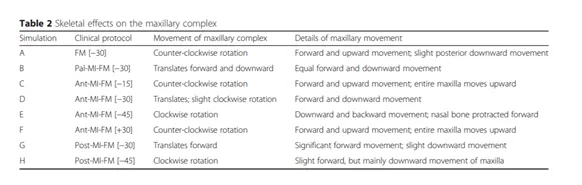
One important question is if you are brachy, dolico, or mesofacial (Short long or medium face respectively). How does this study apply to the MSE +FM is the main question. I've attached a table below that I will now discuss. Well, we can't use the simulations C through F since those are all Anterior micro implants. The MSE is posterior, attached to the first molars. So anterior MI simulations wouldn't be good to apply to our cases.
The remaining simulations that could apply to us are A,B,G, and H. H causes downward rotation which is a definite negative for most of us with long-ish faces. The trouble here is that A B and G all use -30 pull angle! I wish they did one with a posterior microimplant with a 0, +15 or +30 angle. Unfortunately we can't know what would happen at these angles currently. The good news is that even the -30 degree pull caused forward movement. I think for now I will use FM at a 0 degree angle.
I know intuitively you would think a +30 degree angle with MSE+FM is best to get that CCW upward rotation. However, this all depends on what the center of rotation is. Hypothetically, the maxilla's center of rotation could be near the eye area, or low down near the maxillary teeth, or anywhere in between. We don't know where it is since it depends on mass. At a +30 angle, it's hypothetically possible that rotation down near the maxillary teeth could cause recession at the eye area, depending on the center of rotation! In that case, if the center of rotation is halfway in between the maxillary teeth and the eye area, the teeth may come forward but the eye area may rotate back. Ideally, the center of rotation would be such that the entire maxilla and eye area would rotate up.... but we don't know this will happen. So for me I think 0 degrees is safe.
Please let me know your thoughts on this. On the other hand, maybe I'm being overly cautious, since some orthos say that for adults, FM at +15 degrees is fine, so maybe they have already thought through this. And Mike Mew's Mewvector is upwards angled too. So maybe between 0 and 30 degrees upwards is fine too. Thoughts?
I've read 2 different rationales for traction angled downward from the occlusal plane. @varbrah recommended emulating physiological growth of the maxilla, which occurs in a downward and forward direction from the sutures around the maxilla:
It's unclear to me why traction parallel to the occlusal plane (0 degrees) isn't an option to consider. Does pulling down and forward (e.g. -30 degrees) give more forward displacement than just forward? Maybe it helps create separation so there's less resistance from the circummaxillary sutures. Personally, I have a low lip line with reduced incisal display, so I'd gladly accept a shift downward one millimeter to get a shift forward of a few millimeters. Pulling upward and forward (e.g. +30 degrees) like @ronaldead demonstrates in his video about MSE+FM looks like it would be uncomfortable where the elastics press into the upper lip. I wonder if Dr. Newaz recommended an upward angle for FM traction or if this was Ronald's own decision, maybe based on the MewVector or Plato helmet designs.
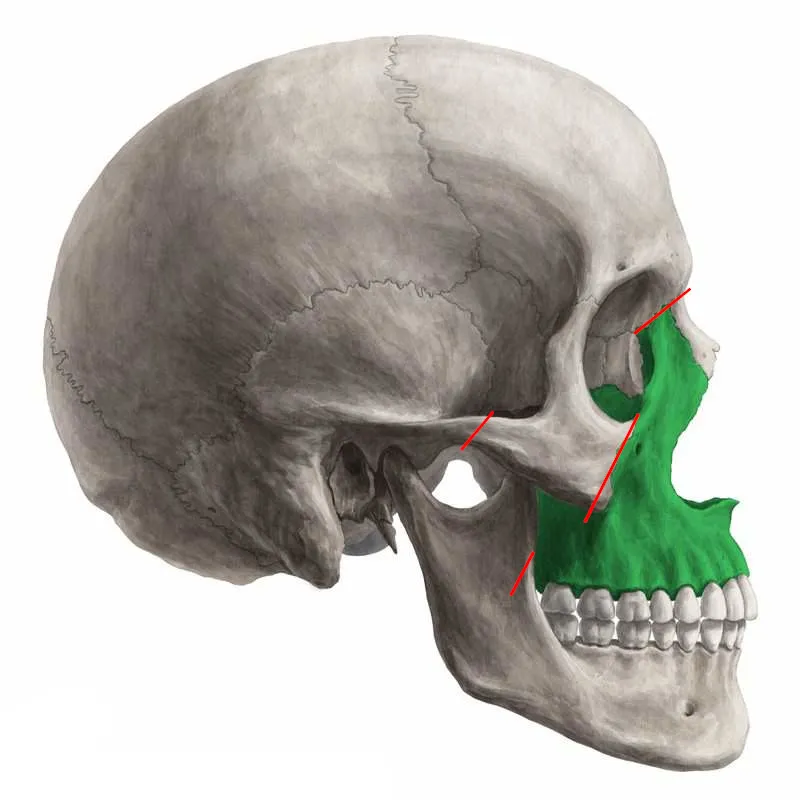
This is just my opinion, but what often needs to be done is stimulating maxillary sutural growth. The four "main" sutures of the maxilla are the frontomaxillary, zygomaticotemporal, zygomaticomaxillary and pterygopalatine sutures, which are all more or less parallel to one another, and are angled from downward posteriorly to upward anteriorly (see below for a rough sketch). Growth at these sutures would translate the maxilla down and forward.
Pushing "against the grain" or up and forwards is probably counter-productive in regards to producing sutural growth, but may be helpful for remodeling existing bone. In adult cases (like my own) I'd imagine it's more important for us to stimulate sutural growth via pulling forward and down (-15 to -30 degrees) since growth largely ceases here by about age 10.
I also read an argument on another forum reasoning that because the MSE anchorage is at the back of the maxilla, pulling down and forward at the back would cause counter clockwise rotation relative to the front. However, I also get the obvious logic that you should pull up and forward if you want to move the maxilla up and forward. I'm more concerned with the forward vector, and I think it makes sense that adding in a downward component could help create separation at the sutures to allow for more forward changes.
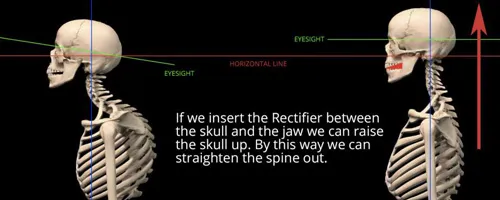
It just occurred to me that pulling the posterior maxilla down and forward would have an effect analogous to bite splint rectifiers, and neuromuscular bite therapy: decompressing the TMJ, improving cervical posture, and potentially alleviating "dental distress syndrome."
Posted : 02/07/2020 2:59 pm
Leave a reply
Skull and Jaw Correction
Free Classes
Join hundreds who are Tensegrity Mewing, enhancing the good results of mewing and reversing damage. Free Newsletter and Classes