

I've been (hard) mewing for 3 months (first 2.5 months with slightly incorrect technique) and my wisdom tooth fully erupted and midpalatal suture split visibly within the first 10 days.
This split also caused a slight (1–1.25mm) medial diastema in the upper arch and has stayed the same for the past three months.
My question is, does the midpalatal suture split and close everyday in a cyclic process with the force exerted by mewing, or does it stay split like that indefinitely without bone tissue closing the split?

I don't have an answer to your question, but have you observed a whitish or light-pink line appear along your mid-palatal suture, during the expansion process? I'm asking because I have recently observed a line like that, but it's only visible in the back of the palate, not at the front.
Also, what is your age?
24 years old
I don't have an answer to your question, but have you observed a whitish or light-pink line appear along your mid-palatal suture, during the expansion process? I'm asking because I have recently observed a line like that, but it's only visible in the back of the palate, not at the front.
Also, what is your age?
Hmm, no whitish or light pink line at all. Just the dark line (the split) from the front to the end of the hard palate. But I sometimes see a slight reddish spot like a small bruise on the soft palate (rarely, tbh). Probably because I engage the rear third of the tongue against it?
I'm 23.


@Azrael. Congratulations! It is very impressing that you managed to split the suture with your tongue. Could you give some details about how you hard mew? I.e how hard you push, what part of the tongue you focus on, if chin tucks are incorporated, etc. It would be interesting if you discussed your case with Mike Mew as well!
As for your question, I don’t have a confident answer. But considering that MSE patients sutures heal, I don’t see why this wouldn’t be the case with you as well.
@Azrael. Congratulations! It is very impressing that you managed to split the suture with your tongue. Could you give some details about how you hard mew? I.e how hard you push, what part of the tongue you focus on, if chin tucks are incorporated, etc. It would be interesting if you discussed your case with Mike Mew as well!
As for your question, I don’t have a confident answer. But considering that MSE patients sutures heal, I don’t see why this wouldn’t be the case with you as well.
Thanks, but that's one of the only two visible changes I've got for the past three months. Hopefully in the next year or two, I'll see some major skeletal changes. I have an x-ray taken about a year before starting to mew and I could take another one then to post an update here, if I do really get some post-worthy changes.
As for my routine, it's very simple:
Yeah, that's what I recall right off the top of my head. Feel free to ask any questions.
And yes, my suture split is closing on the palate. I changed my routine a bit, might have something to do with that? However, I'm more interested in maxillary rotation than palatal expansion right now as I already have a broad enough smile. Still, wouldn't mind any oomph I can get for the cheekbones from the palatal expansion, though.
@azrael Thank you for responding! It would definitely be appreciated if you posted your progress later onwards, especially since you have had x-rays taken. How long have you been mewing for? How old are you? And do focus on any specific part of the tongue?
As for the closing of the split, what did you change up?
@azrael Thank you for responding! It would definitely be appreciated if you posted your progress later onwards, especially since you have had x-rays taken. How long have you been mewing for? How old are you? And do focus on any specific part of the tongue?
As for the closing of the split, what did you change up?
No problem. I've been mewing for three months now. I'm 23. I focus mainly on the posterior third after reading about helmutstrebl's routine.
For the first 2.5 months, I used to hard mew with about 90-100% of max force possible with mostly the tip and middle third. The posterior third was active as well but my digastric muscles (bulge under chin) were also working which apparently was improper technique (What I don't understand is how fast I was able to split the suture, form the diastema and fully erupt my last wisdom tooth with an 'improper' mewing technique).
I now hard mew in a way which doesn't engage the digastric muscles and as a result I can't exert the previous percentage of force for some reason. All of the adjustments to my routine are in line with what helmutstrebl recommended by the way.

@azrael Thank you for responding! It would definitely be appreciated if you posted your progress later onwards, especially since you have had x-rays taken. How long have you been mewing for? How old are you? And do focus on any specific part of the tongue?
As for the closing of the split, what did you change up?
No problem. I've been mewing for three months now. I'm 23. I focus mainly on the posterior third after reading about helmutstrebl's routine.
For the first 2.5 months, I used to hard mew with about 90-100% of max force possible with mostly the tip and middle third. The posterior third was active as well but my digastric muscles (bulge under chin) were also working which apparently was improper technique (What I don't understand is how fast I was able to split the suture, form the diastema and fully erupt my last wisdom tooth with an 'improper' mewing technique).
I now hard mew in a way which doesn't engage the digastric muscles and as a result I can't exert the previous percentage of force for some reason. All of the adjustments to my routine are in line with what helmutstrebl recommended by the way.
You are likely noticing the mylohyoid muscle rather than the digastric muscle:
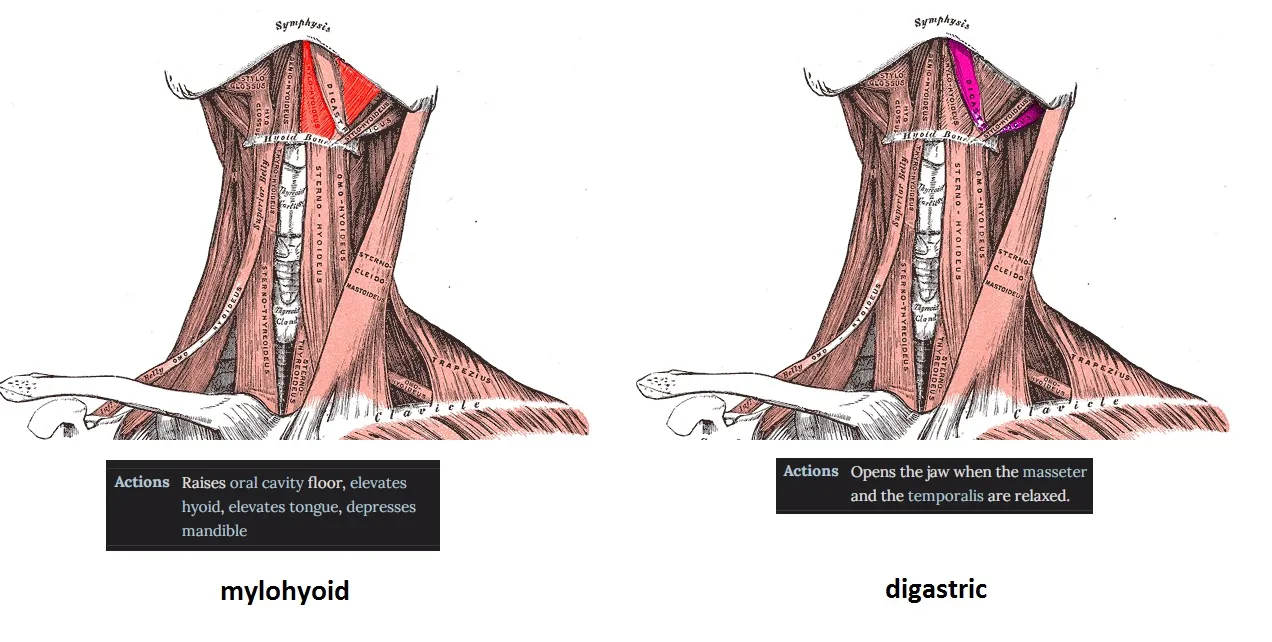
What made you suspect that it would be improper to have this muscle activated? To me it seems like a valuable muscle to keep engaged (can any other single muscle simultaneously raise the hyoid, elevate the tongue and also bring the teeth together?). Your experience strongly suggests so too. Since it is attached to the tip of the mandible, the tone of this muscle could also play part in shaping the chin.
You are likely noticing the mylohyoid muscle rather than the digastric muscle:
What made you suspect that it would be improper to have this muscle activated? To me it seems like a valuable muscle to keep engaged (can any other single muscle simultaneously raise the hyoid, elevate the tongue and also bring the teeth together?). Your experience strongly suggests so too. Since it is attached to the tip of the mandible, the tone of this muscle could also play part in shaping the chin.
I didn't think it was the mylohyoid since the muscle beneath the ramii (digastric) too got visibly engaged along with the muscle under the chin, which lead me to suspect that the digastric muscles were indeed getting involved. But both the mylohyoid and the digastrics are engaged, perhaps?
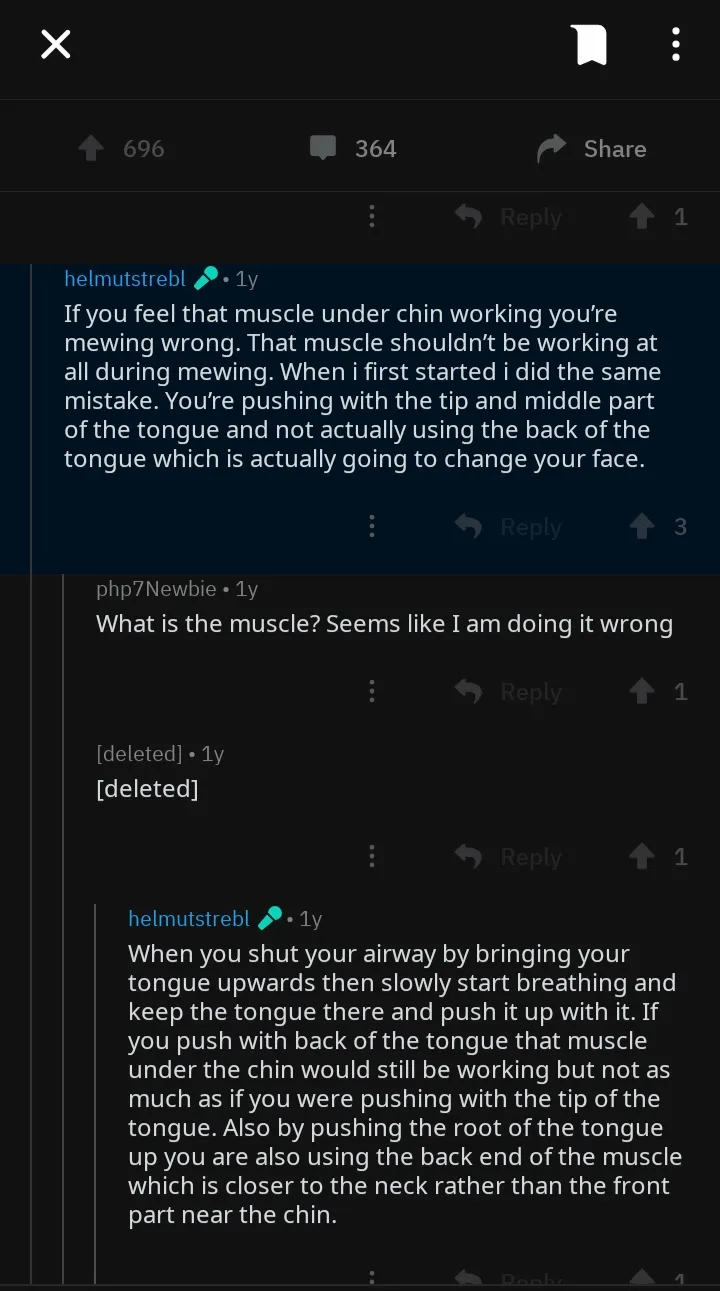
Apparently helmutstrebl (in one of his comments on Reddit) went through the same thing and it was because he was pushing upwards from his tip and middle third more than the posterior third. He said mewing the correct way (explained in the fourth paragraph) could reduce (not eliminate) the bulge to a considerable extent which I've found out to be true (the digastric muscle beneath the ramus still gets activated but waaay less than before). I have screenshots of his comments, could post them down here if you want.
Also, I saw plenty of others online getting a more tighter, stretched looked underneath the chin when they were mewing which wasn't the same in my case. I got this bulgy, double-chinish looking thing when I mewed and I had no double chin in the first place as I am already pretty lean. The bulge wasn't there when I swallowed water or food so I think my old technique was faulty indeed despite it bringing small and considerable changes inside my mouth (mentioned in the op).
helmut was probably right because after taking his advice and mewing in the way he recommended, I could feel the tongue move more backwards than previously possible. Perhaps it's a result from the tongue strengthening (from hard mewing for 2.5 months) and increased mobility, totally unrelated to his advice. Also, I should say that he was advising to push upwards entirely using the posterior third with no pushing from the tip (no ballooning at all which I kinda tried to do).
Also, I took a photo and realized the suture split is still there. So the refined technique is still probably good?

@azrael
Thank you for your routine. By the way is your palate considered vaulted/high arched?
@azrael
Thank you for your routine. By the way is your palate considered vaulted/high arched?
No problem. Vaulted I guess, since it doesn't look flat like most palates I see online.

@azrael Is that why you focused so much attention on the tip/middle of your tongue before? I always wonder if vaulted palates need to be pushed forward so there's further room to engage the posterior tongue. Also, could you post those Reddit quotes from helmutsrebl?
@azrael Is that why you focused so much attention on the tip/middle of your tongue before? I always wonder if vaulted palates need to be pushed forward so there's further room to engage the posterior tongue. Also, could you post those Reddit quotes from helmutsrebl?
No, that's just how it happened when I mewed. I had to consciously exert an effort for the posterior third to rise up, however.
Also, holding a suction hold with the posterior third is mostly difficult (at the moment, it'll get easier in the future) for me as I never hear the 'click' sound when it lets go of the palate and my suspicion is because of the vaulted nature of my palate. The click sound can be made by the tip and the mid third, though.
The screenshot about the improper technique? Here you go (hopefully, he's okay with it as he's very helpful):
I forgot to include this in the reply with my routine but I chew with my mouth closed (no OMC at all) and don't touch teeth while mewing. For the whole three months.
However, I should say that from Reddit posts alone, plenty of people who touch teeth while mewing and people who don't — both kinds have achieved progress. So it's not one-size-fits-all as Prof. John Mew (he recommends teeth contact as they help in upswing apparently) seems to say. Didn't notice a similar pattern for the OMC vs CMC debate, however, as they very rarely mentioned their chewing method in the posts.
@azrael Your age, coupled with the short timespan of your mewing practise, make your achievement is even more impressive. I have to ask, what made you notice the split? I imagine it must have hurt as hell? And did you feel any build up of pain prior to the split taking place?
@paperbag I pretty sure my palette is vaulted, and it is certainly narrow. Despite this, I can still mew with the posterior third(took me about 5 months). I am inclined to think that in most cases, one just have to develop solid muscle-mind-connection with the tongue, and learning the difference between engaging the posterior third and holding ones breath.
@azrael Your age, coupled with the short timespan of your mewing practise, make your achievement is even more impressive. I have to ask, what made you notice the split? I imagine it must have hurt as hell? And did you feel any build up of pain prior to the split taking place?
Haha thanks, hopefully I will be able to keep this kinda progress up in the coming years as well.
I didn't notice the split forming at all but one day the palate felt different to the touch of my tongue. Usually it was pretty smooth and this one time, it felt like there was a hard split near the middle. This was also the same time my diastema started to appear so I naturally took a photo of the palate and the this dark line (the split) was there. I thought the diastema would expand further but it has stayed the same ever since. No pain accompanied the diastema or the suture split (probably because it's small) but there was plenty of pain near my wisdom tooth which erupted fully a few days later.
@paperbag I pretty sure my palette is vaulted, and it is certainly narrow. Despite this, I can still mew with the posterior third(took me about 5 months). I am inclined to think that in most cases, one just have to develop solid muscle-mind-connection with the tongue, and learning the difference between engaging the posterior third and holding ones breath.
Agree with this 100%. My sister tried raising the posterior third after watching the same vid I learned to do it from and even after several days, she still can't do it, whereas I was able to do it in like a couple hours. Both of us used to rest out tongues on the bottom of the mouth, too, so I guess some people are quicker at forming that mind-muscle connection than others despite starting from the same initial point.
