

I need a reference to discuss with an ortho about the MSE. The ortho still uses the advanced turning protocol to separate the suture.
I understood that some of the top providers are advocating slower turning protocols such as 1 turn per day or even slower. Does anyone know who is advocating for the slower turning protocol to split the suture? Won Moon? Dr. Ting?

Dr. Ting often recommends 1 turn per day, sometimes after a few initial turns to take up the slack. I think he might talk about this in his Jaw Hacks interviews. In a recent presentation, Dr. Moon shared this slide saying that failure is less likely with a slow schedule, but it also might give less midface changes. So if you are male and comparatively older, at higher risk of failing to separate, the slow protocol might be better for you. In the same presentation he advised that a subjective approach might be best by turning until it feels tight and then turning a little more, but for a patient with no prior experience to compare the resistance this seems difficult to judge. See this thread ( /community/community/main-forum/how-many-turns-day-for-mse-in-june-2020-seems-like-the-advice-has-changed-is-it-just-1-day-now-when-did-this-new-info-come-out/ ) for more details.
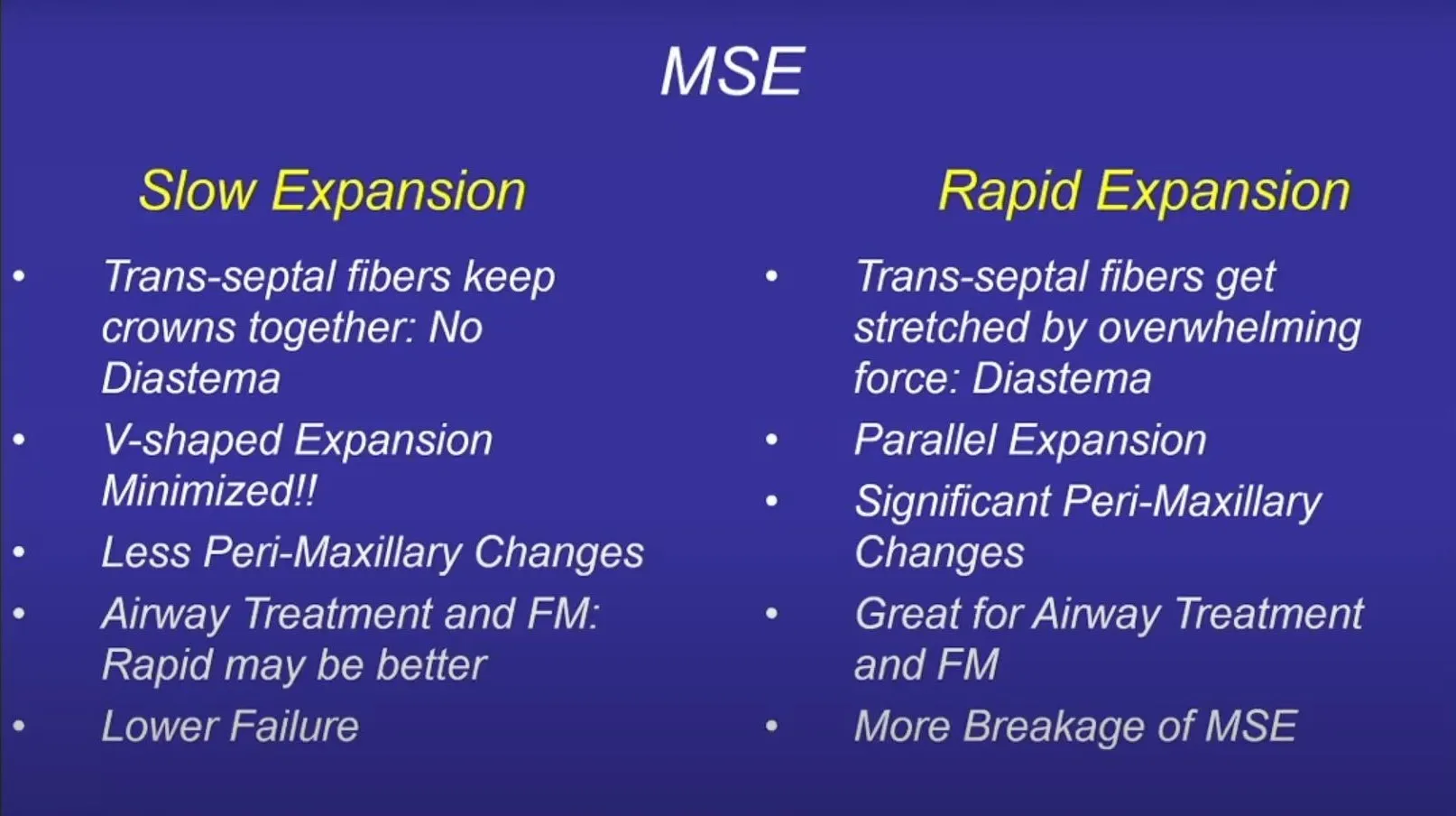

@apollo what is a peri maxillary change?
"peri-" means "around" like in the word "perimeter" or "periphery." So "perimaxillary" refers to the area around or adjacent to the maxilla. I guess this would most often be used in the context of referring to bones/structures that border the maxilla like the zygomas, nasal bone, sphenoid, etc. It's the same way "periodontal" refers to the tissue around the teeth (i.e. the gums, alveolar bone, ligaments, etc.). "Circum-" also means around as in the word "circumference" or "circumnavigate." So "circummaxillary" is essentially a synonym, but I think it more often refers to the sutures surrounding the maxilla. I tend to use the two terms interchangeably, but technically I think of the prefix peri- as meaning "in the vicinity of" and the prefix circum- as meaning "circling." So I guess there is a bit of nuance between the two words.
In the context of the presentation, Dr. Moon is saying there will probably be less overall midface change with a slow protocol in the structures around the maxilla like the airway, cheekbones, nose bridge, etc. and less loosening of the surrounding sutures to facilitate protraction. However there's a greater risk of failure with a fast protocol. So it's a trade-off.
@apollo great explanation I know recognizes the word peri from the perimeter.