

I'm trying to figure out the main difference, with respect to bone cuts and/or detachments, between a LeFort 1 Osteotomy and SARPE/Surgical-Assist-MSE/DOME.
I did undergo the former, which required 4 plates along w/ screws. After doing some research, it appears that the latter does not involve plates/screws (I assume this is partly because they would get in the way of using an expansion device). From what I can tell, the only bone still attached right after SARPE is the pterygoid junction (i.e. the posterior). Is this correct?
Of course new bone is deposited where the cuts were, as the expansion progresses.

I'm trying to figure out the main difference, with respect to bone cuts and/or detachments, between a LeFort 1 Osteotomy and SARPE/Surgical-Assist-MSE/DOME.
I did undergo the former, which required 4 plates along w/ screws. After doing some research, it appears that the latter does not involve plates/screws (I assume this is partly because they would get in the way of using an expansion device). From what I can tell, the only bone still attached right after SARPE is the pterygoid junction (i.e. the posterior). Is this correct?
Of course new bone is deposited where the cuts were, as the expansion progresses.
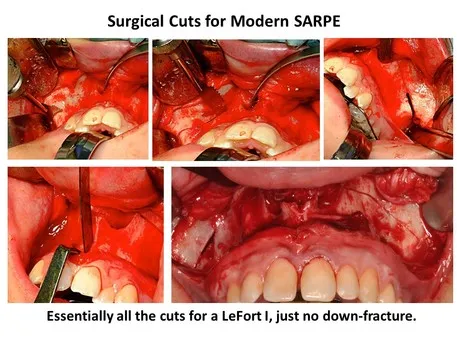
The typical SARPE cuts are the same as LeFort 1 Osteotomy, including pterygomaxillary release. It just doesn't involve the downfracture. DOME is basically the same thing as SARPE, except it uses a bone-anchored expander rather than a tooth-borne expander. What Dr. Moon calls SMARPE (surgery and micro-implant assisted rapid palatal expansion) and Dr. Ting calls MSE with surgical-assist, sometimes doesn't involve all of the SARPE/LeFort 1 cuts, depending on the case. Separation of the pterygomaxillary junction requires hospitalization because of the bleeding risk, so this isn't involved in outpatient SMARPE procedures. Sometimes they also only score the zygomatic buttress rather than making a bicortical osteotomy.
Now I'm wondering what's still attached that becomes separated by a downfracture
Now I'm wondering what's still attached that becomes separated by a downfracture
Yeah, I guess it’s just the soft tissue and any fragments of bone between the osteotomies. You could try asking @sergio-oms.