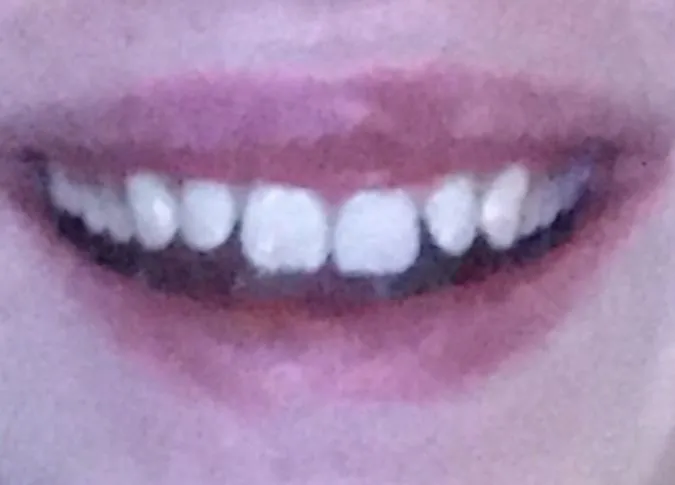
Mine is 34mm, i can put my tongue on the palate but its sides feel a little rolled probably because 34mm is not enough for my tongue to sit there comfortably
About the same. Last time I measured, it was around 33-35 mm at the narrowest point between the first molars. But at second molars the width is significantly greater, somewhere between 40-45 mm.
I've been trying to get a reproducible measurement of my intermolar width (between my first molars) over the past couple weeks. Mine also seems to be around 34mm. I think this might be a slight improvement from where I started over a year ago. Dr. Mew's note in the comments of his video on intermolar width is interesting:
"Important note; modern adults (or anyone over the age of 9) tend to have a molar width of 29 to 34mm. Anyone with 35 to 38mm will find it much easier but still very hard to make progressive improvements without any formal therapy, and as a rule of thumb when I finish therapy any one who can maintain 38mm or more without retainers tends to maintain good alignment almost indefinitely, with a minimal effort. During childrens treatment expand to 42mm for a girl and 44mm for a boy, clearly some of this is tipping of the molars. Ancient man had an inter-molar width in the high 40's to low 50's."
cosmetic line 46mm [distance from nose bulb to the front teeth??] 46 mm (42 is the orthotropic preference)
———-
34 mm for the upper palate. 38 for the lower?
On that note -- I had orthodontics at 13. Lower permanent retainer. Removable upper retainer that i clearly didn't appreciate.
very interesting..odd. and facepalm-worthy. Actually. since looking at those scans again and thinking about all this -- i'm getting a bit angry, actually. damn it man. what a frustrating thing to think about. 4mm differential between the upper and lower; the clear asymmetry/lack of level between the L/R sides of the maxilla. the notch on the jawbone and the downward development. and more.
SO uhh. hey guys, can you remind me the expansion possible in adults w/o appliance? through myofunctional therapy. yeah? Or maybe mention what you know the typical final-resulting size of the palate after expansion is concluded? I mean I don't have an appliance, but i open the floor to all the knowledge. I'm aware of 1mm/week estimate through Mike Mew's videos. What else do you have? I'm looking but don't see.
And to hijack this one more time-- expander recommendation, hypothetically: Y-plate or Active plate? Which is superior? Or which is superior to both of those!?
Posted by: Gregory Actually. since looking at those scans again and thinking about all this -- i'm getting a bit angry, actually. damn it man. what a frustrating thing to think about. 4mm differential between the upper and lower; the clear asymmetry/lack of level between the L/R sides of the maxilla. the notch on the jawbone and the downward development. and more.
This kind of imaging is definitely interesting, but it's actually a little challenging for me to get perspective on how narrow the palate is or how downswung the maxilla is without the context of the soft tissue. I guess I can see some asymmetry (for example the upper left lateral incisor looks to be slightly higher than the right, suggesting maybe the occlusal plane is canted higher on the left?). Where is the "notch on the jawbone" you mentioned? It looks like the upper intermolar width was measured as 34.25mm and the lower intermolar width was measured as 38.73. When you bite together, are the cusps of your lower molars closer to the cheeks than the upper molars? For me, the upper molar cusps are closer to the cheeks, but my lower molars are tilted in to achieve this overlap. I've often thought it might be enough expansion if I could just widen my upper arch to the point that the lower molars weren't tilting in and my lower incisors weren't crowded.
idk what appliance is better,i think any will do as long as you work hard i mean always keep your tongue on the roof of your mouth, keep your mouth shut,work on your head and body posture etc. my palate was narrower, i didnt use any appliance, just my tongue
Posted by: Gregory Actually. since looking at those scans again and thinking about all this -- i'm getting a bit angry, actually. damn it man. what a frustrating thing to think about. 4mm differential between the upper and lower; the clear asymmetry/lack of level between the L/R sides of the maxilla. the notch on the jawbone and the downward development. and more.
This kind of imaging is definitely interesting, but it's actually a little challenging for me to get perspective on how narrow the palate is or how downswung the maxilla is without the context of the soft tissue. I guess I can see some asymmetry (for example the upper left lateral incisor looks to be slightly higher than the right, suggesting maybe the occlusal plane is canted higher on the left?). Where is the "notch on the jawbone" you mentioned? It looks like the upper intermolar width was measured as 34.25mm and the lower intermolar width was measured as 38.73. When you bite together, are the cusps of your lower molars closer to the cheeks than the upper molars? For me, the upper molar cusps are closer to the cheeks, but my lower molars are tilted in to achieve this overlap. I've often thought it might be enough expansion if I could just widen my upper arch to the point that the lower molars weren't tilting in and my lower incisors weren't crowded.
More similarities, yet again.
The lower jaw is closer to the cheeks, visually. Yet the lower teeth do tilt inwards in order to meet the more "vertical" upper teeth. I share that sentiment.
Whole industry, in fact. Intermolar is distance between front of first molars
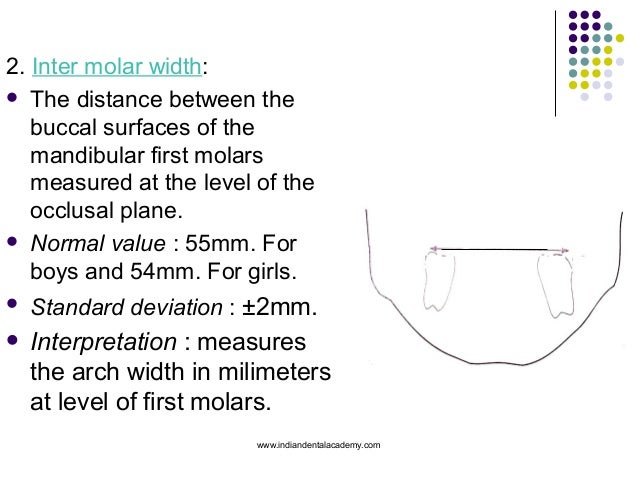
This diagram indicates the distance between the buccal cusps whereas Dr. Mew's video indicates the distance between the ligual sides of the first molars.
Whole industry, in fact. Intermolar is distance between front of first molars
This diagram indicates the distance between the buccal cusps whereas Dr. Mew's video indicates the distance between the ligual sides of the first molars.
Well spotted! It appears that countries/regions/branches of medicine may be using different standards. This may be a good question to ask Mike in the future. Here is an Indian school with the buccal standard - but note they say the average is 55mm! I'm on mobile for the next week but if anyone can followup on why this school (and maybe others) are reporting high average numbers it could be very interesting. Dental schools teaching "averages" for width could paint a picture of development in different regions from which we can pull some interesting correlations.
But most definitely it looks like there is no international standard for palate width measurement. I am honestly surprised by this
One thing I find very strange is that all models of distances between teeth seem to exclude the wisdom teeth. They just act as if they do not exist
I think impacted wisdom teeth tend to erupt in so unpredictable and incosistent patterns that the measurement is not a conveniently clear indicator of anything, at least when compared to molars that usually erupt in their pretedermined spots along the dental arch.
Mine is ~36mm, but I don't have an accurate way to measure. I did just get the impression kit from bracesshop, but without a caliper my figures are useless. Anyway, I plan to get around to getting a caliper at some point and measuring, like the one from the newest video. I'm getting the y-plate expander, and I don't know much about the relationship between age and these things working, but I'm 20, if that's of any significance, so maybe I can still get some good expansion from this device.
Also recently just fixed my sleep apnea, and make it through the night without mouth-breathing at all, signified by the tape that stays on my lips all night.
I expanded IMW from 36mm to 40mm. I was hoping for an improvement in breathing quality and sleep, but the improvements have been negligible from my observations. However, I did tip the incisors forward a bit and that has siginificantly improved breathing and sleep. It seems my issue isn't tongue space, but a trapped mandible instead.
Measured between my first molars, I'm getting around 36.97mm with my calipers.
My tongue is rolled a bit as well. I also have torus palatinus (bony protrusion on the roof of my mouth), which also seems to affect how comfortably my tongue can rest against the roof of my mouth.
I did have braces growing up, as well as a retainer for years, and also had all 4 of my wisdom teeth extracted, FWIW.
Measured straight across the back edge of my retainer (which was made about 12 years ago and is too small to wear comfortably) The edge of the retainer sits right at the middle of the first molar, and measures 40 mm at the spot right in front of the first molar.
Thinking back, I was the only lucky kid in my family who didn’t need expansion. Yay me, I have a decently wide upper palate. My lower jaw is more of a problem though, it’s narrower and smaller.
@eddiemoney Do you see a connection between higher intermolar width and edge-to-edge bite? I'm asking because I had intermolar width of 41mm and edge to edge bite upon starting.
@eddiemoney Do you see a connection between higher intermolar width and edge-to-edge bite? I'm asking because I had intermolar width of 41mm and edge to edge bite upon starting.
Generally the people I see with wide palates can also have extended teeth wear, too. Edge to edge biting can hasten this wear usually. Not a rule but they don't exist outside of each other.