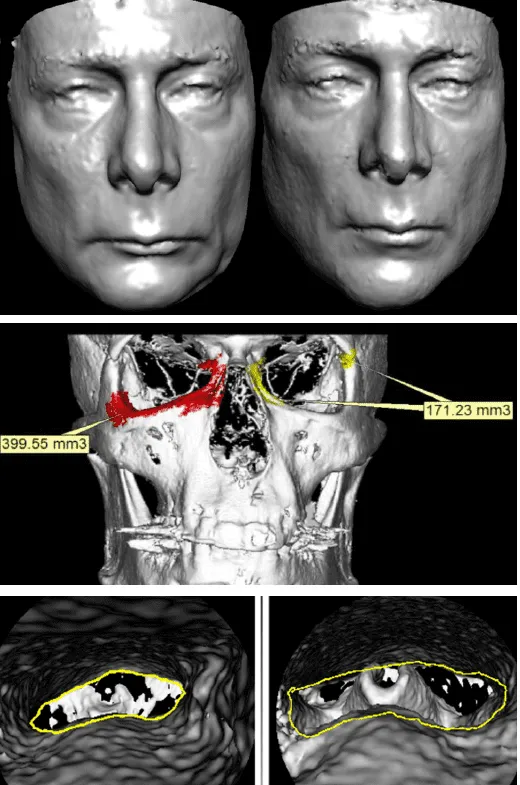
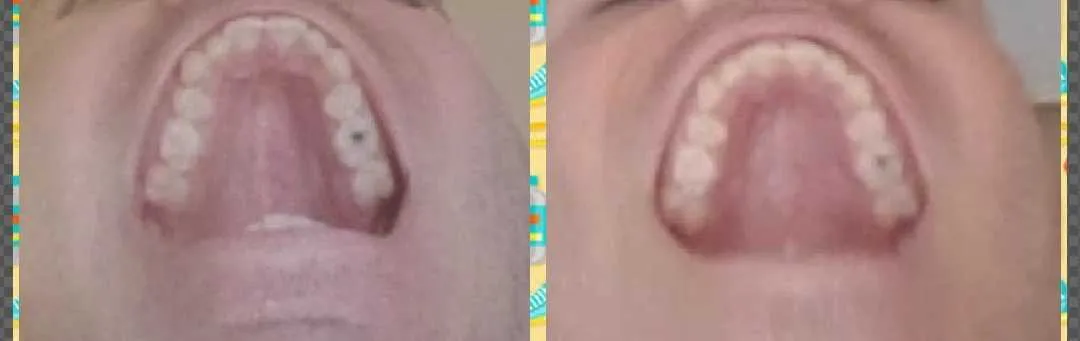
The initial scans showed an intermolar width of 36.4.
My lower jawbone was also significantly recessed, and the condyle was worn away.
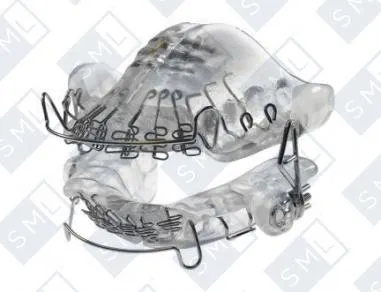
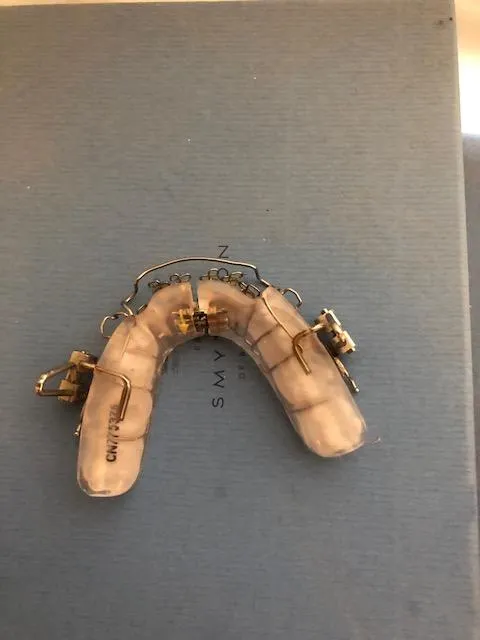
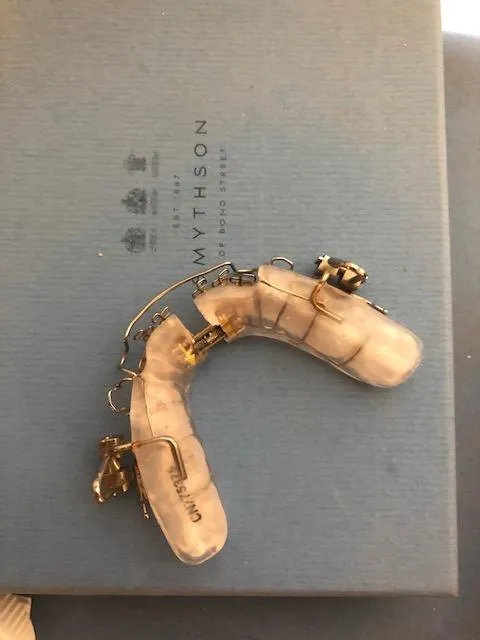
The doctor put me in a y splitter, and a two piece expander for my lower jaw. The second appliance has two metal prongs which prevent my jaw from slipping backwards. This is adjustable.
Every month I undergo a take home sleep test, and based on that, the prongs on the lower jaw appliance are adjusted. In effect, I will keep on advancing the prongs until my sleep apnea disappears.
My sleep isn’t getting better yet, I still don’t dream, but I do breathe more easily when I’m awake. I can usually breathe through both nostrils now, for example.
I have the perception that my sense of smell is improving as well.
The appliances aren’t uncomfortable, and at worst, they just feel tight when I put them on. I have been experiencing some pain at my suture points though, as well as mild headaches.
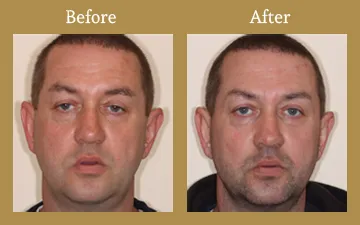
I don’t remember how I discovered functional appliances. They made immediate sense to me though. My facial structure looks normal, if you cover the lower half of my face. The lower half just looks too small, disproportionate to the upper half. I assume this is because my jaw is in the wrong position. If I jut my jaw forward, then it looks proportionate.
I was told the process would take me two years in total.
Thanks for posting your progress! Do keep us up to date!
I am in a similar boat - dealing with TMJ right now, not sure if my condyle is worn away or not as we only did a CBCT, not a MRI. But I'm in a bite split for 4-6 months, and my doc is a DNA provider so we'll chat about the DNA appliance after we resolve the TMJ and jaw alignment issues.
Just wondering how you're going with your treatment. I'm about to undergo DNA treatment when my appliance arrives (supposedly within the next 3 weeks), however my doctor has only prescribed the top appliance and not the bottom one at this stage. Are you turning yours every 4 days and have there been any more improvements since last time?
The process is so gradual, it's hard to notice progress.
With that said, it has cured my snoring. And I do feel that I can breathe more easily through my nose. I turn the screw once a week, and when I do, I can certainly feel it. I don't feel it in my jaw or in my teeth though, it's the suture lines in my maxilla. You can feel the pressure, edging on pain. It's not difficult, but it is noticeable.
It's also sore to the touch, especially where my Maxilla meets my Zygomatic, and nasal bones.
Wearing the device opens my Eustachian tubes, which is welcome. My right side Eustachian tube was always closing up on me.
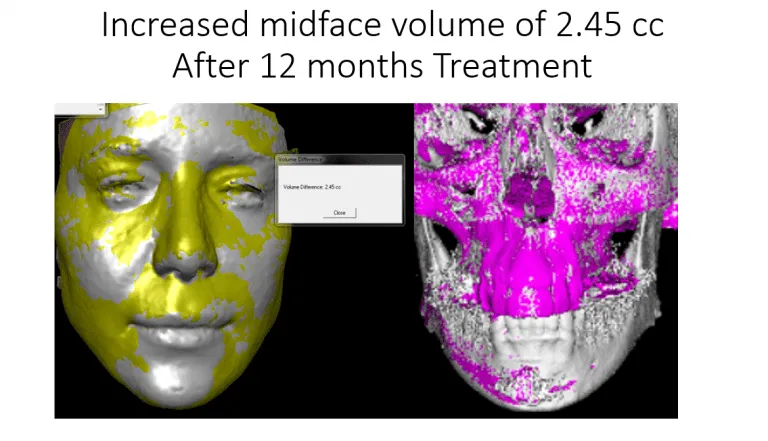
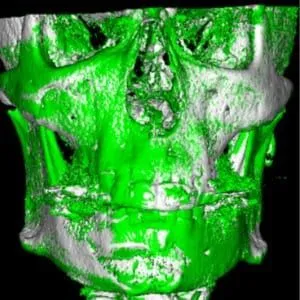
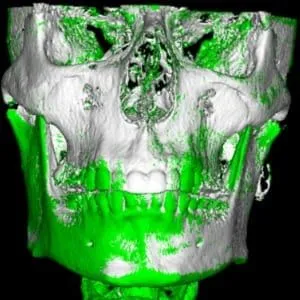
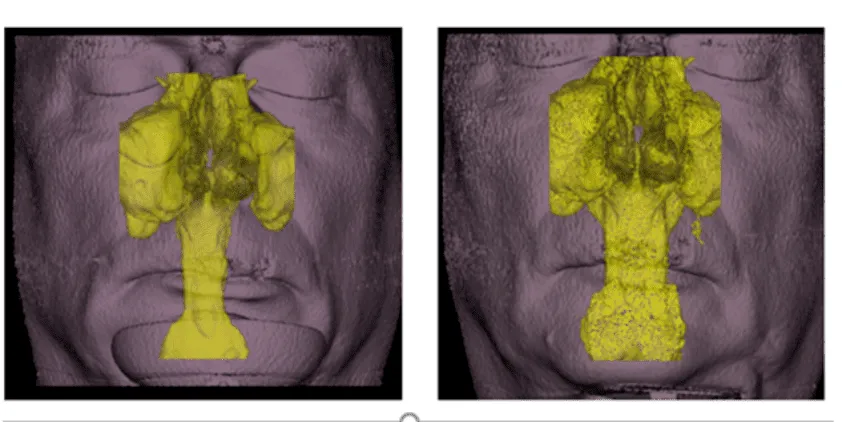
Photos are taken from the Homeoblock website. The green in the lower images shows growth, and or movement.
It's my hope that I'll see similar improvements, given the devices work the same way. The more time I spend reading, and reflecting on my own Craniofacial Dystrophy, the more I appreciate I've got a lot of work to do. My mandible, for example, is unhooked on one side (for lack of a better way of describing it) and has rotated left. As a result the midline doesn't match the midline of my upper jaw.
are you noticing your mandible come forward with expansion? Did your doctor say any thing about remodeling the condyles?
I have a heavy beard, so I can't see physical changes in the lower half of my face. I think it's come forward slightly, but I'd need to shave to tell.
The doctor said that he normally sees condyle repair as treatment progresses, but he's never seen complete recovery.
One of the downsides to the DNA Appliance is that the providers are unlikely to be experts. They're not designing the appliance for example, Dr. Singh's team is. So my doctor, he doesn't always have answers for me unfortunately.
-
I happen to own a mild Hyperbaric Chamber, and I'm getting back in the habit of using it daily. Hyperbaric oxygen speeds bone repair, and remodeling, and I'm hopeful that this will help quicken the work of the appliance. We'll see.
There are gaps opening up between my lower front teeth. They were very crowded and overlapped each other, and that's starting to change. You can see where the springs in the DNA Appliance are pushing them out, on their own trajectories.
The doctor put me in a y splitter, and a two piece expander for my lower jaw. The second appliance has two metal prongs which prevent my jaw from slipping backwards. This is adjustable.
i've never heard of this with DNA. I've visited three providers now, and every one of them informed me that DNA would only help broaden my maxilla. He said specifically that DNA would do nothing for the mandible or lower jaw(which would require a BSSO).
As my pallet is mostly narrow towards the front and not the back, I basically gave up on the DNA through provider. It would improve my smile(why most people want it), but probably not help my sleep apnea very much at all. I decided there's no point in paying $8000 for something I can do myself as the DNA is basically just a slightly modified y splitter.
Is this lower jaw thing extremely new? My consults were almost a year ago and I know this field is legitimately growing by leaps and bounds. I'm literally set to order a y splitter this week.
There are gaps opening up between my lower front teeth. They were very crowded and overlapped each other, and that's starting to change. You can see where the springs in the DNA Appliance are pushing them out, on their own trajectories.
That's great! How is this working? Surely your jaw isn't going to widen? Did they do anything surgical at all, like splitting a bone or anything like that?
They make a Sleep Apnea version they call the MRNA. It's the normal mandible expander, with a mandibular advancement device bolted on.
I have no data or studies to back it up, but I think it will be more effective than a normal expander, and it will help speed the growth process. By 'curing' apnea, which mine has, you'll spend more time in deep sleep, and in turn, I believe you'll see more rapid bone growth. Or, to flip it around, poor sleep won't retard that healing process.
With work shut down, I've had the opportunity to read a lot of studies, and look at a lot of before and after photos.
If you scroll up, you'll see the 3D skull images, with the green shading denoting movement or growth. With the after photos, the jaws do look wider. Now part of that may be movement, it may be the "trapped mandible" moving forward as the maxilla expands, but either way, the patient's faces do look broader at the base. I do believe part of it is growth though, palate expanders may not restore your face to what it should have been, but they do transmit forces throughout your facial complex, and that force, by law, should promote bone remodeling. So even if the bulk of the growth is in the dental ridge, you should see symmetrical, and sympathetic, growth in other areas of your face.
How much growth? I don't know.
Studies of adult patients often talk about 2mm or 3mms of growth at the Zygos.
If I remember correctly, this was from a six year follow up.
Look at how much higher his cheekbones are, and how his mandible has moved, or grown. And this is a much older man.
My lower device is identical, my upper device is a Y splitter, unlike the one pictured.
-
One thing that I wonder about, the growth figures are tabulated at the end of the study periods. Be they 7 months, 12 months, or two years.
What do those patients faces look like at the three year mark, or the four year mark?
When does remodeling process actually finish?
Growth in one area of the face will provoke corresponding changes in other parts of the face, and I believe that the face will take some time, after you've fully expanded the device, to balance out.
That's great! How is this working? Surely your jaw isn't going to widen? Did they do anything surgical at all, like splitting a bone or anything like that?
One last comment.
I listened to a podcast of Dr. Belfor this evening, and he specifically says that the Homeoblock lengthens the Ramus. Which I assume would also widen the jaw as well.
He also believes that his unilateral bite block is responsible for a lot of the facial growth. The bite block on his device, a flat raised piece of plastic, works as a proxy for the hard food that is missing from our diet, in his words.
I continue to feel mild pain in and around the frontal process of my maxilla where it meets the nasal bone. Both sides. It's the sort of pain you take an Advil for, and it disappears.
I assume the bones are under pressure from the appliance. So I should see growth there?
We'll see.
-
Dreaming, I certainly do dream now. Which I didn't do before treatment. That indicates my sleep has improved.
I'm using the MRNA version which, as mentioned above, will move the jaw forward to the correct position.
No, I am not quite sure why. I feel quite certain I will be in a DNA+mRNA combo if/when we start ... so I don't know why he wanted to go with the bite splint first. It just seems to be his process - he says this is a very conservative approach.
Given that my lower jaw was retruded backwards and both condyles out of position (assuming both are still there) it seems like he wants to get the lower jaw mostly into the position it wanted to be in first ... and then we'd take the necessary 3D CBCT scans and try to build a strategy to fix the maxilla.
The bite splint has definitely done something for my bite and my TMJ. Some of my TMJ symptoms I was experiencing (facial/sinus pain) are a bit better. And some that I didn't realize I had - such as limited range of shoulder motion - also seem to be clearing up. Unfortunately, bringing the lower jaw forward without any changes to the maxilla yet has moved me to an underbite with a posterior open-bite. So I'm now dependent on the bite splint for eating for the time being. But I've only got a few more months, and then we do the full "airway" analysis - and I assume that gets shipped off to Vivos for design/development of my appliance strategy.
I turn the screw once a week, and when I do, I can certainly feel it. I don't feel it in my jaw or in my teeth though, it's the suture lines in my maxilla. You can feel the pressure, edging on pain. It's not difficult, but it is noticeable.
That's fascinating. You're the first person I've heard report that, and in a way I find that very encouraging! The biggest complaint/concern with appliance strategies is obviously things like tipping teeth, pushing teeth through the alveolar structures, etc. You only have to browse this forum for a while to see all the horror stories about Ronald's AGGA case to get pretty scared.
You'll hear from orthodontists saying you don't get palatal growth with a DNA Appliance, only a DOME or MSE will do it. But if you're experiencing pain there, that really would seem to indicate that you might be getting growth at the palatal suture. So I'm actually really excited to hear you report that!
Out of curiosity, what has your provider said - if anything - in terms of checking for safety over time? Are there periodic re-scans via CBCT to make sure you're not pushing the teeth out of the alveolar process or other issues?
Dreaming, I certainly do dream now. Which I didn't do before treatment. That indicates my sleep has improved.
Were you clinically diagnosed with sleep apnea before you started this? I'm not sure if you said so or not.
I was diagnosed (in-lab AHI of 41.8). I can definitely tell you that once I got onto CPAP, I started to dream again - so that's another positive sign that it's working for you.
Oh, and that routine of having to get up and pee in the middle of the night, usually 3-5 nights per week? That disappeared immediately. I had no idea that was tied to my sleep apnea.
If you really want to track how your sleep is doing, there are overnight logging pulse oximeters you can buy from Amazon for not too much. I have the Wellue O2 ring ... and when I have my CPAP mask on, I typically log 94-98% oxygen levels all night. If I take a nap on the couch on my back ... ugh ... crashing down into the 80's. So if you're interested in a feedback mechanism ... that might be an interesting one for you.
i've never heard of this with DNA. I've visited three providers now, and every one of them informed me that DNA would only help broaden my maxilla. He said specifically that DNA would do nothing for the mandible or lower jaw(which would require a BSSO).
You're not alone in this. I've spent the better part of the last 4 months trying to track down as many patient stories and details as I can ... and ... it's just not made clear at all.
But here you can see a patient story from many years ago, and you can clearly see the lower appliance has an adjustment mechanism in the center ... and he talks about the adjustment process. So clearly there's a mandibular strategy as well.
i've never heard of this with DNA. I've visited three providers now, and every one of them informed me that DNA would only help broaden my maxilla. He said specifically that DNA would do nothing for the mandible or lower jaw(which would require a BSSO).
You're not alone in this. I've spent the better part of the last 4 months trying to track down as many patient stories and details as I can ... and ... it's just not made clear at all.
There's so little good information out there. I haven't found a single patient account of the changes they experienced through the end of treatment.
That's why I created this thread. Hopefully it will be useful to other people.
Ideally I'll be able to put up post treatment numbers that show how much growth there was too.
-
With the lack of information, I think that goes back to Vivos.
It's simple to market the Appliance as an Apnea treatment. Apnea is a known medical condition, covered by insurance, where you can readily measure the severity. Vivos can also document how the device reduces Apnea events, or even cures the condition.
It also allows them to make a promise they can keep. The device will help you sleep better.
They don't have to worry about patients who didn't see the cosmetic changes they'd hoped for.
Also how would you document and present the variable bone growth that patients experience when using the device? It must vary quite a bit from patient to patient. And how does that improvement compare to what they should have been? You can't establish what they should have looked like. And what medical condition are you treating? Cranial Dystrophy isn't considered a condition (yet).
Dr. Belfor does market Homeblock as a "face lift" and an "anti-aging device" but it's tricky, because all he can really do is present individual case studies, that show how patients look more attractive after treatment.
Dreaming, I certainly do dream now. Which I didn't do before treatment. That indicates my sleep has improved.
Were you clinically diagnosed with sleep apnea before you started this? I'm not sure if you said so or not.
I was aware of the fact I snored but I never thought much about it. When I did my consult, they gave me a take home sleep test. My AHI was just above the threshold for moderate Apnea. I'd like to say it was in the mid twenties? I don't remember.
I took another test in early February and my AHI had dropped to 16. I believe that immediate improvement came from the lower appliance, holding my jaw forward.
Better health was one of my hopes for this. Given how rough I feel when I sleep without the device, I do think it's helping.
It also shows me that I had no idea how poorly I was sleeping before treatment.
I turn the screw once a week, and when I do, I can certainly feel it. I don't feel it in my jaw or in my teeth though, it's the suture lines in my maxilla. You can feel the pressure, edging on pain. It's not difficult, but it is noticeable.
That's fascinating. You're the first person I've heard report that, and in a way I find that very encouraging! The biggest complaint/concern with appliance strategies is obviously things like tipping teeth, pushing teeth through the alveolar structures, etc. You only have to browse this forum for a while to see all the horror stories about Ronald's AGGA case to get pretty scared.
You'll hear from orthodontists saying you don't get palatal growth with a DNA Appliance, only a DOME or MSE will do it. But if you're experiencing pain there, that really would seem to indicate that you might be getting growth at the palatal suture. So I'm actually really excited to hear you report that!
Out of curiosity, what has your provider said - if anything - in terms of checking for safety over time? Are there periodic re-scans via CBCT to make sure you're not pushing the teeth out of the alveolar process or other issues?
That was poorly worded on my part. I feel the pressure around my eyes and nose, and not in my mid palentine suture. I assume that’s because the bones are being compressed at those sutures.
I do believe that the DNA Appliance and the Homeoblock promote bone growth throughout the facial complex though.
You can see it in the scans that Dr. Belfor has on his website.
Dr. Belfor credits the plastic bite block on his device. If that’s true, it could explain why people might be getting different results than from the older devices.
Teeth tipping, my doctor does a visual examination once a month. He doesn’t appear to be concerned, and I haven’t seen any changes in the gum line. I’m also expanding the device at very slow rate. Just .25mm a week.
Yeah you’re the first I’ve seen have a ~7 day schedule on turning the screw. Was that the initial recommendation from the provider, or did you talk a bit about it? Other patients have been doing 4-5 days in between turns ... so just trying to get a sense on how they determine the schedule.
I just got my DNA appliance today. I had to travel to a dentist in another province (I'm in Canada), so it was mailed to me. So I'm a little bit apprehensive about doing my treatment remotely, though this Covid-19 situation has basically made that a requirement anyway. But the dentist is pretty confident that we can communicate via videos and photos, and skype if needed. It concerns me a bit not being able to have a thorough examination to be sure it's fitting properly and not doing damage to my teeth. It feels pretty snug right now, but they said that it would at first. I'm really hoping it can get me enough expansion to improve breathing and eliminate my sleep problems that I think are mainly due to Upper Airway Resistance...I don't know if I'll ever get a definitive diagnosis since it's not severe OSA.
I opted to just get the upper appliance, since my lower teeth are decently straight and wide, and my scans showed that I don't necessarily have a really narrow airway in my throat... it seems to be mostly my nasal area that's narrow. So I didn't really want to spend twice as much money for something I wasn't sure I needed. Though I am wondering if the mandibular advancement component might have been helpful for me...I just kind of gambled on the upper appliance alone helping me since it's half the price - and I'm still a bit skeptical about this appliance doing what it claims to be able to do - so I didn't really want to spend twice as much money on something that is kind of a gamble. I've been told that when the upper appliance expands the maxilla, that it makes room for the mandible to come forward a bit, so I figured that would maybe be good enough. The lower mRNA, as far as I know, isn't doing any permanent remodelling anyway, it's just functioning as MAD while you sleep.
Speculation. I assume your mandible would move forward, as your maxilla expands. That's what all the devices claim at least.
Does your device have a bite block though, a raised plastic surface on one side?
If Dr. Belfor is right, then you won't see the same bone growth in the rest of your face without one.
This is one I wonder about. He tells this story in interviews, but he chanced across one sided bite blocks. He hired a stringer to make orthodontic devices for his office, and the man he hired included unilateral bite blocks in them. The man had apparently learned to do this in Europe.
Belfor says his patients, who largely worked in Broadway, started coming back to him, claiming their bone structure was changing. Their bones were growing.
To my knowledge, he's never done a comparative study that shows the effectiveness of a device with one, vs one without. He does say that it's the pressure on the nerves underneath the teeth that triggers growth. I don't know how he established this.
The lower mRNA, as far as I know, isn't doing any permanent remodelling anyway, it's just functioning as MAD while you sleep.
It does expand the lower jaw ridge. It may also expand the jaw itself, perhaps. But that assumes that growth in the ridge, triggers growth elsewhere. And I have no science to substantiate that.
Right, sorry I meant the mRNA isn't permanently moving the mandible forward....it is meant to expand the lower jaw though.
My appliance doesn't have any bite pads. I'm pretty skeptical about all this epigenetic/nerve stimulation talk, but maybe there's something to that. I honestly don't know if the DNA appliance is meant to cause a whole lot of bone growth in the face anyway...it's just pretty minimal expansion in the jaw that may cause some changes to physical appearance but I don't think it's usually that dramatic.
Right, sorry I meant the mRNA isn't permanently moving the mandible forward....
I don't know. I assume the growth of the Maxilla is more important. I viewed the MAD as a sort of a stop gap that would fill in until the jaw growth took it's own course.
My appliance doesn't have any bite pads. I'm pretty skeptical about all this epigenetic/nerve stimulation talk, but maybe there's something to that. I honestly don't know if the DNA appliance is meant to cause a whole lot of bone growth in the face anyway...it's just pretty minimal expansion in the jaw that may cause some changes to physical appearance but I don't think it's usually that dramatic.
Dr. Singh doesn't sell the facial changes, but it's at the top of Dr. Belfor's list. I think it goes back to marketing, and how they've decided to make their money.
Some cases are pretty impressive. Others, not so much.
I'm pretty skeptical about all this epigenetic/nerve stimulation talk
And I think that's warranted. Dr. Belfor's papers note the changes he sees in patients, but he doesn't explain the actual mechanism for the changes. He says it's pressure on the nerves underneath the teeth but doesn't go further. I think he may have chanced into something that works, but that he doesn't fully understand.
-
The bite block is located on the side of the face that's underdeveloped, so in my case the left side.
Dr. Belfor credits the plastic bite block on his device. If that’s true, it could explain why people might be getting different results than from the older devices.
Have you come across anything from Dr. Belfor on why he goes with a unilateral bite block? I believe the DNA Appliance is typically configured with bite acrylic on both sides, no? At least some of the photos I've seen seem to have bite plates/blocks/whatever extending across all the molars on both sides.
Dr. Belfor credits the plastic bite block on his device. If that’s true, it could explain why people might be getting different results than from the older devices.
Have you come across anything from Dr. Belfor on why he goes with a unilateral bite block? I believe the DNA Appliance is typically configured with bite acrylic on both sides, no? At least some of the photos I've seen seem to have bite plates/blocks/whatever extending across all the molars on both sides.
The DNA Appliance actually has a bite block. There's a raised surface on one side of the acrylic.
-
Belfor as mentioned had a stringer who made orthodontic devices for him. He found that patients experienced bone growth wearing these devices, and so when he created the homeoblock he included it.
He uses your dental imaging to determine which side of your face is less developed, and locates the block on that side of the device.
Dr. Singh does the same thing with the DNA appliance.
I assume that you transmit more force through your jaws with the one sided block.
I started my DNA appliance a couple weeks ago and have bite blocks on both sides of my appliance. I was a bit concerned about having bite blocks though because of the risk of it causing an open bite with the back molars, but so far the bite blocks are comfortable. I know it’s meant to be beneficial for the bone to be frequently chewing, that’s why Mike Mew encourages his patients to chew gum often, and I imagine that that is the purpose of the bite block.
I’ve noticed pretty good changes so far even in just a few weeks. My right nostril seems to be intaking more air than it did previously and my lips seem to be slightly more symmetrical. There’s also a bit more space for my tongue already. I’ve been expanding 1 turn every 4-5 days, though my doctor said to start with one turn a week to see how it goes and then we would move to turning every 4 days. But I’ve noticed the appliance is generally quite loose around day 4 so have been adjusting it accordingly already.
In my opinion the actual bone remodelling and more evident facial improvement changes probably occur within a few years after treatment, provided proper tongue posture is maintained after the treatment. I imagine that teeth will likely move through the alveolar bone first regardless, but as long as the bone is healthy and continuing to remodel/expand during treatment I don’t necessarily see an issue with this. As long as you’re not overzealous with the speed of your expansion, and as long as there is consistent pressure on the roof of your mouth both from your tongue and the device, my theory is the bones will show growth over time, provided the teeth remain stable during expansion.
Thanks for the updates on your progress! I thought I had seen bite surfaces on both sides of the appliance.
Has your provider talked about grinding those down over time? That may help with any posterior open-bite concerns. That's what my provider does right now with the occlusal bite splint he's got me in (before we get to the DNA appliance part). Every few weeks I go in, and I'm not making contact on all molars, so he grinds a bit down each time and checks them with bite papers until I'm making contact on all molars on both sides. Then I go away again for a few weeks, and we repeat the process again.
I would assume the same could be done with the DNA Appliance - in fact, I thought that was supposed to be part of the standard process. Otherwise - as you state - how do you not end up with a posterior open-bite?
How "loose" is the appliance after 4 days? Is it so loose, it would be falling out of position at night, so you almost feel like you have to adjust earlier than 7 days?
Also, if you don't mind my asking - what's your general age range? Obviously, making these changes are a bit easier for younger bodies than older bodies. Also, had you been having any sleep apnea and/or TMJ issues which caused you to seek out this treatment protocol?
I’m not too sure but I actually believe one of the points of contention that Dr Belfor had with Dr Singh was the bite block. The homeoblock always only has a bit block on one side, which Dr Belfor states is to promote growth on the underdeveloped side, whereas the DNA appliance from my understanding either has a bit block on both sides or none at all - probably to balance the bite. I do notice on mine occasionally there is one side hitting the molars first, depending on the position of my jaw in that moment.
I’ve actually not had a proper bite in a few years because of previous extraction orthodontics which left my jaw misaligned and very asymmetrical. As a result the tips of my front teeth usually touch slightly first when my mandible is more relaxed, but I have a very slight posterior open bite already. So it’s difficult for me to say, but I’m thinking I will likely need braces/Invisalign of some sort at the end of the DNA appliance treatment to help fix the occlusion of my molars. I’ve noticed even with the slight expansion in the past few weeks my molars already bite differently, and the edge to edge contact on my incisors has slightly reduced.
So far I do not think I’ve had any/much teeth tipping. I have a Y-plate appliance and the acrylic towards the front seems to have a decent suction hold when I place my tongue properly underneath it. It feels like a very gentle pressure on my palate just above the front teeth and seems to help keep my sinuses clearer (just as my tongue does when in its proper position without the appliance in). Perhaps it actually does help drop high vaulted palates - the way Dr Singh described the point of the acrylic.
I will say though, my tongue posture without the appliance in during the day does seem to be a bit worse. But I’m thinking this is due to the constant changes in my mouth so my tongue isn’t sure exactly where to sit comfortably currently.
I’m 23 FYI. I have had constant TMJ and breathing issues ever since I had extraction orthodontics in my mid-late teens. It was actually a few years ago when I kept wondering why my voice kept getting tired very quickly and couldn’t project properly that I started delving deeper and realised it’s because my tongue was constantly pushed into the back of my throat, and my jaw was not relaxed. I had constant neck pain at that time which I’ve mostly resolved by trying to keep my tongue pushed forward out of my airway. However in doing so I’ve had constant TMJ and clicking on the right side of my jaw especially. I also noticed maybe two years ago that I would frequently stop breathing for extensive periods of time when lying down. Anyway, fast forward to 3 months ago and I met with Dr Mahoney who suggested I do a sleep test. I had never actually considered this before. I didn’t end up doing the sleep test through his clinic though because he lives interstate, so I managed to find a local provider who knows Dr Mahoney and has recently started using the DNA appliance. He also recommended I do a sleep test before he treated me and it was from that that I found out I have mild sleep apnea (AHI was about 13). He has started me off on doing a full turn about once a week but like I said I felt that a week was actually too long in between turns so have been doing it every 4-5 days which is what he said we would be changing to anyway after my next appointment. It’s definitely not loose to the point of falling out after 4 days, but there is definitely a lot less pressure felt, if any at all.
I am also unsure as to whether I’ll be getting the mRna appliance. I only have the upper one currently and my doctor doesn’t seem to think I’ll need the lower one - at least not at this stage.
Thanks for the update! I think slower progress is better, as long as the appliance is not falling out. You want to give the structures time to adapt to the movement, so that the movement doesn't get ahead of the body.
FYI - found a DNA paper which talks about the expected process for the bite plates, I expect those will get ground down at some point in your process:
"The occlusal acrylic was also selectively equilibrated and gradually removed, to permit the lower teeth to track the changes in the occlusion."
DNA appliance from my understanding either has a bit block on both sides or none at all
My RNA Appliance has a unilateral bite block. It's on the lower appliance.
The acrylic is raised on the left side to act as a bite block. If you lay the appliances on top of each other, they only touch on the left side, there's a gap on the right side of several milimeters.
Is the purpose of the bite block on your left side to stimulate further growth on that side? Do you think it could potentially make the open bite worse by any chance?
Thanks for that! I believe adjusting every 4 days is pretty standard with the DNA appliance - I know of a few others also adjusting theirs roughly at the same rate. There’s also some evidence which Dr Mew quoted to suggest the semi expansion rate is the most ideal and allows for teeth stability whilst still allowing sufficient time for bone growth. I can’t remember which video it was in but it was on the Orthotropics channel.
"Is the purpose of the bite block on your left side to stimulate further growth on that side?"
We never talked about it. But I assume so, I'm going to ask when the office reopens in May, and I have my next follow up.
"Do you think it could potentially make the open bite worse by any chance?"
No. They've treated too many patients with these devices for that to be an issue.
-
There was a study done at the University of Illinois where the team glued a piece of acrylic to one tooth, inside the mouth of a rat. A bite block. They showed bone growth.
I’m sorry to hear that! Is that sprain from the DNA appliance?
I haven’t had any issues yet with mine, except the acrylic needs to be shaved down more by my dentist because it sort of feels like it’s scraping the side of my palate a bit. And I don’t see him for another month...
I’m sorry to hear that! Is that sprain from the DNA appliance?
I haven’t had any issues yet with mine, except the acrylic needs to be shaved down more by my dentist because it sort of feels like it’s scraping the side of my palate a bit. And I don’t see him for another month...
It's probably a couple of factors.
I bit down incorrectly, and quite hard, and that canine collided with my upper teeth. The pain started perhaps an hour or two later.
The ligaments are likely loose from expansion.
I may have also been too aggressive about expanding my lower jaw. That area is a bit of a train wreck, with teeth crowding each other, and often overlapping each other.
I had also developed the habit, good or bad, of chewing with that canine, while wearing the appliance. With them in, I would apply pressure to the canine.
-
I had that happen too, it was painful in my case. They took me in for a quick visit and shaved it down.
I’m sorry to hear that! Is that sprain from the DNA appliance?
I haven’t had any issues yet with mine, except the acrylic needs to be shaved down more by my dentist because it sort of feels like it’s scraping the side of my palate a bit. And I don’t see him for another month...
It's probably a couple of factors.
I bit down incorrectly, and quite hard, and that canine collided with my upper teeth. The pain started perhaps an hour or two later.
The ligaments are likely loose from expansion.
I may have also been too aggressive about expanding my lower jaw. That area is a bit of a train wreck, with teeth crowding each other, and often overlapping each other.
I had also developed the habit, good or bad, of chewing with that canine, while wearing the appliance. With them in, I would apply pressure to the canine.
-
I had that happen too, it was painful in my case. They took me in for a quick visit and shaved it down.
Ah so it was from the lower appliance...I see.
You have been eating with the appliance in? I didn’t even think it was possible - at least not with the upper appliance. Maybe the lower is different.
I definitely am a big advocate of chewing tough foods particularly on the molars - I think this helps reduce teeth tipping. But if your ligaments are quite loose perhaps it would be better to invest in something like Acceledent or a similar machine to help stimulate the area? Not sure.
Also, I have had some good progress recently with my appliance. Most of my TMJ pain on the right side of my jaw has subsided! It’s not cracking as often when I try to open my mouth wide, so that can only be good news. I imagine the TMJ issues may even be completely gone when I expand another millimetre or so.
I had also developed the habit, good or bad, of chewing with that canine, while wearing the appliance. With them in, I would apply pressure to the canine.
Was that recommended by your provider - eating with the appliance(s) in-place? I would have thought most providers would have steered clear of that. The DNA Appliance was always billed as an "after dinner, and overnight" protocol.
But if your ligaments are quite loose perhaps it would be better to invest in something like Acceledent or a similar machine to help stimulate the area? Not sure.
Also, I have had some good progress recently with my appliance. Most of my TMJ pain on the right side of my jaw has subsided! It’s not cracking as often when I try to open my mouth wide, so that can only be good news. I imagine the TMJ issues may even be completely gone when I expand another millimetre or so.
This is the first time I've heard of this Acceledent machine - is this often used by people going through an expansion process? I guess since appliances like the DNA are working mostly in the alveolar process just like braces ... anything that helps for stability of orthodontic teeth moving would help here?
Great to hear that your TMJ issues have been subsiding! My TMJ (+ OSA, + tinnitus, etc.) is one of the reasons I've always leaned towards the DNA approach. The fact that the provider can keep grinding down the bite wings over time to make sure your occlusion lines up seems like a solid approach for dealing with a messed up bite.
I had also developed the habit, good or bad, of chewing with that canine, while wearing the appliance. With them in, I would apply pressure to the canine.
Was that recommended by your provider - eating with the appliance(s) in-place? I would have thought most providers would have steered clear of that. The DNA Appliance was always billed as an "after dinner, and overnight" protocol.
I don't eat with it in. I don't think I could, there's not enough space, and you'd probably bend a wire.
When I say chew, I'm just chewing on the appliance plastic.
If it just accelerates tooth movement, I would be concerned about ultimately pushing the teeth out of the bone ridge.
I imagine it does both. Anything that would stimulate the jaws would probably help speed up tooth movement if you’re undergoing orthodontic treatment, whilst also speeding up bone remodelling. I have never tried it but I know a lot of people use it alongside Invisalign treatment.
It apparently delivers a series of evenly distributed, high-frequency micro pulses to the upper and lower Jaws. By stimulating the soft tissue and bone, these micro pulses increase the blood supply to the site, which in turn speeds up the remodelling of the jawbone. Apparently it’s also meant to decrease tenderness during orthodontic treatment. I personally wouldn’t mind trying it and I don’t see how it would cause any harm when used in conjunction with the DNA appliance.
I believe there are a few other devices like this, so may be worth shopping around. I just mentioned Acceledent because it has had some studies done on it and I’ve seen dentists on YouTube use it.
I have a mild hyperbaric chamber, and one of the benefits is that it increases blood flow to areas that have little.
Hyperbaric chambers have also been used to speed the healing of broken bones. They increase blood flow, but they also increase the number of stem cells by a factor of eight.
I have had to shave down the acrylic several times now myself as it has been consistently cutting into my soft tissue since the last 2-3 turns. I haven’t found any need to see my dentist yet but I’ll probably advise him to shave down more at my next appointment in 2 weeks.
On the bright side my lower jaw is definitely starting to stabilise a lot more. Unfortunately now my mid lines are way off now that it’s started to find a comfortable position, and I’m going to need a lot more expansion on my right side compared to my left arch. I wonder if there is a way with the appliance to perhaps slow the rate of expansion on one side compared to the other so that the side that is significantly recessed can catch up, and I don’t just mean via a bite block...
More good news: I caught up with a friend today who I haven’t seen since getting the DNA appliance and they asked me if I lost weight - which I haven’t (in fact I’ve gained slightly during this lockdown period). And I think it’s because now that my mandible is more forward, my lower jaw is more prominent which makes my face look slimmer. They also mentioned my teeth look even straighter than before (they were already straight from braces), and even thought I may have got them done! So pretty happy in that regard.
@eternally12 Nice to hear it's working well for you. The DNA appliance seems to be great for more minute/complex facial problems, as opposed to the usual train of thought of just pushing everything forward.
One thing I have found super interesting is that the DNA appliance seems to be correcting the tilting of teeth from previous orthodontic work without the need for brackets to be placed on each individual tooth. The idea that expansion alone is enough to guide teeth into their natural position seems to hold true (at least to a degree). I’ve noticed that from previous orthodontic work my upper arch midline had been tilted to the left to try and align the mid lines, however this was a mistake on the orthodontist’s part as he never set the jaws in their natural position in the first place. As I have expanded with the appliance my upper mid line seems to be uprighting to how it naturally was before orthodontic treatment, although it does not align perfectly with the lower jaw mid line now as my lower jaw is still finding a new stable position to sit comfortably.
I need to send my device back for replacement. So I'll be without for four weeks. It's covered under warranty, so it's free, but still, annoying.
Either the wires in the lower are bent incorrectly from adjustment, or my mouth has changed shape so much that it no longer fits correctly. I don't know.
I only have a problem with the lower appliance, but they require you to send both back at once. Apparently there are several companies that make the devices, and four weeks is a good turnaround. Some of the companies are slower.
That’s annoying that they require both to be returned. What if you lose some of the expansion you’ve obtained? Or has your dentist made you a temporary retainer?
That’s annoying that they require both to be returned. What if you lose some of the expansion you’ve obtained? Or has your dentist made you a temporary retainer?
No temporary retainer.
I'm curious, because they're taking a new impression to create these. Presumably I will lose some expansion while we're waiting, so how well will these devices fit when they arrive?
On the other hand, it does suggest that the growth in the upper jaw is occurring not just on the alveolar ridge, but at the suture as well.
What makes you say that?
I have done a ton of research on trying to prove - somehow - that the DNA appliance is actually doing this. My brother-in-law is a retired oral surgeon, and he has helped me review some of Dr. Singh's papers ... and there's just no way to be proving this is happening.
I really want to believe all the parts about stem cells along the suture and things like that ... but it seems like there would be a lot of ways with a 3D CBCT to prove growth at the suture, but he's never done that.
Curious to know what makes you so certain?
(and again, not saying this to be difficult - I really do want to believe that's what it's doing)
The suture is the only structural difference between the upper and lower jaw. If the upper jaw is expanding more quickly, then it’s probably the suture.
Have you noticed any pain in your lower jaw even if you don’t have the lower appliance in? For some reason the last few weeks I have been having a lot of pain near the back teeth of my lower jaw when wearing the upper appliance...
Have you noticed any pain in your lower jaw even if you don’t have the lower appliance in? For some reason the last few weeks I have been having a lot of pain near the back teeth of my lower jaw when wearing the upper appliance...
I've had some lingering pain in my canines and incisors. But it goes away within a few hours If I remove it.
When I was a child, I had a normal smile, but by the time I reached eight grade, it looked a little strange.
When I smiled, I developed a deep nasiolabial fold on side of my face, and on the other, well, it looked normal. I looked pretty peculiar.
That's gone away... I don't think it's bone growth, but perhaps it's the lower device shunting my jaw forward? I don't know.
I feel like that's similar to me. I feel like there are photos of me in high school and I have a very wide, level, even smile. Now, my smile seems more narrow, it's crooked (can't smile as wide on my right as on my left), I've had the "face melt" kind of look described here come in over time. And I swear now that I've started learning about all of this, I swear that my right eye socket is a bit lower than the left one. So this all points to cranial deficiency ...
I think your nasiolabial fold going away is absolutely due to the appliance. Based on some of the patient samples Dr. Singh has shown, they've shown bone growth all the way up into the zygomatic bones (cheek bones) which are obviously not making contact with the appliance in any way - they are on the other side of a skeletal suture.
I've only been in a "bite splint" for 4 months, but my "marionette lines" have mostly disappeared. And the small double-chin that had formed recently in the past few years has also gone away. And we're not even expanding right now ... we're just moving the mandible forward a bit during this part.
If you look at this case sample from Dr. Singh (it's at about 15:25 into the video if I got the timestamp wrong) you can absolutely see where it corrected some facial assymetry: https://www.youtube.com/watch?v=vHRTuY4s3eY&t=15m25s
According to my appliance, I have now finally hit the 4mm mark of expansion laterally. My dentist thinks I only need one more month with the appliance but I am going to try and hold out till we reach 7mm at least as I am still getting occasional TMJ pain and my tongue doesn’t get perfectly fit in the palate.
In regards to facial asymmetry, I can definitely see some minor improvements in the soft tissue but overall the expansion seems to have been even. I wish it had expanded my right side more slightly though as that’s where I really need more expansion but unfortunately my dentist said there is no way to really target one side individually with the appliance. He said at best we could over expand and let the larger side relapse slightly, which I already knew but am not really satisfied with that answer. I imagine I wouldn’t want any relapse at all as even my more developed side still has a way to go in my opinion.
Does anyone wonder if the appliance can resolve cants? I feel like it has helped mine but only very slightly so far.
When I was a child, I had a normal smile, but by the time I reached eight grade, it looked a little strange.
When I smiled, I developed a deep nasiolabial fold on side of my face, and on the other, well, it looked normal. I looked pretty peculiar.
That's gone away... I don't think it's bone growth, but perhaps it's the lower device shunting my jaw forward? I don't know.
I feel like that's similar to me. I feel like there are photos of me in high school and I have a very wide, level, even smile. Now, my smile seems more narrow, it's crooked (can't smile as wide on my right as on my left), I've had the "face melt" kind of look described here come in over time. And I swear now that I've started learning about all of this, I swear that my right eye socket is a bit lower than the left one. So this all points to cranial deficiency ...
I think your nasiolabial fold going away is absolutely due to the appliance. Based on some of the patient samples Dr. Singh has shown, they've shown bone growth all the way up into the zygomatic bones (cheek bones) which are obviously not making contact with the appliance in any way - they are on the other side of a skeletal suture.
I've only been in a "bite splint" for 4 months, but my "marionette lines" have mostly disappeared. And the small double-chin that had formed recently in the past few years has also gone away. And we're not even expanding right now ... we're just moving the mandible forward a bit during this part.
If you look at this case sample from Dr. Singh (it's at about 15:25 into the video if I got the timestamp wrong) you can absolutely see where it corrected some facial assymetry: https://www.youtube.com/watch?v=vHRTuY4s3eY&t=15m25s
Face melt is a good way of putting it. It looked like I had a stroke!
Looking at those photos now, it’s clearly skeletal. One half of my face developed roughly normally, and the other did not.
I wonder, is the issue with my lower appliance a growth issue? Has my face changed enough that it simply doesn’t fit my jaw anymore?
-
I fixed my posture too. Is that the device, habit, or both? I don’t know.
According to my appliance, I have now finally hit the 4mm mark of expansion laterally. My dentist thinks I only need one more month with the appliance but I am going to try and hold out till we reach 7mm at least as I am still getting occasional TMJ pain and my tongue doesn’t get perfectly fit in the palate.
In regards to facial asymmetry, I can definitely see some minor improvements in the soft tissue but overall the expansion seems to have been even. I wish it had expanded my right side more slightly though as that’s where I really need more expansion but unfortunately my dentist said there is no way to really target one side individually with the appliance. He said at best we could over expand and let the larger side relapse slightly, which I already knew but am not really satisfied with that answer. I imagine I wouldn’t want any relapse at all as even my more developed side still has a way to go in my opinion.
Does anyone wonder if the appliance can resolve cants? I feel like it has helped mine but only very slightly so far.
I'm currently considering getting the Homeoblock (The DNA Appliance isn't available in my country). My one concern is about the nature of the expansion however. To those of you currently using this device, does your expansion feel skeletal/has your dentist detailed the nature of the expansion? Or is it purely aveolar? The thought of potentially loosening my teeth is quite terrifying.
@eternally12 I'm also really interested in the potential use of AcceleDent alongside such a treatment if expansion is purely aveolar? Could the use of this device help the potential problems which come with moving teeth through alveolar bone?
I fixed my posture too. Is that the device, habit, or both? I don’t know.
But I stand up straight now.
Almost certainly the appliance. Once bite/occlusion gets better, there are a lot of subtle postural things which suddenly start correcting - that maybe you didn't fully notice before.
For example ... after I had had the bite splint for about a month or so, I noticed that I would torque my body to turn around to back out the car and look out the rear window ... suddenly I felt like I could turn a lot further, like I had extra range of motion. It was really weird.
There are even some of the AGGA providers who claim and take video samples showing much better posture overall.
In fact, there's even another appliance I've heard about that has been used to clear up some minor scoliosis too.
It's all just so wild to see how many systems are so intertwined.
I'm currently considering getting the Homeoblock (The DNA Appliance isn't available in my country). My one concern is about the nature of the expansion however. To those of you currently using this device, does your expansion feel skeletal/has your dentist detailed the nature of the expansion? Or is it purely aveolar? The thought of potentially loosening my teeth is quite terrifying.
@eternally12 I'm also really interested in the potential use of AcceleDent alongside such a treatment if expansion is purely aveolar? Could the use of this device help the potential problems which come with moving teeth through alveolar bone?
Welcome aboard! If the Homeoblock is the only appliance available in your country, it might be worth a shot. Dr. Belfor and Dr. Singh actually created the joint patent on the system - they apparently just disagreed on some of the smaller details and went different ways with it.
As for the expansion ... well ... wow. You're basically me, about 4 months ago. And reading forums like this (and especially seeing Ronald Ead's story) is both enlightening but potentially not helpful.
So there's two reasons why you really want skeletal expansion - #1 it's safer, #2 it won't really relapse over time.
So how do you get skeletal expansion? MMA surgery is the most straightforward route. But if you don't want to do that, you can do any of the palatal-suture splitting procedures ... EASE, DOME, MSE, etc. Each has some reasons why it might be right, but reasons why you might not want to do it. For me, as someone who does professional speaking and presenting for a living, the 1cm gap between the two upper front teeth that DOME creates ... is just too much for me to consider.
So, what's the discussion about alveolar expansion and if that's bad? Two main things - #1 if not done well, there are risks to push the teeth through the alveolar structure. That's a bad outcome. Even orthodontists have to worry about this. So ideally you want a provider who will take the expansion slowly, and I guess check with periodic CBCTs. #2 alveolar bone is more "spongey" (for lack of a better word) so relapse is much more likely. Children who get orthodontic braces often have to wear a retainer for a little while to make sure things hold, but then are able to stop. When adults get braces they sometimes have to get permanent retainers installed behind their teeth, because the teeth would have risk of relapsing over time. So the risk with anything that's happening only in the alveolar process is that it will just relapse back over the course of a couple years.
(Then there's other things like "root resorption" which are honestly (as far as I can tell) the same types of risks you find with standard orthodontics - you're moving the teeth around, the roots might shorten up a bit.)
Now, is the DNA/Homeoblock providing expansion at the palatal suture, only in the alveolar process, or a combination of both? I've spent months reviewing this, and I believe it is doing a little bit of both. On the alveolar process, if you are increasing the overall diameter of the arch as measured from the left rear molar, around the front incisors, to the right rear molar ... it's going to be longer at the end then at the start. So there's absolutely alveolar expansion, there's no other way to explain it (but this differs from something like an MMA surgery procedure). But Dr. Singh and Dr. Belfor believe that the appliance - I guess since it doesn't make direct contact with the roof of the mouth - provides light signaling to the suture that is like the tongue, and the suction of the palate against the suture and then moving down ... creates growth/stretching of the suture over time.
If you search for "Vivos DNA" on YouTube, there's a 90 minute lecture from Dr. Singh on his process. At about the halfway mark, he details why he believes we're getting sutural growth with his appliance ... instead of entirely alveolar.
So assuming DNA - if used by a competent provider - doesn't have significant risk of pushing teeth through the bone, the only real downside is more potential risk of relapse. Dr. Singh is very cautious in his language on this ... they say you are "potentially" cured for life.
But the way I look at it ... in my 50's, my breathing is so bad, I'm on CPAP, severe AHI of 41 ... TMJ, other issues ... that if I have to wear the Vivos appliance nightly for the rest of my life, that's actually a far better tradeoff than my current situation. In reality, I've seen case reports from some patients who say they'll just pop it in for a few nights every few weeks to make sure things aren't relapsing at all.
For me, the #1 appeal is that Dr. Singh - based on the case studies he has published - really seems to demonstrate that they've frequently been able to cure mild to moderate sleep apnea.
Welcome to the rabbit hole! It gets super deep in here!
According to my appliance, I have now finally hit the 4mm mark of expansion laterally. My dentist thinks I only need one more month with the appliance but I am going to try and hold out till we reach 7mm at least as I am still getting occasional TMJ pain and my tongue doesn’t get perfectly fit in the palate.
Did you provider have a specific reason why they seemed to think 5mm was right for you, but for some reason you think you need/want more?
I don't know if you saw Ronald Ead's latest video on his JawHacks channel on youtube ... but based on the comment discussion there, it seems like he may have just tried to push a bit too far because he was trying to get a full 10mm out of AGGA after doing a previous acrylic expansion of some number of millimeters. So even though the numbers seem small, every mm makes a difference. So it might make sense to get to 5, and then maybe let the body rest for a while, take some new CBCTs and make sure the teeth are still comfortably on the alveolar ridge before each additional mm?
I wonder what criteria Dr. Balfor and Dr. Singh use for deciding how much to expand.
Is it based on the size of your face, or do they target a certain inter molar width, for example? A fixed ratio seems like the most reasonable option.
I haven't worn my lower appliance for a month now. So the contact between my left molars surprised me. Is it possible that my upper left jaw grew downwards? That seems unlikely.
Looking at the mold they took, my lower left jaw was underdeveloped. It seems more likely that it has grown slightly, pushing the teeth on the left side up, and into contact. Which means the bite block on that side is working, encouraging growth in the lower jaw, or it's happening independently of the upper device. But at the same time, I think my lower just must be expanding laterally too - otherwise how else is it keep pace with the expansion in my upper jaw? If it was staying in place, my teeth wouldn't touch.
No idea.
This is hindsight, but I wish I took monthly self portraits, that would help me track the physical changes in my face.
I don't know if the hbot is helping with bone growth. That's an unknowable, but my skin does look younger, which happens whenever I use the machine for a few weeks. Hbot increases collagen production.
Currently, how is your expansion going? Would you recommend the appliance? And has your dental provider gave any information about the expansion process, alveolar stuff etc?
It’s so funny. Literally after I mentioned the whether the appliance helps with cants or not I feel like I’ve noticed it actually helping mine. As my palate has expanded it seems the angle of my jaw has slightly evened out too.
As much as I would love to believe the expansion is all in the maxilla, I do think some of the palate expansion is in part to do with teeth being pushed through the alveolar bone. How much, I’m not sure. But there are definitely times I feel the pressure being placed on the teeth, and then there are times when I genuinely feel a (pleasant) pressure in the maxilla region under my nose area.
Since I have been expanding 0.25mm every 4-5 days lately rather than every 7 days I have also been playing around with doing a slight quarter turn nearly every day. I am a little worried that doing this may destabilise the teeth somehow, but then the pressure applied to the teeth with each turn isn’t as significant as if I did an entire turn once a week. Maybe I’ll mix it up a bit more...
Do you know how much Ronald expanded initially with the palate expander he used before trying AGGA? 1cm of expansion would be lovely but I think it’s better to err on the side of caution and 7mm to me sounds like the perfect amount of expansion without becoming dangerous (for my particular palate).
I would’ve thought that the amount of expansion required should be based around the size of the tongue...that seems logical to me. But I don’t even think Dr Singh or Dr Belfor necessarily would base it around the tongue size. I’m sure there’s a few other factors involved. Does every DNA appliance provider get their patient’s treatment plan viewed by one of Dr Singh’s specialists?
I imagine any type of stimulation to the bone/gums is helpful. I would definitely try it out if you have the option to use the device. That’s probably partially why chewing is also helpful. Chewing itself helps upright teeth into a straighter position rather than just being pushed on an angle according to the orthodontic research.
I forgot to mention, sounds like you’ve had some good progress too. I do wonder about my lower jaw. Sometimes when I expand the appliance and first put it in in the evening I feel a lot of pressure in my lower jaw for some reason. And I don’t even have a lower appliance! So I’m not sure what’s happening there or what that means. The pressure can be mildly painful, but maybe the lower jaw really is expanding slightly. My molars never touched in perfect occlusion since having braces as a teenager, and they still don’t. Although, there does seem to be some improvement. I think my doctor’s intention was simply to incline the lower back teeth outwards via some orthodontic treatment at the end of the DNA appliance treatment to get the molars to occlude properly. I believe this is the standard process for those who they deem do not require a lower appliance?
I have already noticed pretty significant improvements in my face and with looking more youthful. Because my palate is now fuller, when I smile my smile lines are no longer as deep around the eyes as they were previously and my upper lip seems slightly fuller.
Currently, how is your expansion going? Would you recommend the appliance? And has your dental provider gave any information about the expansion process, alveolar stuff etc?
The problem with the DNA system, is that the dental providers don’t understand the process. They’re just technicians.
They scan your mouth and build a 3D model, and they’re trained to adjust the devices as needed. But that’s it.
So if you have in depth questions - they probably won’t be able to answer them.
I would absolutely recommend the appliance though. I do think the design of the Homeoblock may be superior, it’s also much cheaper. 3k vs perhaps 9k.
I’m coming up on the five month mark and I have the sense that my face is changing. The nasiolabal folds have disappeared and my breathing is certainly much easier. The gap between my two front teeth has also grown.
Changes are slow though. Bones grow slowly. So I suspect I’ll look back at old photos in two years, and that’s when the changes will pop.
Thats not to say the month to month changes are trivial, but that I can’t measure them. I don’t have the tools.
It’s so funny. Literally after I mentioned the whether the appliance helps with cants or not I feel like I’ve noticed it actually helping mine. As my palate has expanded it seems the angle of my jaw has slightly evened out too.
As much as I would love to believe the expansion is all in the maxilla, I do think some of the palate expansion is in part to do with teeth being pushed through the alveolar bone. How much, I’m not sure. But there are definitely times I feel the pressure being placed on the teeth, and then there are times when I genuinely feel a (pleasant) pressure in the maxilla region under my nose area.
Since I have been expanding 0.25mm every 4-5 days lately rather than every 7 days I have also been playing around with doing a slight quarter turn nearly every day. I am a little worried that doing this may destabilise the teeth somehow, but then the pressure applied to the teeth with each turn isn’t as significant as if I did an entire turn once a week. Maybe I’ll mix it up a bit more...
Do you know how much Ronald expanded initially with the palate expander he used before trying AGGA? 1cm of expansion would be lovely but I think it’s better to err on the side of caution and 7mm to me sounds like the perfect amount of expansion without becoming dangerous (for my particular palate).
I would’ve thought that the amount of expansion required should be based around the size of the tongue...that seems logical to me. But I don’t even think Dr Singh or Dr Belfor necessarily would base it around the tongue size. I’m sure there’s a few other factors involved. Does every DNA appliance provider get their patient’s treatment plan viewed by one of Dr Singh’s specialists?
I imagine any type of stimulation to the bone/gums is helpful. I would definitely try it out if you have the option to use the device. That’s probably partially why chewing is also helpful. Chewing itself helps upright teeth into a straighter position rather than just being pushed on an angle according to the orthodontic research.
I like the idea of smaller, more frequent adjustments. That just makes sense to me.
I suspect that would be harder for most patients to manage though.
I have switched to a keto diet, for unrelated reasons, and I’m eating a lot more red meat. So there’s more chewing.
Perhaps not a bad thing?
Keto reduces inflammation in the body, and inflammation slows bone growth. So that’s a side benefit.
I wonder what criteria Dr. Balfor and Dr. Singh use for deciding how much to expand.
Is it based on the size of your face, or do they target a certain inter molar width, for example? A fixed ratio seems like the most reasonable option.
I haven't worn my lower appliance for a month now. So the contact between my left molars surprised me. Is it possible that my upper left jaw grew downwards? That seems unlikely.
Looking at the mold they took, my lower left jaw was underdeveloped. It seems more likely that it has grown slightly, pushing the teeth on the left side up, and into contact. Which means the bite block on that side is working, encouraging growth in the lower jaw, or it's happening independently of the upper device. But at the same time, I think my lower just must be expanding laterally too - otherwise how else is it keep pace with the expansion in my upper jaw? If it was staying in place, my teeth wouldn't touch.
No idea.
This is hindsight, but I wish I took monthly self portraits, that would help me track the physical changes in my face.
It's a good question. I don't know how Vivos comes up with the target treatment plan based on the data they receive. Certainly, for some cases it might be pretty straightforward - if you had extraction/retraction orthodontics and they took out your premolars, then 7mm is the default (since 7mm is the "anterior-posterior domain" measurement of the premolars). If you have other things going on, maybe they have other ways to assess that.
As for your upper left jaw growing downwards - yes, that is a possibility. As the "vaulted ceiling" of your maxilla flattens out, the plate drops a bit. If you watch the most recent video from SmashFaceJimbo on YouTube ... he noted that his upper palate has dropped 0.5mm since he started. If you watch the "Good Day Orange County" video interview with Huntsman (CEO of Vivos) he says something similar about how the maxilla and mandible evolve once better breathing is restored.
How does the lower jaw keep pace with the upper? Simple. Eating. "The mandible follows the maxilla" is what they say ... so if your maxilla is going through evolution, your mandible should be keeping track with it over time (as long as it's not too fast).
Currently, how is your expansion going? Would you recommend the appliance? And has your dental provider gave any information about the expansion process, alveolar stuff etc?
I am not currently in an expansion appliance yet. Only a bite splint. My expansion appliance(s) process should hopefully start in the next month or two.
Your upper appliance is a Y-plate, yes? Lately I've been wondering why it seems like I have 4mm of lateral expansion on my appliance, whereas the forward saggital expansion seems slightly less even though I have turned them at the same rate. Upon doing some research, according to Dr Robert Ricketts gaining significant arch length can be achieved by gaining lateral width. Apparently, a gain of 4 mm in molar width yields an increase of 1 mm in arch length. I believe most of his research is for the Damon braces system however. But I am sure the premise is the same and it can be applied to any type of expansion - and explains why when I measure the saggital space on my expander it seems to have increased slightly less than the transverse expansion.
I also found a few websites talk about how the bone/tissue continue to change/remould up to 2 years after using the appliance (I think this applies to any dental appliance for that matter). I was always under the impression this was the case as even with surgery I've noticed patients' faces can often look completely different a year or two after the swelling has disappeared.
"I also found a few websites talk about how the bone/tissue continue to change/remould up to 2 years after using the appliance (I think this applies to any dental appliance for that matter). I was always under the impression this was the case as even with surgery I've noticed patients' faces can often look completely different a year or two after the swelling has disappeared."
That makes a lot of sense to me. I imagine changes will cascade through our facial complex, and given the slow rate of bone growth, it could take a while to complete.
All in all ... that sounds like pretty positive progress? Are you happy with it?
Where is the diastema? Is it between the upper front two incisors?
I am happy with it.
I try and report observable phenomenons because that's what I was looking for when I began researching palate expanders. I wanted concrete observations, so I could decide if it was worth it. I was also curious about the reports that the mandible would grow, on it's own, if you expanded your upper jaw. I was skeptical - but I think it's true.
Overall, even just five months into treatment, this has been worth it. Breathing is easier, and my jaws have shifted into proportional alignment.
Interesting. I thought the axial springs would allow providers to direct the movement of the teeth a bit so that there wouldn’t be too much of a gap that forms, but the fact that the gap is forming there really does lend credibility to at least some growth occurring due to stretching the suture.
You’re actually the second patient I saw today that started at the beginning of the year, and is reporting a midline diastema.
Interesting. I thought the axial springs would allow providers to direct the movement of the teeth a bit so that there wouldn’t be too much of a gap that forms, but the fact that the gap is forming there really does lend credibility to at least some growth occurring due to stretching the suture.
You’re actually the second patient I saw today that started at the beginning of the year, and is reporting a midline diastema.
I looked at the springs last night, they’re anchored into the plastic in a way that you can’t really change their angle.
I don’t think you could adjust them. And if you did, it would reduce the force they exert.
On the Homeoblock you also have one spring that touches both front incisors simultaneously, pushing them forward, on the DNA you have two separate springs that are set at slight angles.
For me, now, my biggest hope is that the device will correct the asymmetries in my facial structure.
Pure vanity I suppose, but I realized that all my favorite photos depict the right side of my face. I look odd at any other angle.
I'm about two months into wearing my upper DNA appliance and I haven't really noticed any observable changes, other than the appliance has clearly expanded....but I haven't noticed a gap in my teeth, or better nasal breathing, or a change in my bite (maybe a little). I have maybe been expanding slower than I should be, but I've been nervous about tipping teeth, and I am unable to see my provider in-person to check any of this. When I wake up in the morning I definitely feel a bit of pressure or soreness around the sides of my palate near my teeth, particularly in the front where the coaxial springs are, which I hope is normal and isn't a sign that it's pushing teeth instead of doing something else. I definitely feel a bit of pressure on my front teeth, almost like my front teeth are pushing forward, but I can't really tell if it's the teeth exactly or the boney area before the teeth. I can't say I'm feeling any pressure on my palate or suture...but should I be feeling anything there?
I looked at the springs on the appliance and I'm not really sure what they could be doing. They're just little pieces of metal, like paper clips, just sitting at the front of the appliance. I'm skeptical that they are 'sending signals' to stimulate stem cells or whatever Dr. Singh claims. I'm not really sure how that would work. Seems like it could just as likely be some marketing mumbo jumbo or a differentiating feature for their patent. But what do I know?
I also don't know if I'm placing my tongue in the right place. My provider didn't give me a lot of instruction about that, but I think I should be trying to 'mew' even with the appliance in, and the pressure from my tongue when I swallow should be pushing against the front of the appliance where the springs are shouldn't it? It's difficult to put my tongue up there with the appliance in, since there isn't a lot of room, so I think I sometimes forget to do that and my tongue maybe falls down sometimes.
For me it's been a serious of, aha, moments. One day you'll just notice your breathing is better, or that your bite has improved.
The posture improvements were an exciting one for me. It occurred five months in, almost to the day.
You're familiar with the way people hunch over to read their cellphones? It's more comfortable for me to lift my phone up to eye level now.
I keep my tongue planted on the the bottom of the device but I don't apply any extra force. It just sticks there. For a while it felt like there wasn't enough forward room in my mouth for my tongue, it felt like it should rest between my upper and lower incisors, but that's changing.
As far as the springs go, I like them because they're a gentle way to expand the jaw. And if you go too quickly, you'll fee pain. And while I have no evidence to support this, I suspect gentle expansion achieves better results. My theory being that all the bones are connected, and when you expand one, the others must expand with it. So sticking with the normal speed of bone growth seems prudent.
I don’t want to overstate this, but I think my sense of smell is becoming more acute.
I had a very limited range going into this. Powerful odors like paint, yes, but that was about it.
Mew has a video where he compares malocclusion to a piece of crumpled paper. Everything gets folded in and compressed back on itself.
It does feel like my face is, decompressing.
I do forgot what I post here sometimes. If I haven’t mentioned it though, I did shift to a Keto diet a little over a month ago.
I’m skinny but I shower signs of low grade inflammation - dandruff for example. And inflammation impairs bone growth.
The dandruff went away within a week, and my eyesight is actually crisper, of all things. I have gotten to skinny for my own good though and I’m trying to build up more fat.
That’s good to hear you are noticing those improvements! I’ve noticed pretty similar improvements myself.
I’ve also finally passed the 5mm milestone! I was supposed to have a check up today but it’s been delayed a few more weeks due to coronavirus.
A few things I’ve noticed: there definitely is some aspect of moving teeth through alveolar bone but I’m not sure to what degree that is. I’ve been proactively trying to eat very chewy, hard foods the past few weeks to ensure bone growth is stimulated and minimise the tipping of teeth. I believe this is a key factor in ensuring it is bone growth and not just tipping.
Also, I’ve finally developed mild spaces (approx 2mm) between my canines and premolars. This was really not noticeable before the last 2 turns I would say. I never had my premolars taken out but I did have molars taken during my teens which I think significantly narrowed my palate. Either way, I don’t mind the slight spaces! I was just surprised to see them as it was never in our plan to open up that space.
So I just met with a traditional Orthodontist who - unsurprisingly - felt that appliances will just tip the teeth to get any necessary transverse expansion.
I also had an appointment with my DNA provider (although I'm not in DNA yet, we're working on a bite splint first to correct and level out my mandible) this morning, and he says what he does with the appliance is orthopedic correction ... not orthodontic correction (which is inflammatory by nature). He was very certain to make that distinction.
I interpret that to be "skeletal correction, not dentoalveolar".
As patients who are not trained in years of dentistry and orthodontics ... how on earth are we supposed to make heads-or-tails of any of this? I mean, I really want to believe everything that Dr. Singh has said is true, and it is stem cells along the suture responding ... but ... wow, how does one know for sure?
For your case specifically - would you really know if your teeth were tipping? Apparently my lower teeth are tipped inwards slightly, but I had no idea until I started working with my DNA specialist.
Would your provider know just by looking? Does the DNA treatment protocol call for periodic additional CBCTs periodically to make sure the teeth are staying at the same angle, make sure they're not pushed out of the alveolar ridge?
If a tooth has tipped a little bit and is detected, can it be tipped back somehow to correct?
This all seems so risky. It's frustrating. Sorry for dropping in a bunch of things that are probably un-answerable, it's just that the clock is ticking down on my go/no-go decision point ... DNA or full-on orthodontics + MMA surgery ... and even after 6 months of investigating this space and really feeling positive about DNA, I still have doubts (especially when I go sit with a traditional orthodontist or oral surgeon who just absolutely say it can't be done).
Yep. In my heart, I agree 100% with everything that you said. Especially about giving my body a shot at correcting its deficiencies on its own first. If it works, my body is certainly going to do a far better job correcting throughout the mid face and nasal regions than even a skilled oral surgeon probably would.
But in my head? When I'm faced with a professional with 20+ years' experience who says "It can't be done" straight to my face?? It's hard.
(it doesn't help that one of those professionals is my brother-in-law, a retired oral surgeon from Texas).
But Dr. Singh in his long 90-minute video says quite clearly "no tipping of teeth." The time-lapse video earlier in the thread (if it's the one I think it is), yeah - to me things don't look like they're tipping ... but I have no medical or dental background. Dr. Belfor, in a video about Homeoblock ... basically said the same thing ... if you expand the alveolus, the teeth just go along for the ride ... implying that the body knows how to keep them in position. As long as you don't expand too fast, everything should be fine.
So hard to know.
Thanks for chiming in, though. Always good to chalk up yet another "don't seem to be getting any teeth tipping with DNA" story to add to the list.
I just got the DNA appliance today, and while wearing it in bed, I felt quite a bit of pressure on my teeth. Nothing that wasn’t manageable, but it was noticeable for sure. I took it out briefly to get some water, and felt a good amount on pain in my upper front teeth. Is this normal? I understand that it’s my first day, so of course it’s going to feel different, but I am very curious if discomfort in front teeth is normal at this beginning stage.
I felt pain for two reasons. As my lower jaw expanded, the fit of the lower appliance deteriorated, until it became painful. This apparently is somewhat common? And many people need to have their appliances replaced as the shape of the jaw shifts
The other time it’s hurt, is when I’ve advanced the springs on the upper appliance too quickly. When I’ve done that, I simply retract it slightly, which revolves the issue.
Pain isn’t good because it means (eventually) inflammation, which impairs bone growth.
I do remember being advised that there could be some mild pain when I first started and to take Advil. If Advil doesn’t resolve it, then I would talk to your doctor.
Thank you, I really appreciate this response! I am thinking that part of the reason I felt the pain in my two upper front teeth specifically is because they point slightly outwards. The combination of the springs putting pressure on the back of the teeth along with the bite block keeping them in place I believe is the culprit for the pain. I’m sure I could’ve managed just fine with the appliance on the entire night, but I really didn’t want to take any chances.
I’ve really enjoyed reading this thread as it’s given me a good idea of what to expect on my DNA appliance journey. I hope you and the others continue to update it with your progress.
It’s my pleasure, I hope my anecdotal experience will be useful to other people as they research the process.
It will be a little while before you see changes, month five has been the one where I’ve felt things really shifted. That’s when my posture fixed itself, and my forward head posture went away.
Pain isn’t good because it means (eventually) inflammation, which impairs bone growth.
This is kind of a "yes and no" as far as I understand it.
I had a stress fracture in my fibula at the start of the year, so my doctor told me I could take pain killers as long as they weren't NSAIDs. I asked why, and he said you did not want to interrupt the inflammation process, because inflammation is how the body heals bone.
Adding on to that, inflammation is how typical orthodontic movement happens. That monthly checkup with your orthodontist where they tighten your braces, and then you can't eat for like 24-36 hours? Yeah, that's inflammation ... causing bone resorption on the side you're moving away from, and (hopefully) remodeling on the side you're moving towards.
Having said that, Dr. Singh in one of his videos is quite clear ... that the DNA should not be causing orthodontic/inflammatory movement (i.e.: pain). My interpretation of his theory - he believes that how the appliance fits basically mimics the tongue in the roof of the mouth, and it's basically the body doing its own remodeling over 9-18 months to accommodate what the body must assume is an ever-growing tongue. He says the body knows how to move teeth without inflammation occurring, and so he believes he has tapped into that with DNA.
Since I'm not in the DNA appliance yet, I can't comment about painful experiences. But if there is pain, I would 1) speak to my provider, 2) take pain killers that are not NSAIDs.
It's interesting. I certainly do not believe that all pain is bad pain. But I must admit that the past few times I have turned my appliance I have felt some more tenderness in the teeth the following day or two. Admittedly, I am probably turned a little on the faster side - trying to do a full turn by every 4th day. This is what has made me think that the appliance has also achieved some degree of expansion through moving teeth through the alveolar bone, though I'm not sure to what degree. I have also missed out on my routine monthly check up to make adjustments to the appliance due to covid. Perhaps I would benefit from slowing down.
I had my dentist shave down the acrylic on the front bite block and that seemed to help quite a bit. After wearing the appliance for multiple hours and taking it out, I do feel quite a bit of pressure on my teeth, but I have to imagine that is normal & just a sign of the appliance doing its job. Now the only points where I really experience any pain are where the metal springs slightly dig into my gums under my 12 yr molars.
Just out of curiosity, do you guys wear your appliance for 12-15 hours in a row, or do you break it up over the course of the day? Does anyone know if there’s a method that’s more effective?
@eternally12 I've been doing two half-turns every week. My dentist said it was okay to do that. I'm not really sure if it has a different effect, but I think it should be fine if you're still achieving the same expansion every week. Although sometimes if I don't wear it as much on certain days, it still feels tight after a few days and I end up doing only a half turn after like 5 or 6 days. It'll probably take longer for me to see results but I kind of prefer to play it safe than push things too quickly.
It’s my pleasure, I hope my anecdotal experience will be useful to other people as they research the process.
It will be a little while before you see changes, month five has been the one where I’ve felt things really shifted. That’s when my posture fixed itself, and my forward head posture went away.
Did you have any neck Or back pain Prior to your posture correction?
It's a before and after photo - and what I found interesting was how the sinus grew, and became symmetrical. There are a lot of invisible changes that occur due to treatment.
@thomas22 Any change in your sleep apnea? You started off your thread months ago noting those problems, that you don’t dream, etc. Any changes there? Are you still doing a monthly sleep test with your provider - and if so, are you seeing results there?
That's great ... given that you said at the start of this thread that you didn't dream at all! So it's definitely doing something.
I went from a "rarely/almost never dream" state ... to dreaming multiple nights a week once I went on CPAP. So the appliance definitely is helping you.
In the absence of doing a regular sleep test, phone apps are good (I use Snore Lab). But I also have found the use of a logging pulse oximeter to be an interesting aid. I use the Wellue O2 ring available on Amazon. It's a bit pricey for a pulseox, but the ease of use and comfort is really worth it (it goes on the thumb like a ring, instead of on the fingertip like a clip).
Now it's no replacement for a proper HST or PSG ... but if my oxygen levels stay up all night long, I know my CPAP is working. I'm looking forward to the day when maybe my oxygen levels stay up all night long even without the CPAP. It's also given me a clue that my OSA is much more positional in nature. If I sleep on my side, I have very few disturbances ... but if I'm on my back, it's quite a mess (which is what also points to this being an upper airway problem, maxilla/dental).
Interesting. Were you expanding the bottom? Or was it just changing naturally?
I just sent my upper appliance in to modify it into an mRNA. I’m going to be without it for about 4 weeks but my sleep has been so bad that I’m just doing it. I originally just got the upper appliance because I thought that would be enough, but my jaw drops down and back quite a bit when I sleep, which seems to squish my soft palate and cause snoring or some kind of resistance, and my sleep is really bad, even with CPAP, so I’m hoping the lower appliance will help keep my jaw locked in place and forward enough to prevent that resistance.
I believe it’s supposed to function like a mandibular advancement device so I hope that helps my UARS. I’m currently waking up several times per night which I think is from this resistance. So hearing you say the mRNA prevented your snoring sounds promising for me. I’m trying not to get my hopes up too much but I think it should help in some way if it holds my jaw forward a bit. Because right now when I try to simulate my relaxed sleep-breathing, I can quite easily feel resistance and make a snoring noise, but if I hold my jaw in place or forward, it’s much more difficult to feel that resistance or make a snoring noise.
I would have to ask my doctor for the records, but I believe it cut my score from the middle twenties to something around ten.
I started experiencing dreams, immediately, if I remember correctly.
Looking at my Snore Lab results, I have seen improvement over the last two months. Snoring is almost gone. So I do think you’re right, and that eventually the upper device would resolve the issue, but it could take six or seven months.
Were you expanding the bottom? Or was it just changing naturally?
Here’s my logic.
If the device had become painful to wear, either the jaw or the device has changed shape, and it can’t be the device. Because the device doesn’t change shape.
So it must be the jaw.
I assume it’s the growth of the maxilla, and the lower jaw moving forward. Because if the device was the primary mover, wouldn’t the jaw simply mold itself to the shape of the plastic?
If I remember correctly though, the plaster cast of my jaw, the lower left side looked like an flat tire - deflated. And that was why I had an open bite.
That is no longer true, my teeth touch on that side.
So perhaps that’s the big change. I truly can’t tell, because of my beard. It’s going to be strange looking at myself when I shave it off after treatment 🤔
- I'd like to see my antegonial notch disappear. How much remodeling is possible?
Is that ... actually a thing that potentially could happen? I have not heard of that before. In fact, I didn't even know what an antegonial notch was until you mentioned it, but yeah - I have them too, I can feel them. One more thing to be frustrated about how childhood orthodontics destroyed my face.
You also said this in an earlier post which caught my attention: "The doctor said that he normally sees condyle repair as treatment progresses, but he's never seen complete recovery."
That's pretty amazing if both the condyles and the antegonial notch end up with some amount of repair because of the process. Do you have any more details on either of these potential outcomes above and beyond what you've posted?
Since a few of us on the thread are currently using the DNA appliance with the Y-plate, I’m curious as to whether or not people are expanding forward as well as laterally. I’ve been reading that the supposed “forward expansion” cause by the Y-plate just pushes the teeth out of the maxilla and makes them flare outwards. Does anyone else have any thoughts about this? Before starting the appliance, I already had a small diastema and flaring of my two front upper teeth - I’m wondering if attempting to expand forward would make the problem worse. What are you guys doing? Are you only expanding laterally?
So I'm not in DNA yet ... but it is my understanding that the acrylic plate isn't typically making contact with the body 24x7 ... that there's a small gap/space between the two. And then when you swallow, the entire appliance is pressed up against the roof of the mouth, creates a little bit of suction on the suture in doing so, and the axial springs apply a little bit more force, and then release when the swallow is done.
Basically a "prosthetic tongue" (as I have started to call it).
The axial springs should - as far as I've interpreted - be generally applying the minimal amount of force possible to just sort of hold their place, until a swallow action occurs. Then, there's intermittent force as they press briefly and release again.
Even with a protocol like AGGA, and a case like Ronald Ead's which didn't work out so well ... he got 9mm of forward expansion on one side from what I understood. There are not 9mm of alveolar bone in front of any teeth ... probably only 1-2mm. So if even the AGGA was only pushing the teeth out of the maxilla, within a couple months his teeth would have been in his gums, and then on the floor shortly there afterward.
(one possible theory with Ronald is that he tried to push too far, past his genetic potential ... so if maybe he had stopped after 6-7mm he would have come out ok)
I believe I have had flaring of my lower front incisors due to tongue thrust while sleeping once I started on CPAP. It's a documented side effect that happens sometimes - so flaring can occur with or without an appliance. The question is whether the angle can be corrected later ... either through the body uprighting the teeth into their proper position naturally as the arch grows (this seems to be Dr. Singh and Dr. Befor's theory) or perhaps through traditional orthodontics (i.e.: inflammatory movement) later.
Want to see some huge flaring, brought under control afterwards via orthodontics? Check out the mid-treatment photo for this patient (class III skeletal malocclusion, corrected non-surgically with an appliance-centered strategy): https://www.ncbi.nlm.nih.gov/pmc/articles/PMC3700158/
I appreciate both of your responses! I’ll be honest, as interested as I am in all of this stuff, I am not super knowledgeable about it, which is why I ask these questions. Both of your answers are reassuring and I really do appreciate it.
In the TMJ report that my DNA provider wrote up for my case, he noted "moderate to severe degeneration" ... which really sent me into an emotional tailspin when I read that part of my report. Unfortunately, my provider - despite having spent a couple decades in this space and being an early believer in DNA - doesn't have a great bedside manner or really explain a lot of stuff in detail.
I had assumed the degeneration of my condyles was likely permanent. But it seems like that might not be the case. Here's one of the reasons theorized in that paper:
"Mandibular condylar cartilage is characterised histologically as fibrocartilage containing a layer of pre-chondroblastic mesenchymal stem cells which can undergo rapid differentiation into chondrocytes."
In other words (as I read it), the cartilage in the TMJ seems like it behaves a little bit differently than cartilage in other places of the body ... and it can actually help regenerate the condyles. And in the patient presented, they seem to be confirming that via the radiographs. Maybe not 100% back to what they were, but hopefully good enough to function well. So it was encouraging to read that and I just wanted to add that into the discussion.
Interestingly enough, the strategy documented in this patient case is basically what my provider is making me do right now - an occlusal splint across the entire (lower) arch, which we grind and adjust every 4 weeks. This has leveled out my bite left-to-right (I was imbalanced, didn't realize I was mostly chewing on one side) and also dropped my mandible closer to what I think is the correct gonial angle for my jaw. These are the things that I can see, but now I'm a bit happier having read this knowing that maybe we're rebuilding my condyles first before starting the DNA part of the process.
And this might be part of why my bite splint process is taking so long, he wants the condyles to remodel as much as they can on their own before starting the next phase ... so any movement he's seeing in the jaw position he might be attributing to change in the condyles.
Anyway, thanks for tipping us off about your provider telling you that, Thomas!
As I did not have a lower appliance, as my lower jaw has come forward I have developed a pretty steep open bite where my back molars are. But I believe this will be resolved with braces after treatment with the upper appliance has concluded so I'm not too fussed. But I do wonder what it would have been like if I had the lower appliance as well.
Currently my provider has put a wire in the key hole of the lateral expansion on the Y-plate so for the past month I have only been able to turn the forward expander (sort of like the AGGA appliance). He has decided to do this until my lower jaw moves forward to become more stable. I actually didn't think this was something ever done with the DNA appliance until he did it for my case. I hope to start expanding laterally again in a few days though when I see him, but we are also concerned about the cant in my jaw which is causing one side to expand more than the other side (and unfortunately it is not the recessed side). Unfortunately the cant was caused by a second round of braces which were put on a few years ago only on my top teeth by my old orthodontist in an attempt to close the bite. We intend to to correct the cant once enough expansion has been achieved.
Are you sure your current path forward is wise? Your dentist, moving you to an open bite and underbite (!), does not seem to be proceeding with logic or wisdom, and contrary to the common sense of upper jaw expansion -> lower jaw following along.
I think you are being led along by people with their own shortsighted views, instead of doing for yourself what you know is correct, based on your reading of this forum.
Are you sure your current path forward is wise? Your dentist, moving you to an open bite and underbite (!), does not seem to be proceeding with logic or wisdom, and contrary to the common sense of upper jaw expansion -> lower jaw following along.
Thanks for your concern. I'd be a liar if I said I wasn't a little bit concerned ... but anything being done right now could be reversed if needed. It would take some time - couldn't do it overnight - but none of the changes would be really permanent.
However, per the link I posted above - I am hopefully getting actual rebuilding of my TMJ condyles because of what we're doing.
And there's hopefully also a certain logic to it ... in terms of having the mandible tell us where it wants to rest if given a choice ... and then figuring out how much we will need to expand or bring the maxilla forward to accommodate it. Every month when we re-check my occlusion, the mandible is moving less and less between visits. It's slowing down, it seems to be finding its ideal preferred resting place overall - which seems about 3mm forward from where it was (my regular cleaning dentist told me that's how much he thought it had come forward). Getting 3mm forward movement/expansion of the maxilla definitely seems to be in the realm of possibilities for what Vivos DNA patients typically experience - that would eliminate my temporary (hopefully) underbite, and hopefully eventually bring occlusion back to the rear molars, once the maxilla is less vaulted.
Vivos providers do treat many (but not necessarily all) patients by targeting the maxilla first, and what they find in some patient cases is that the mandible sometimes ends up coming forwards on its own with no specific treatment applied to it. Vivos themselves is clear that that doesn't always happen - more often, if it's a case where "the mandible is trapped behind the maxilla" for the patient. But in my case, we're taking it from the reverse angle given how retruded my lower jaw apparently was, in order to get pressure off of the TMJs and let the condyles remodel.
I've spoken directly with patients here and elsewhere, that have had open bites corrected by Vivos - both posterior and anterior. Watching this appliance close up an anterior open bite for an adult patient, is pretty amazing to see.
I think you are being led along by people with their own shortsighted views, instead of doing for yourself what you know is correct, based on your reading of this forum.
I think you might be making a few to many assumptions about my history, and what I have vs. have not considered and analyzed over the last 7 months, and how much weight I do or don't give to posts in this forum. There's no way for me to know 100% for sure - all of this stuff is way out there in terms of medical/dental technology. But trust me when I tell you, I have spent a lot of time researching this stuff ... and I don't believe I am currently on a path that is likely to lead to permanent long-term impairment or damage. But for this exact moment, yes - I'm functionally a little bit worse off. Hopefully that starts changing for me once we hit phase #2 soon.
My point is that what you're paying him for, you should be able to do yourself. If you look at many crossbited or small upper palate people, their lower teeth are inwardly tipped, for example, which shows that there's potential for correction in the lower jaw without any extra work, provided the upper jaw is modelled correctly.
Any chance the Vivos provider that's helping you out is in Ontario (Oakville or Richmond Hill to be more specific). I have my first consults next week with one of the only Vivos providers in the province.
- I can always breath through both nostrils. They still feel slightly constricted though.
- My open bite closed.
- I've developed a gap between my two front teeth.
- Nasiolabial folds are reduced.
What's Next?
- I'd love to see more symmetry in my face. Especially between my eyes, and my cheekbones.
- I'd like to see my antegonial notch disappear. How much remodeling is possible?
- A better sense of smell.
- Easier breathing (which I'm sure will happen)
How big would you say is the diastema now after around 6-7 months of the DNA appliance? Much like Toomer, I work in an industry where appearance matters quite a bit (along with not having speech impared) and want to know how bad the diastema will get. It obviously won't be as bad as a palatal expander but a general idea would be great!
And to answer your question about the diastema....I'm pretty sure there is almost no noticeable gap in people who use Vivos appliances. I've never seen one big enough to be noticeable. The expansion is so gradual, and doesn't create the same kind of forceful rapid expansion as things like MSE or SARPE.
And to answer your question about the diastema....I'm pretty sure there is almost no noticeable gap in people who use Vivos appliances. I've never seen one big enough to be noticeable. The expansion is so gradual, and doesn't create the same kind of forceful rapid expansion as things like MSE or SARPE.
There's also the possibility that providers use the axial springs to conduct a bit of orthodontic movement of individual teeth, so they're effectively "closing up" any diastema at the same time it's forming.
As I’ve said above, the changes are so gradual you don’t notice them in the moment.
I won’t be able to answer question until I’ve completed treatment.
My sleeping has improved though, and my snoring has subsided (even when I don’t wear the device). My posture is also much better.
My teeth positioning is also much more symmetrical.
I hope the device will resolve the asymmetries in my face, but we’ll see.
I finally sent my device in for repair and it’s going to be two months before I get it back. So that’s means I’ll complete treatment sometime around March of 2022
As I’ve said above, the changes are so gradual you don’t notice them in the moment.
I won’t be able to answer question until I’ve completed treatment.
My sleeping has improved though, and my snoring has subsided (even when I don’t wear the device). My posture is also much better.
My teeth positioning is also much more symmetrical.
I hope the device will resolve the asymmetries in my face, but we’ll see.
I finally sent my device in for repair and it’s going to be two months before I get it back. So that’s means I’ll complete treatment sometime around March of 2022
Do they give you any sort of a retainer to wear at night while you're waiting, in order to prevent any degree of relapse?
I’m still waiting on my appliance to come back, but my provider did send me the airway intelligence report they created back in December of 2020.
It’s a series of scans showing skeletal and airway measurements, packaged up for patients to read. It helps you understand what’s wrong, and what Vivos hopes to treat.
- I have a counter clockwise rotation in growth. And a vertical growth deficiency.
My face isn’t too long, which you see talked about, but too short.
- I have noticeable asymmetries, including a midline palate shift, and a deviated septum.
- My left nasal passages are 55% smaller.
- I have a class I malocclusion “with type III tendencies”
- I have a “Deep Bite”. As is common with this, my upper lip covers my upper teeth completely when I smile.
The report includes a profile scan, that shows both the bone, and the soft tissue. The skeletal structure looks too small for my face, and looks retruded.
After consulting with two DNA-approved dentists, I've decided to get a frenectomy before thinking about getting DNA. Even if I got the DNA, I feel like it would be wasted progress if I don't enable optimal tongue posture.
Also, after seeing Michale Chatham's insane 2-year results achieved with just a tongue tie, chiropractor and lots of myofunctional therapy (scroll down for pics: https://www.michalechatham.com/blog/celebrating-two-years-migraine-free ), I wonder if everything you need *can* be achieved with the tongue after all.
I didn't realise that the maximum forward expansion on the appliance was only about 5mm before you need to get a new one. Has anyone else had this experience? Mine fell off because it expanded too far in the forward direction, but my provider seems to think any further expansion should just be an adjustment orthodontically rather than with another DNA appliance. So for now, I have stopped turning any of the screws for over a month now and am getting new impressions next week before we decide on the next course of action (ie. either braces or another appliance). Either way I will need orthodontic work done as my bite was already off from prior orthodontic work when I started the treatment.
@progress thanks! Also of note, I believe Michale has dropped in to this forum before (can't find the thread now) where she has said her results came from a passive suction in the posterior palate. Wonder if the fact that she's achieved such drastic changes as an adult puts the hard mewing vs. suction debate to rest.
My provider wrote a bad prescription, and it will be another two months before I get my appliance back.
So I’ll be without any appliance for four months in total on this warranty claim.
Despite the fact I’m not wearing an appliance, and haven’t for two months now, my snoring has stopped. There’s been a linear improvement charting back to last winter, according to the SnoreLab app.
I only wore the upper for seven and a half months in total. And the lower for three months before it stopped fitting.
So what’s happening? Why has my sleep continue to improve?
I believe it’s the change in my oral posture. I keep my tongue resting at the top of my mouth now.
she has said her results came from a passive suction in the posterior palate.
Kind of hard to do for some of us, if our entire upper arch form has collapsed inward, and we can't even get our tongues flat on the roof of our mouths.
I've finished with the DNA appliance about two months now and interestingly my practitioner and I decided to do controlled arch braces to close up the gaps. I know CAB is normally done after AGGA, but I didn't want to risk losing any expansion and I needed braces anyway to close an anterior open bite from previous orthodontics. I've just had my band fittings today!
I am concerned about further orthodontic work as this will be my fourth time, but I have a good feeling this will be the last time. My provider seems very careful in addressing all my concerns and he is accommodating and open to suggestions. Surprisingly my roots are still pretty good on all teeth except one of the lower premolars, but he says we will take an x-ray again in 6 months (halfway through braces treatment) to see if there is any further resorption. And if so, we will take the bracket off that particular tooth. I'm pretty happy with that approach for now.
Glad to hear you're hitting the final stages. Post-DNA orthodontics is not all that unusual. Whether it's done with Invisalign, brackets, or I guess CAB ... all depends on the patient case as well as preference. But it's pretty normal - I met with Dr. Liao a couple weeks ago and he indicated that usually they do post-DNA orthodontics on about 50% of cases.
How long were in you in DNA total, and what would you say is different now for you compared to when you started?
Not that anyone cares about my progress, but just for the sake of reference for anyone considering the DNA appliance, I’d like to share it.
I am four months in now, and I can definitively say that the DNA appliance does what it claims to do. My upper and lower jaws have expanded significantly. Before I started the appliance, only six teeth of my upper jaw were present in photos. Now, eight are visible, and two more are on their way. My face has certainly widened a bit as well, which is good, because before I started I had a pretty narrow face. My breathing has also improved exponentially. I used to get constantly stuffed up at night time, since starting the appliance, I have not gotten stuffed up once.
I am definitely very pleased with the progress I’ve made so far - I believe I started at 34 mm IMW and this would put me around 38 currently. After this appliance maxes out at 6 mm of expansion and puts me at roughly 40 mm IMW, I’m not sure if I will continue on or not, but either way, it has been a great success.
Not that anyone cares about my progress, but just for the sake of reference for anyone considering the DNA appliance, I’d like to share it.
I am four months in now, and I can definitively say that the DNA appliance does what it claims to do. My upper and lower jaws have expanded significantly. Before I started the appliance, only six teeth of my upper jaw were present in photos. Now, eight are visible, and two more are on their way. My face has certainly widened a bit as well, which is good, because before I started I had a pretty narrow face. My breathing has also improved exponentially. I used to get constantly stuffed up at night time, since starting the appliance, I have not gotten stuffed up once.
I am definitely very pleased with the progress I’ve made so far - I believe I started at 34 mm IMW and this would put me around 38 currently. After this appliance maxes out at 6 mm of expansion and puts me at roughly 40 mm IMW, I’m not sure if I will continue on or not, but either way, it has been a great success.
I care 😀 , congrats thats awesome! I'll be getting one soon too, my face also needs to widen. Are you just widening or pushing forward too?
Before I started the appliance, only six teeth of my upper jaw were present in photos. Now, eight are visible, and two more are on their way.
This is me exactly. I can look at photos of me from a decade ago, and I had the "10-tooth smile", but at some point over the last 10 years the arch collapsed ... vaulted ... and now I say I'm a "6.5-tooth smile". Looking forward to getting mine hopefully in the next month or two.
I haven’t been expanding the appliance forward, only laterally. I started expanding it forward in the beginning, but it seemed to be making my slight overbite more pronounced, so I stopped.
Az, it is hard for me to pinpoint exactly where my face has widened, but I’d say it’s mainly in my jaw for sure. My cheekbones might be a little more pronounced too. I haven’t seen much forward growth (which might be because of my unwillingness to expand the appliance forward), but I think I will start to see that when I am able to consistently mew.
Before I began the appliance I couldn’t mew at all without restricting my breathing ability completely, now I can do it, but only for very short bursts of time before my tongue is exhausted. I am going to get a frenectomy which should help with my tongue mobility.
I view it all as a multi step process really that might take a few years (or more) to see some serious results, but I’m ok with that! So far I’ve been really encouraged by the progress I’ve made and I can definitively say the DNA appliance does what it claims to do if anyone is on the fence about it.
@owp99 You will get a bit of forward growth from lateral expansion. I’ve seen this in a medical journal report once, and recently heard a patient consult from Dr. Zaghi that confirmed this as well. Your body has to create a little bit of forward expansion as you get lateral, in order to try to maintain the “arch” shape.
I think I had read that it might be something like for every 4mm of lateral expansion, you might get about 1mm of forward growth ... but don’t quote me on that. Next time I come across that data, I’ll be sure to write it down this time.
Yes in the end I decided to ask for CAB even though I know it's generally used for AGGA cases. This was because I still wanted a little bit more lateral expansion but we wanted to be able to control it a little more on my more recessed side, as well as to close spaces without losing expansion.
I was in the DNA appliance since April and stopped expanding early August. I maxed out the forward expander which only goes to 5mm (though I would have liked a little more which I'm hoping braces will be able to achieve), and the lateral expander we stopped around 7.5mm. I don't have the exact measurements on me at the moment. Whilst I'm currently waiting for my braces I've been wearing the appliance every night as a retainer basically, so as not to lose expansion.
I would say my breathing is definitely a lot better now. Though interestingly, I feel I have gotten to a stage where I actually breathe better without the appliance in. I've noticed if I take a nap without the appliance it is a lot more relaxing and restful than it used to be. However, I do still get occasional TMJ pain on my right side but I think this is more to do with the fact my bite is not aligned properly. When I have the appliance in there is no TMJ pain.
@eternally12 That's great to hear you got solid results from it, after only 4 months of wear (April - August)? You expanded the full 7.5mm in just 4 months?
Dr. Liao is actually not my current provider. I started with a different Singh-trained provider in my area who treats with DNA, but he's an old-school TMJ guy ... and he said I had to do a bite splint to get my mandible forward first ... which is odd, because the DNA can usually do that once you start expanding the maxilla the mandible often untraps itself. So the splint is going on 9 months now, 24x7, and now because of some neck and shoulder pain (which almost certainly was caused by the bite splint introducing a lot of skeletal change without any breaks for my body to adapt) he says he doesn't want to move me into expansion until his osteopath referral can get my upper body "more stable".
Oh, and he didn't really make it clear that once he moved the mandible, I would basically lose any/all bite that I had. I have a complete posterior open bite now on both sides. Can't eat without the splint. TMJs are in a good spot (according to Dr. Liao), but qualitatively I can make an argument that my life is worse in some ways now than before I started all of this.
We definitely have not had a positive provider/patient relationship lately. I made a mistake by just starting out with the first DNA guy I consulted with, since I thought the protocol would pretty much be the same for any dentist treating with it. Boy, was I wrong about that. Lesson learned, provider selection really matters.
So that's why I did a consultation with Dr. Liao a few weeks ago - he's my "plan B" if I can't work something out with my current provider to get to the expansion phase in the next few weeks. I've explained my current circumstance to Dr. Liao, and he thinks he can safely transition me out of this splint-centric approach to his techniques. Unfortunately, he's trying to pitch me on his own "Liao" appliance ... not DNA. Apparently he's branching out a bit. So that's kind of frustrating as well.
The initial scans showed an intermolar width of 36.4.
My lower jawbone was also significantly recessed, and the condyle was worn away.
The doctor put me in a y splitter, and a two piece expander for my lower jaw. The second appliance has two metal prongs which prevent my jaw from slipping backwards. This is adjustable.
Every month I undergo a take home sleep test, and based on that, the prongs on the lower jaw appliance are adjusted. In effect, I will keep on advancing the prongs until my sleep apnea disappears.
My sleep isn’t getting better yet, I still don’t dream, but I do breathe more easily when I’m awake. I can usually breathe through both nostrils now, for example.
I have the perception that my sense of smell is improving as well.
The appliances aren’t uncomfortable, and at worst, they just feel tight when I put them on. I have been experiencing some pain at my suture points though, as well as mild headaches.
I don’t remember how I discovered functional appliances. They made immediate sense to me though. My facial structure looks normal, if you cover the lower half of my face. The lower half just looks too small, disproportionate to the upper half. I assume this is because my jaw is in the wrong position. If I jut my jaw forward, then it looks proportionate.
I was told the process would take me two years in total.
My appliance came back in early November.
I’d lost a little bit of my upper expansion while the appliance was being remade. But I recovered that quickly.
The lower appliance they made for me though just didn’t fit me - at all.
So either they did a bad job taking the impression, or my lower jaw has changed shape.
I’d lost a little bit of my upper expansion while the appliance was being remade. But I recovered that quickly.
The lower appliance they made for me though just didn’t fit me - at all.
So either they did a bad job taking the impression, or my lower jaw has changed shape.
If you had to guess, how much do you think you may have lost in the upper expansion ... compared to how much you had gained ... and how long were you without any appliance - it was a little while, wasn't it?
The lower jaw stuff ... I still just don't really understand since there's not a suture there. Was the new appliance too large (I assume) meaning there was relapse? Maybe in the lower that's just entirely alveolar expansion, and therefore it relapses more quickly ... whereas the upper may be a combination of skeletal and dental, so the skeletal stuff held for you.
I didn't have my upper appliance for four months. I don't think I lost more than two turns of lateral expansion.
For the lower, my original lower device stopped fitting in April of 2020. They took an impression for a new one in August of 2020, which I only just received.
It doesn't fit over my teeth at all.
This may be wishful thinking, but I'd like to believe my lower jaw was remodeling to match my upper jaw during this period.
I didn't have my upper appliance for four months. I don't think I lost more than two turns of lateral expansion.
That's pretty damn impressive IMO. Thanks! If/when I finally complete my DNA process ... I did want to continue using it for retention long-term, but didn't necessarily want to wear it every single night. This tells me I could probably wear it a handful of nights per month to help make sure I maintain my gains.
I've started wearing a DNA appliance also - doing my 2nd turn today.
So far its been super easy, I wear it when I sleep and pop it in a few hours during the day randomly when I don't have to talk (i'm WFH every day due to lockdown).
I need a lot of expansion laterally so might be going for the full 10mm or as far as I can get to it. I took a lot of photos and even a video to track my progress.
@aleksandr444200 Did your provider hint that you might need a second appliance? I believe the expansion screw in a standard DNA is only about 7-8mm. So if you're aiming more for 10, a second appliance would almost certainly be necessary I would think.
Keep us posted on how it's going! There aren't enough DNA patient stories here IMO ...
@aleksandr444200 Did your provider hint that you might need a second appliance? I believe the expansion screw in a standard DNA is only about 7-8mm. So if you're aiming more for 10, a second appliance would almost certainly be necessary I would think.
Keep us posted on how it's going! There aren't enough DNA patient stories here IMO ...
Will do!
TBH I feel like i'm driving this a lot myself lol, and he'll just go with what I suggest. But I did a fair bit of research myself before starting with him, and I found him in particular because he did DNA.
I've had extractions of teeth behind my canines on my upper. At this point I think i'll just see how it goes, and if I want more expansion or not. I don't think i'm up for so much expansion that I need fake teeth to be put back in, or even if I want gaps big enough to warrant braces. Thats one of the things I like about the DNA, is slow gradual expansion so you can kind of take it as it comes.
I'll reassess when I get closer to the 7-8mm of expansion, although I thought I remembered him saying it could do 10mm.
@thomas22 I think it’s more of a colloquialism than an argument that is necessarily backed by science and research ... that the mandible “follows” the maxilla.
Hey bros, I've been reading the forum a lot recently as I've been deciding what to do about my situation. It's not anything severe (as far as I know) and my IMW is approx. 40mm. However, I have symptoms of TMJ (clicking, ear throbbing, ringing ears), my right side is more recessed (I also can't fit the entire posterior third up without blocking my airways. And Finally, my wisdom teeth are coming in (Im 20).
I'd really appreciate your insight.
I'm not sure what's best, I think DNA tbh, but I don't know of any in Europe (and how to know if they are good).
Why the homeoblock over the DNA if I may ask? (Belfor over Singh)
I agree with you on the stuff about the Western diet although I am grateful as I seem to be one of the lucky ones, (I have fairly strong features, people have always commented on my cheekbones and smile. About nine of the teeth on my upper jaw show when I smile.) I also don't have sleep apnea that I know, so like I said I feel blessed.
That's not to say I've reached my genetic potential. (I'm 20yr old male)
However, I had an overbite when younger and had some sort of appliance when I was 12 and then had typical train tracks + retainer afterwards. My retainer broke after a year or two and I'd have to bite down to get the lower right side to stay stuck on my back molars (this could have something to do with my bad bite) although they said it was fine.
I stopped wearing it though and I would say my right sided relapsed a bit.
I also teeth clench sometimes, and one time I started to fall asleep on my back and kept gasping for air (this made me think mild sleep apnea honestly although I'm not sure).
I only have three incisors or whatever on my lower jaw, although my ortho when I was younger said it wasn't an issue.
Why the homeoblock over the DNA if I may ask? (Belfor over Singh)
Either appliance is potentially very useful for a lot of similar cases. They are actually covered under the same joint patent that Drs. Belfor (lead) and Singh (co-author) filed back in 2004. The implementation styles are slightly different, but there are far more similarities mostly.
Probably the biggest difference is that Dr. Belfor seemed very very focused overall on facial asymmetry, and so he was a big advocate of an occlusal bite block only on one side of the appliance. He believes that stimulates the deficient side a little bit better.
Dr. Singh was very focused on airways and airway improvements - so he was more of an advocate of having occlusal bite blocks on both sides. Maybe because he wanted to target the center of the body a little bit more than one side or another. However, that's not to say that DNA won't help correct some problems with asymmetry too.
Beyond that, it starts to get much less significant in terms of differences - I believe for Homeoblock it typically only has 5 axial springs in the front (the front two incisors share the same spring) whereas DNA has six. Not a huge difference.
And the treatment protocol should probably be identical with both - same expansion schedules, same grinding it down to make sure the acrylic is not making contact with the roof of the mouth so that the palate has room to drop down, etc.
I'd say if it was a tossup between the two ... maybe do a home sleep test and see if you have sleep apnea. If you do, maybe lean a bit more towards DNA. If you don't then give Homeoblock a shot ... but all of that should be secondary towards your comfort level with a provider. Even though I am a sleep apnea case, I would absolutely lean more towards a rockstar Homeoblock provider that had turned their entire practice over to airway ... over a DNA provider that seemed like they were flying by the seat of their pants, and it was just a secondary treatment in addition to all the cleanings, whitening, etc. typical dental services they do.
@toomer I see, thank you for your in depth response!
I actually got in touch with Dr Belfor and he (or one of his team) gave me a referral to the only practitioner who has be trained by Dr Belfor. in the UK
I already sent an email over asking to speak directly with the Dr so I will see what happens, but I'd like to hear your take on their website
It doesn't mention Homeoblock anywhere as far as I know and like you mentioned they seem to be focused on traditional dentistry so that's why I'm keen to see what you think of them.
What would you say are the most important factors when telling the difference between a good and bad practitioner?
Also, I have read that mans blog and it is fascinating.
@thesnari Not really a whole lot I can discern from that web page, unfortunately. Looks like a standard multiple-services dentist, who is adding in a few more treatments here and there. So I guess the question is whether he's done 1 Homeoblock ... or 100 ... there would just be no way for you to know.
Unfortunately in the UK I am not sure there are any Vivos-trained providers currently ... so Homeoblock might be your only choice.
@toomer They don't have to be in the UK necessarily. Anywhere in Europe is ideal honestly.
I guess I'll speak to the guy who was supposedly trained by Dr Belfor and see what he says.
One issue for me is that I'm sure my wisdom teeth are coming in. Would the Homeoblock/DNA be able to make enough room for them? I'd rather not have to extract them.
@thesnari It has happened to at least one Vivos DNA/MRNA patient who I think was about 30 years old that I have spoken with - they ended up having 2 wisdom teeth come in ... 1 upper, 1 lower, and on different sides! So, it might help. Generally more jaw space should be better for them.
I am several decades older than you, and I still have all my original wisdom teeth ... I resisted the calls of dentists for decades telling me I absolutely positively had to get them taken out. Unless they are intruding on the roots of the 2nd molars (and thus putting the health of those at risk) I think it's better to leave them in. But I'm not a medical or dental professional.
So the last time I posted was about two months ago, and I figured I should share some of my progress since then, as I visited my dentist for the first time in multiple months. I’ve been wearing the appliance for roughly 5 1/2 months now, and in that time I have seen roughly 5 MM of expansion of my IMW. More impressive than that however was the expansion of my airway. According to CT scans taken, the volume of my airway has increased 10ccs. Now I’m not sure exactly what that means, but my dentist was shocked and said she hadn’t seen anything like it.
In terms of changes I’ve noticed myself, I think my face is still asymmetrical, although it was never too terribly asymmetrical, I’m not certain that the appliance has helped improve that much. My sleep has improved - I had extremely mild sleep apnea according to the sleep test I took before getting the appliance, which I guess could best be exemplified by my constant waking up still feeling tired and groggy. That is not an issue anymore.
Small update from me - i'm a month into my upper DNA appliance, having done 4 turns (1mm) width wise and 2 (0.5mm) front.
I think I need less frontal expansion and more width expansion, so I might even just stop at 1 or 2mm for the front turns.
Its been very easy - very little pain, just my teeth are a bit sore. More so after the turn. I've been wearing it while I sleep (8-10hrs) and on and off a few more hours during the day, trying to get the 12-16hrs a day down.
I talked about getting a lower appliance with my orthodontist too, but he said to expand the top first. Because the bottom jaw doesn't have a suture, what is the lower appliance doing? is it just tipping teeth?
In regards to the teeth being a bit sore, make sure you keep to the proscribed wear time / turn schedule guidance! One of the things Vivos trains their doctors to be careful about, is patients that slip into a "mostly just overnight" wear time ... so they only do 8-10 hours a day, but then still advance the screw on the same 5-7 day schedule (as if they were getting 14-16) because they still want to get done with their treatment on the same schedule. That seems to increase the chances of problems happening.
You could also look into more in-and-out time during the day. If you look over on @greyham's blog - he's got a link to a video recorded by Dr. Ben Miraglia who treats patients, and he said that the alternate cycling of in-and-out time is what really makes a difference in terms of bone growth and development.
As for the bottom appliance, I too don't understand the mechanics on that. If you watch the Thomas Colquette Homeoblock video on YouTube (search for it with those 3 words) and go the to the point where he shows the time lapse photos ... it absolutely looks like the entire mandible is getting larger. These were professionally done photos by an orthodontist colleague of his (Dr. Colquette is a restoration dentist) who did a full set of intra-oral photos ever 3 months over an 18-month timespan. It's amazing to watch in its time lapsed view - you'd swear the jaw itself is getting bigger and the teeth are "just going along for the ride" (as Dr. Belfor and Dr. Singh have both said before).
@owp99 Thanks for the update! In addition to lateral expansion, are you also turning the forward expansion screw? (assuming your DNA has one, sometimes they don't depending on the patient case)
What was your AHI on your pre-treatment sleep test, and is your provider going to set you up with another sleep test at some point to confirm that you have cured your sleep apnea?
I believe my AHI was somewhere in the range of 5-6 AHI - it was extremely, extremely mild sleep apnea. I am fairly certain they will have me take another sleep test at the end of my treatment, I’m just not sure when that will be.
When I started treatment I felt pressure on my nose bridge. I still feel that when I wear the appliance, but I’m also feeling pressure along the lower orbit of the eye socket now.
When I started treatment I felt pressure on my nose bridge. I still feel that when I wear the appliance, but I’m also feeling pressure along the lower orbit of the eye socket now.
Can you describe the pressure? Does it feel like it's stretching "outward" or anything?
Interesting to feel pressure along the eye socket too. All interesting signs of lateral expansion taking place.
My nose opens up when I wear the appliance in the evening.
You're making me really look forward to getting mine. Nasal airflow is a major problem for me - and it's gotten worse in the last half of this past year it feels like. I need something to make a difference, and soon.
Does that feeling start immediately, or within a few minutes? Do you get that sensation even when you're on the tail end of an expansion turn, so like 4-5-6 days in and you're just about to turn again ... but you still detect a noticeable change once it's in? Or do you only get it after an expansion cycle?
I'm hoping you say the former rather than the latter, because my provider wants me in a straight saggital Schwartz first for 2-3 months to "bump out the front" a little bit, before we switch over to DNA and we can work on forward and lateral expansion. Extremely annoyed and frustrated with my provider, but it's his process and he's been doing it for a decade so I kind of have to see it through. But I'm hoping the forward expansion, plus the swallow action creating the negative pressure against the palate, might be what does the trick.
Maybe my septum is straightening out. Perhaps the pressure from the appliance moves things, just enough, so that it starts to straighten out.
That would be an ideal outcome. After all, if you think about it, if your maxilla is remodeling slightly downward and your palate is dropping, the maxilla is directly connected to the septum (through the maxillary crest) so you'd think it naturally would pull it a bit straight? I've also read that cartilage has a bit of "memory" to it, so if it wasn't always deviated ... maybe it wants to go back to being slightly straighter.
However, I have a good contact who is a Homeoblock provider in my area, and she said that at my age (past my 40's) I shouldn't expect any straightening of my septum from a DNA or Homeoblock. My deviation is "mild" (according to 2 dentists and 2 ENTs) so I guess that's not too bad. But still, I'll take every fraction of a millimeter I can get.
One other question - were you one of the people who gets a small diastema that appears between your front teeth sometimes after activations? Some patients report that result, others don't. I have a theory that patients with sutures that are less fully fused (so, younger, and also female) might be more likely to have that kind of result which would seem to indicate some amount of expansion at the suture, whereas other patients might be getting predominantly alveolar expansion and unlikely to see that happen.
However, I have a good contact who is a Homeoblock provider in my area, and she said that at my age (past my 40's) I shouldn't expect any straightening of my septum from a DNA or Homeoblock. My deviation is "mild" (according to 2 dentists and 2 ENTs) so I guess that's not too bad. But still, I'll take every fraction of a millimeter I can get.
Have you considered surgery, when you finish treatment?
One other question - were you one of the people who gets a small diastema that appears between your front teeth sometimes after activations? Some patients report that result, others don't.
Have you considered surgery, when you finish treatment?
Interesting. Now, you had noted before that overall your breathing was better - or at least your sense of smell had gotten better. So this is in addition to the other benefits you feel you've received?
Is it every day when you put it in, or mostly only the day when you do an activation? Dr. Singh - in one of his lectures - does talk about "proprioception" in the oral cavity, which is why you don't constantly chew your own tongue while eating - your teeth and tongue and everything else just kind of knows or "senses" where everything else is at. So when you've got a big old acrylic appliance in there, which is spaced off of your palate just a bit ... your body is maybe perceiving that it's your tongue, and it's widening the teeth and maxilla out ... which gives a sensation of better breathing.
Yes, I absolutely have considered some nasal surgery at the end of this, and pretty much assume I'll probably get some work done. Overall, it looks like I'm going to be working on my "upper airway" in thirds. The lowest part (throat), we've improved through the use of the bite splint my provider started me off with - my mandible is no longer back in my throat due to my TMJs being out of position. So that was stage one. Stage two - once we start with the maxillary appliances in the next couple weeks - will hopefully help address the "middle third" of my airway over the next 12 months. And depending on how things end up at the end of that, yes ... I have considered surgery for the "upper third" of my upper airway as well - the nasal cavity.
After all is said and done, I should hopefully have the most open airway possible (for me and my genetic ability) from my nostrils down to the bottom of my throat.
The fins on the DNA Appliance hold your jaw forward, but they also rotate it.
By fins, do you mean the occlusal overlays between your posterior teeth?
How do you think they "rotate" it? Obviously, "counter-clockwise rotation" of the maxilla (as you might depict it looking at a x-ray or ceph taken from your right side) is key for a lot of us considering this procedure - and a bit of a "holy grail" to hope to achieve. I had always assumed that any rotation was coming from the "negative pressure" created between the appliance and the palate when you swallow ... as that's kind of what Belfor and Singh described in their patent. But it would be interesting to ponder whether the occlusal overlay is contributing to that as well - and if so, how do you think so?
I have a cross bite, my jaws are at an angle to each other, so if the fins are adjusted equally, only one fin will be in contact with the upper appliance at any time.
What the provider does is adjust them unequally, until both fins are making simultaneous contact with the upper appliance. This in effect rotes the jaw into the correct alignment.
When I was 12 my orthodontist glued my front teeth together, so they would look "good". When I started treatment with the DNA Appliance, my provider removed the glue.
The diastema emerged about two months after that? It's possible it's the removal of the glue, the expander, or a combination of the two. No way to tell.
You have a similar problem to what I have by the looks of it, so when I try to put my teeth together there is a larger overhang on one side. I'm currently in CAB though (my request instead of using conventional braces after treatment) to try and align the top and bottom teeth. We are trying to artificially expand and tilt out the lower teeth to meet the upper teeth, but if that isn't able to make my bite meet on both sides then we may consider bringing in the over-expanded side slightly. But yes, my mandible also rotated slightly as a result of the treatment, and because the teeth on both sides don't touch perfectly yet it's difficult to decide exactly on the perfect position of the mandible at this stage for me.
I've only worn the upper appliance for six months total, and the bottom appliance three months. And that may be part of it.
But no. I don't see structural changes in my face.
My lower appliance has about 6mm of expansion, at maximum. I have to imagine there will be some changes at that point. I don't want to drift into wishful thinking, but the lower appliance also pulls the left side of mandible forward. My bones will have to remodel to accommodate that new position.
I see, why have you only worn the bottom appliance for 3 months? Did the orthodontist only realise you need it afterwards? Also did the orthodontist talk about facial changes/ palate changes/ straightened teeth or just improved airway?
I found a provider in my area and also another doctor that does MSE but haven't spoken to them yet, I'm not sure how many cases they've done successfully, though I'm expecting it to be pretty little. Other than a recessed jaw + maxilla, I definitely have an open bite and the right side of my teeth are lower than the left side and I also have a "middle tooth" like Tom Cruise though sadly I don't look like him lol, which seems like a huge issue though I have no TMJ issues, don't really know how to proceed from here.
Cool, thanks for the link. Does calling him work for countries in South East Asia? I'll probably send a Facebook msg instead.
Weirdly I can't find the provider that claims to do DNA in my area on the Vivos site..
I'm surprised you're not seeing mandible expansion if the bottom appliance has increased by 6mm. Maybe you're not noticing it cause the movement is slow? Has it at least made more room for your teeth to move into place?
Despite what you read, the DNA Appliance does have a bite block on one side of the lower appliance.
Perhaps that's a factor.
I think in many/most cases a DNA would actually have occlusal overlay on both sides of the appliance. This seems to be one area where Dr. Belfor and Dr. Singh's opinions varied significantly. Belfor has been (and still is) very focused on facial symmetry and balance, so he believes you put the occlusal overlay on the deficient side of the patient's body to stimulate growth. Singh has been very focused on the airway overall, so maybe he thinks having overlays on both sides gives more ability to improve the center of the body (airway).
@thomas22 Most DNAs I've seen have occlusal coverage for the posterior teeth on both sides. It might not be the same amount on both sides depending on the patient, but usually it's on both sides.
But dentists are given a wide amount of leeway in terms of what they choose to configure. Heck, there is even an option to configure a DNA Appliance without any of the front springs if that would be necessary for some reason. So maybe in your case your initial doc just felt it was best to really work on one side.
Yes, I have noticed improvements in under eye support but more so when I smile. I still have smile lines but they're not as pronounced as before. I think this may also be because my mandible is more relaxed and centred than before, so my smile looks more balanced. My upper jaw also looks a bit fuller (which could be due to lateral expansion, whether that's teeth being moved through bone or the actual bone remodelling or both). I had a friend tell me my face looks "friendlier" after not seeing me for 3 - 4 months.
So you've worn this appliance for 3-4 months and have these results already? That's great to hear. May I ask if you have both the upper and lower expander?
May I ask what problems you had in terms of health, teeth and facial assymetry at the start?
Also do you chew? Have you been working on anything else that might help facial assymetry since getting the DNA appliance?
I’d forgotten how much a difference the lower appliance makes.
When I woke up this morning, it felt like someone had replaced my spine with rebar. My posture was so much better.
I’ve been wearing this lower for just a week and half. I assume the postural change has something to do with the way the appliance holds the jaw forward, and perhaps because my teeth are (sort of) in contact.
I wore the actual appliance from late April until October last year. Since October I've been in braces to try and align my upper and lower teeth and expect to be in braces for approximately 12 months. I was concerned about losing expansion from braces so my provider and I decided to try controlled arch braces (CAB). I only had the upper appliance. I was diagnosed with mild sleep apnea and my provider determined I probably wouldn't need the lower appliance. He might be right. My breathing has improved substantially.
In way of asymmetry, my left side has more space for my tongue than the right side. But I think the symmetry has improved slightly thanks to the appliance and skilfully placed brackets (orthodontics). It's not perfect yet, however, and obviously achieving perfect symmetry is impossible.
I don't chew gum. But I do try to chew hard foods properly, even when my teeth are tender from the braces. Apples and crisp chips are my go-tos 😆 Keep in mind it's more difficult as the upper and lower molars don't touch how they should, so hard chewing is also a jaw workout.
I wore the actual appliance from late April until October last year. Since October I've been in braces to try and align my upper and lower teeth and expect to be in braces for approximately 12 months. I was concerned about losing expansion from braces so my provider and I decided to try controlled arch braces (CAB). I only had the upper appliance. I was diagnosed with mild sleep apnea and my provider determined I probably wouldn't need the lower appliance. He might be right. My breathing has improved substantially.
In way of asymmetry, my left side has more space for my tongue than the right side. But I think the symmetry has improved slightly thanks to the appliance and skilfully placed brackets (orthodontics). It's not perfect yet, however, and obviously achieving perfect symmetry is impossible.
I don't chew gum. But I do try to chew hard foods properly, even when my teeth are tender from the braces. Apples and crisp chips are my go-tos 😆 Keep in mind it's more difficult as the upper and lower molars don't touch how they should, so hard chewing is also a jaw workout.
Great to hear your breathing got better. Have you had a follow-up sleep test to determine whether or not your mild sleep apnea has been cured?
Was there an option to not do orthodontics afterward? Did your provider feel your bite was stable enough that you could have done without if you were willing to live with the look? Or were there still functional issues to address and he/she felt braces could do it well enough (and then you get the aesthetic benefits as well, obviously).
There were still pre-existing functional issues to address from 3(!) rounds of prior braces. I was left with an open bite on my left side due to braces where the molars weren't hitting properly. Funnily enough, the right side actually need(s) more expansion than the left. Currently as a result of the expansion combined with poor orthodontic work prior, neither my lower or upper molars touch on each side. So, the orthodontics is simply to try and align the back teeth, keep the jaw in a stable position, and improve symmetry where possible. I've been wearing braces since October but the actual controlled arch component where most of the movement occurs isn't starting till next week! That's where we try to move teeth (including the molars) forward along the alveolar bone. I'm just hoping my roots can handle it as I've already had a lot of prior orthodontics. My provider said there's only one tooth in the lower jaw we need to watch, and we will be taking another x-ray halfway through braces treatment.
I haven't had a follow-up sleep test and to be honest it's probably better to wait until all the orthodontic work is done. This is because I've noticed even slight adjustment to the teeth positions due to braces can impact breathing. So I'd rather wait until everything is functionally where it's meant to be before doing it. But, my quality of sleep has improved and I'm not longer waking up short of breath multiple times in the middle of the night like I used to be - so that can only be a good sign.
But, my quality of sleep has improved and I'm not longer waking up short of breath multiple times in the middle of the night like I used to be - so that can only be a good sign.
That's a great sign.
Previously, would you also have to get up and pee during the middle of the night - and if so, has that diminished as well? "Nocturnia" is reasonably well correlated with sleep apnea as well. It was funny, because my getting up multiple nights in the week in the middle of the night to pee ... I had just assumed was becoming a "normal" thing as a part of getting older. But once I got on CPAP, that went away in like a week.
Depending on what you want to figure out, there's a couple low-cost ways to do a sleep test - first, you can buy a single-use WatchPAT-1 from Amazon (assuming you are in the US) and put that on one night, and you'll get a full sleep study report within a few days. They are supposedly reasonably accurate compared to a full in-lab PSG test, at least as far as OSA and UARS (can't detect for other things that need brain wave activity though, since there are no sensors on your head).
The other way is to buy a "logging" pulse oximeter, and then log the results all night and look at them in the morning. I use the Wellue O2 ring, and it is super easy to use, and has a reasonably good iPhone app as well.
Congrats on getting back to some good sleeping! Very jealous, hoping I can get there soon.
Some nights, yes. But I don't anymore. I do however usually have to pee first thing when I wake up in the morning, but that might just be because I do usually have a bit of water before bed. I will say, I currently have a TPA across the roof of my mouth which cuts into my tongue and does still occasionally make it difficult sometimes at night time, so once that is out things will be even better.
Thanks for those suggestions! I live in Australia so not sure how cheap it would be to ship any of that here. I'm happy to wait till my orthodontic treatment is finished because by then *hopefully* my jaw position will be stable and that's likely how I'm going to be breathing for the rest of my life. So at that point it would be more pertinent to do a sleep test.
I had asked my provider when I would be finished with expansion. They said I would eventually stop responding to the appliance. That at some point, expansion would become painful, and I would stop making any gains, no matter how much I wore it.
I wasn't entirely happy with that answer. But it is interesting.
I'm not sure how I square that with appliances like AGGA, which don't appear to follow that rule.
In nine months of treatment, my IMW has gone from 38mm to 41mm. It doesn't appear like it's going to stop anytime soon either. I don't feel any resistance to expansion.
Eyeballing the appliance, I think it could easily expand up to 45mm.
For the record, how much forward growth is the Y Appliance capable of?
Physically, I can expand my appliance by at least a one cm.
The provider did say that the body will stop responding to the stimulus of the appliance at some point. You'll hit a wall, and you won't be able to expand more.
My Y-plate stopped expanding at 5mm forward, and laterally 1cm. I do wish the forward plate could go further, but we're using CAB to correct inward tipping of the front teeth from previous orthodontics so hopefully that gives me the further "expansion" I would like to keep my lips looking a bit fuller and more normal.
I highly suggest anyone who needs to have orthodontics after using the DNA appliance to ask if their orthodontist can use CAB or a similar method that won't retract any teeth to lose the expansion gained.
In regards to the teeth being a bit sore, make sure you keep to the proscribed wear time / turn schedule guidance! One of the things Vivos trains their doctors to be careful about, is patients that slip into a "mostly just overnight" wear time ... so they only do 8-10 hours a day, but then still advance the screw on the same 5-7 day schedule (as if they were getting 14-16) because they still want to get done with their treatment on the same schedule. That seems to increase the chances of problems happening.
You could also look into more in-and-out time during the day. If you look over on @greyham's blog - he's got a link to a video recorded by Dr. Ben Miraglia who treats patients, and he said that the alternate cycling of in-and-out time is what really makes a difference in terms of bone growth and development.
As for the bottom appliance, I too don't understand the mechanics on that. If you watch the Thomas Colquette Homeoblock video on YouTube (search for it with those 3 words) and go the to the point where he shows the time lapse photos ... it absolutely looks like the entire mandible is getting larger. These were professionally done photos by an orthodontist colleague of his (Dr. Colquette is a restoration dentist) who did a full set of intra-oral photos ever 3 months over an 18-month timespan. It's amazing to watch in its time lapsed view - you'd swear the jaw itself is getting bigger and the teeth are "just going along for the ride" (as Dr. Belfor and Dr. Singh have both said before).
Thanks Toomer, I checked out that timelapse video and it was fascinating.
I'm about 3 months into my DNA treatment now, still only using the upper. I mentioned to my provider about the lower last time we met (once a month) but he still wanted to see some more expansion from the upper.
The photos on the left are before treatment, and the right 3 months in.
One thing I've noticed is that the left side of my face (the right side looking straight on to me) the teeth drop down slightly lower, causing an asymmetry. Is there a way to fix this?
I'm also considering buying a facemask appliance, because I think I need some counter-clockwise rotation (my face is long probably thanks to the 6 extractions i've had - 4 wisdom teeth and 2 from behind the upper canines).
Thanks Toomer, I checked out that timelapse video and it was fascinating.
I'm about 3 months into my DNA treatment now, still only using the upper. I mentioned to my provider about the lower last time we met (once a month) but he still wanted to see some more expansion from the upper.
The photos on the left are before treatment, and the right 3 months in.
One thing I've noticed is that the left side of my face (the right side looking straight on to me) the teeth drop down slightly lower, causing an asymmetry. Is there a way to fix this?
I'm also considering buying a facemask appliance, because I think I need some counter-clockwise rotation (my face is long probably thanks to the 6 extractions i've had - 4 wisdom teeth and 2 from behind the upper canines).
I don't have my DNA yet, so I can't speak from experience. One thing my provider did tell me (we're doing some other work before we start DNA) is that depending on what condition your TMJs are in, there could be some asymmetries. He described the process as being somewhat "unpredictable" once you start triggering expansion and let the body decide what it should do. I am pursuing DNA in order to try to beat sleep apnea, so as long as my eyeball doesn't end up down at my chin, I won't care as much about aesthetic impacts.
Overall, it looks like you've had good expansion of your upper arch already. I also wonder, is it that your left side is sinking ... or is it going to where it actually should be, and maybe the right side will come down to join it in time? You look like you did have your left side a bit lower pre-treatment, so I think you maybe already had some asymmetry there?
Here's another time lapse to look at - I made this one off of one of the more famous Vivos patient cases. It's interesting to note a couple things here - for one, her left ear more or less stays in the same position in space, but her right ear is suddenly practically 1 centimeter (guessing) out to the right at the end ... implying her facial width is expanding. At the same point in time, her nose was clearly deviated a little bit to her right, but you can see that re-centering as a result of the treatment. And then the smile is getting wider, and it looks like the jaws are rotating counterclockwise too.
Thats a great time lapse! And yep, I definitely had this asymmetry before - my dentist noticed the minor nasal deviation and mentioned it. But i've noticed its that whole side of the face - the teeth are lower, the eye is a bit lower with less under eye support too.
Yeah, hopefully as it widens further it'll even out.
@aleksandr444200 have you noticed any changes to your side profile?
Not really if you mean the lower jaw coming forward more. I think maybe my cheek bones are popping out a bit more though. But i'm only using the upper DNA right now, not the lower and only 3 months in so we'll see how things go
@thomas22 Is it painful or uncomfortable? What does it feel like?
Because I have the opposite - I have had pressure in the bridge of my nose for the past couple years ever since going on CPAP. I assume the pressure was due to my upper jaw being retruded and maxilla vaulted, and that DNA would help bring it down and forward (CCW rotation) and potentially relieve that pressure.
It varies from mild pressure, to light pain. The pain runs in a straight line, right down my nasal bone to where it meets the cartilage. I'm going to pause expansion for little while to see what happens.
I also have some pain in the left hemisphere of my face, in the sinus areas, that comes and goes. This is the underdeveloped side of my face.
I did search around on the internet, and pain at the nose bridge is listed as a side effect of traditional palate expansion in children. I didn't see it mentioned by any DNA providers, or anyone who uses slow palatal expansion. The advice I saw from traditional practitioners was slow down, and take a Tylenol.
I do have a deviated septum.
I'm not worried about the pain, one of the most noticeable changes in the before and after photos, is growth in that region. The bones appear to shift forward. I expect the nasal bone undergoes some compression, due to the palate expander.
Just an update on my experience so far: my under eye support has improved so much when I smile! I still get smile lines of course, but they are less pronounced. I've noticed this more recently in the last month, so I'm not sure if it's due to the controlled arch braces bringing the teeth forward to close up the gaps, and then my skin and lips are sitting over the teeth roughly where they would have had I never had extractions in the first place, or whether there has been a cascade effect upwards of new bone growth around my upper cheeks, or both. But it's good progress, nonetheless.
I do still occasionally get jaw pain on the right side of my face, but it was far more frequent before I had the DNA appliance. Plus I imagine it will subside completely once my upper and lower teeth are completely aligned and the face sits in balance.
I started hyperbaric treatment this week for unrelated reasons.
Hyperbaric medicine does many things, but it also mobilizes stem cells and speeds up bone remodeling.
I felt some pressure in my face during diving, and the bones around my nose were sore when I finished. I have the impression my sutures are loose, from my expander, and I think the session may have moved my bones around.
I say that, because of the pressure and soreness I felt, and because it feels like my nasal volume has increased. I’m breathing easily through both nostrils.