
There's three things I think causing this problem for people
1. Chin tucking - While it's a good thing to not heave your head craned forward, it's possible to chin tuck too much.
2. Swallowing - People are told to mew correctly, do a cheesy smile swallow and hold it, the problem with this is that a swallow is different from resting tongue posture, in a swallow the hyoid will come up and forward beyond what it usually does to pull and tilt the epiglottis backward, closing the airway, you do not want this.
3. Tongue on the whole palate - In my opinion, you shouldn't stress too much if your tongue is on the whole palate, specifically the soft palate, the soft palate is right in front of the airway, it does you no benefit to try to get the tongue up in this area, focus on the hard palate and don't push up on the soft palate.

From what helmutstrebl said of his routine, he couldn't breathe while mewing in his first eight or so months. However, he was able to do this later and he cited his expanded airways as the reason.
This is something I've heard from a lot of people on Reddit. They couldn't breathe while mewing at first but it was possible later on.
What in your opinion, is the explanation for this?
@azrael
People are usually mewing wrong initially and it takes some time to figure it out, also with helmut he supported chin tucking, from what I've read he chin tucked for prolonged periods and pretty intensely, it might have took a while before he got enough forward growth for his maxilla to get out of his airway and for chin tucks to be more comfortable.

3. Tongue on the whole palate - In my opinion, you shouldn't stress too much if your tongue is on the whole palate, specifically the soft palate, the soft palate is right in front of the airway, it does you no benefit to try to get the tongue up in this area, focus on the hard palate and don't push up on the soft palate.
I found it interesting when John Mew suggested to somebody on Reddit that they don't need to reach so far back with the posterior tongue. Commonly when people learn that they have to engage the posterior tongue, they interpret this as going as far as physically possible, and then some. It makes sense that there is no further benefit to raising the posterior tongue beyond the 'ng' spot, which resides at the end of the palatine bone.
It makes sense that there is no further benefit to raising the posterior tongue beyond the 'ng' spot, which resides at the end of the palatine bone.
I can breathe while having my tongue at this spot. But I don't think my posterior third is engaged, more like the middle third (I can even sleep with this, it's that easy, from what I can see). Do you think that's enough?
If I engage my posterior third, it touches the soft palate quite easily and I can't breathe.
I agree with John Mew
@Azrael
I think you're fine, as long as the tongue is on the hard palate.

Completely shutting of ones airway is certainly taxing. But shouldn't most people expect some of their breathing to be impaired? When Mike Mew talks about "embarrassing the airway", isn't that what he means? Even if this is not necessary, I still think it could be beneficial to spend some amount of the day mewing like this. One of them would be that you are being ensured that enough of your tongue is being engaged. The other would be that when you go back to "non-embarrassed mewing", this position will seem relatively effortless. Thus, this could be an effective way to habituate proper tongue posture. The same way Mike Mew recently stated that hard mewing might serve the same purpose.

There's three things I think causing this problem for people
1. Chin tucking - While it's a good thing to not heave your head craned forward, it's possible to chin tuck too much.
2. Swallowing - People are told to mew correctly, do a cheesy smile swallow and hold it, the problem with this is that a swallow is different from resting tongue posture, in a swallow the hyoid will come up and forward beyond what it usually does to pull and tilt the epiglottis backward, closing the airway, you do not want this.
3. Tongue on the whole palate - In my opinion, you shouldn't stress too much if your tongue is on the whole palate, specifically the soft palate, the soft palate is right in front of the airway, it does you no benefit to try to get the tongue up in this area, focus on the hard palate and don't push up on the soft palate.
Tbh thats excatly opposite to what ive learned from people who had the best/fastest results. Of course you dont want to chin tuck all the way if you have severe forward head posture, but w/o stress i dont see how one can adapt. Of course I can be wrong cause im just starting and dont have results to back it up, but its my current state of mind.
Completely shutting of ones airway is certainly taxing. But shouldn't most people expect some of their breathing to be impaired? When Mike Mew talks about "embarrassing the airway", isn't that what he means? Even if this is not necessary, I still think it could be beneficial to spend some amount of the day mewing like this. One of them would be that you are being ensured that enough of your tongue is being engaged. The other would be that when you go back to "non-embarrassed mewing", this position will seem relatively effortless. Thus, this could be an effective way to habituate proper tongue posture. The same way Mike Mew recently stated that hard mewing might serve the same purpose.
Gotta agree with this. I was actively trying to engage my posterior third from day 1 and somewhere along the past 3.5 months I was able to learn to do it to such an extent that pushing against the soft palate is now almost second nature (if not for the breathing issue). I didn't know that pushing against the hard palate was enough (learned that in this thread) and if I knew that from the beginning, I don't think I would have progressed (my tongue posture) this much, this fast.
I think for beginners at least, recommending contact with/pushing against the soft palate is a good idea for them to strengthen their tongues quickly and make the 'ng' spot mewing effortless.

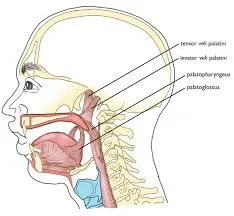
It doesn't matter how recessed someone is, you should always be able to breath with proper tongue posture if you can breath through the nose properly without tongue posture. You should not push with the tongue against the soft palate, there's no point in doing so, however if you engage the palatoglossus the tongue will touch against the soft palate, but not push, this is because the palatoglossus itself is attached to the soft palate.
There's two reasons someone can't breath because of mewing :
1) (Highly Likely) You're mewing as if you're swallowing, tensing the levator palatini muscle, blocking the nasal airway by pulling the soft palate upwards.
2) You're tensing the styloglossus too hard. I think this is very unlikely as the genioglossus is antagonistic of the styloglossus.
https://www.youtube.com/watch?v=eh9OqEd5z1k
Picture of the levator palatini muscle :