This post is an extension to a question I have been asking for some years now: how to properly close the jaws? There is going to be quite a lot of information and I'm not sure of my ability to present it so that everyone will grasp the idea, so feel free to ask if some part seems unclear.
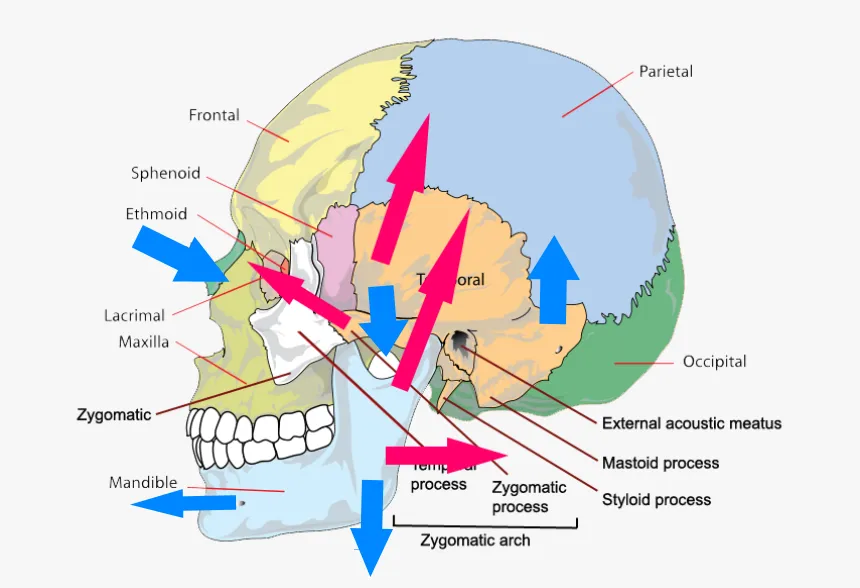
To begin, it appears evident that there are two major vectors along which the teeth can be brought together, created by the masseters and the temporalis respectively.
The assertion I am going to make is that the temporal pattern, rather than the masseter pattern, is responsible for proper sagittal positioning & development of the jaws. My premises for making this assertion are following:
1. With masseters being attached to the mandible and the zygomatic arch, there is no leverage with which the maxilla could be positively affected by masseters. In other words, masseters exist within a closed system that is unable to affect anything outside the mandible and the zygos.
2. Due to the above point, hypertrophy of the masseters does not seem to reverse ante-gonial notch. Opposite happens: as masseter hypretrophy builds up bone mass in the gonion, depth of the notch tends to increase.
3. The temporalii are recognized by physiotherapists and other professionals of that nature as postural muscles. As such, they are the only muscles of mastication recognized as having postural importance. Since form follows function, they are likely to be the only muscles of mastication that are responsible for facial form.
4. The temporalii, by leveraging the mandibular arch against the maxillary arch, create a long axis between the temporal bone and the palate, so that the maxilla gets trapped between the compressing forces of temporal muscle and mandible.
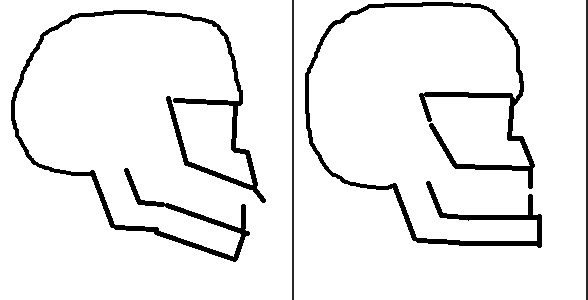
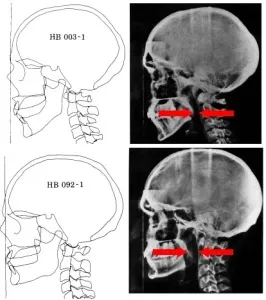
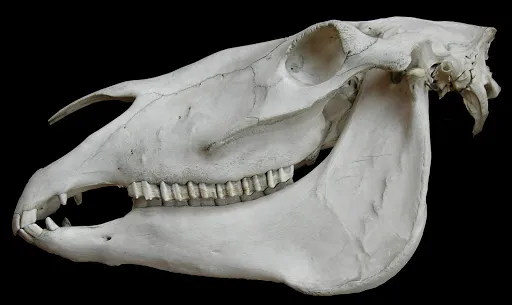
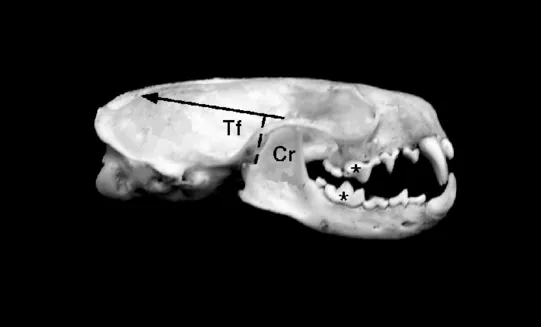
In order to demonstrate the importance of having active temporal pattern, refer to the following pics. Slack in the temporal pattern results in lengthening of the face along the temporal vector (temporal-palate axis):
In addition, lengthening of the temporal axis results in relative compression of the masseter-zygomatic axis because the masseter pattern is now dominating the temporal pattern:
As the gonion and the zygos pull toward each other, and the temporal bone and the maxilla drift away from each other, we see appearance of ante-gonial notch, dorsal hump, increased gonial angle, receding chin, convexity and other classic symptoms of craniofacial dystrophy.
At the opposite end, well functioning temporal pattern results in shortening of the face along the temporal-palate axis and relative decompression of the masseter-zygomatic axis:
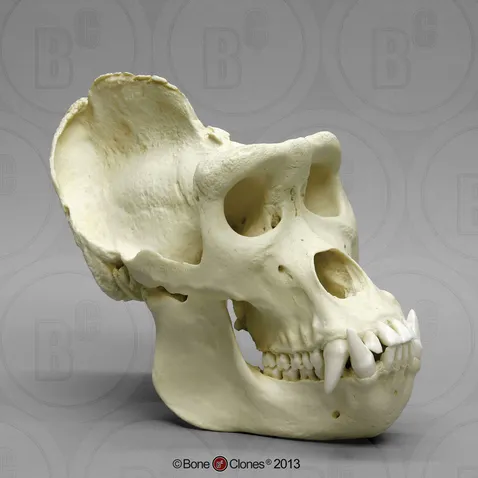
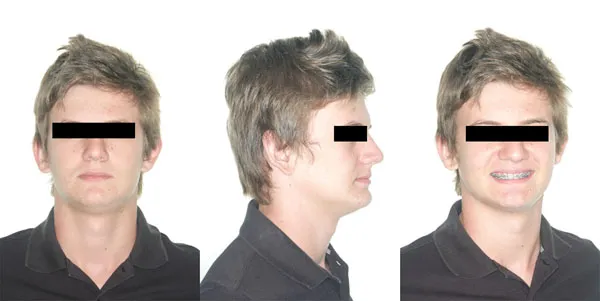
This results in a backward and upward positioning of the maxilla, which in turn allows the jawline to straighten out, the chin to project more and the profile to lose its protruding convex shape, creating an illusion of reduced mid-face length (while likely also increasing facial width). The resulting difference would be a bit similar to this.
It should also happen that proper activation of the temporal pattern guides the lengthwise development of mandible by virtue of the maxillary and mandibular molars pushing each other against opposite directions, the latter forward and the former backward:
Given the differences between temporal and masseter patterns, keeping the teeth together may not be as simple as doing just that. Rather, the teeth have to make contact in accordance to a specific vector, that is, the temporal vector. This is likely why John Mew emphasizes molar contact, because with active temporal pattern, strong molar contact is precisely what ends up happening, where as with active masseter pattern the forces of the bite seem to want to shift towards the anterior teeth. While there is nothing wrong with chewing with the masseters (after all that is their natural role), I suggest that one returns to gently engaging the temporalii after there is no more need for mastication, so that the proper postural functioning of the jaws can be regained.
Very interesting take. I have a couple of questions I was hoping you could clarify:
1. How does this theory account for the reduced dental arch length (lack of space for wisdom teeth) that we observe in CFD? And would temporalis pattern remedy the situation and make room for the wisdom teeth?
2. What's the role of the tongue that you suggest? Lightly suctioning in the back? Pushing upwards? Anterior vs posterior engagement? I notice that on the mandible, we have forces acting on it from the masseter pushing it up and forwards, and from the temporalis pushing it up and backwards. Consequently, we need some balancing force pushing downwards. This could come either from the tongue, pushing on the roof of the mouth, or the immediate dental forces of teeth resting against each other, or some combination. That being said, I don't think anyone is advocating for clenching.
And also, could you elaborate on the specifics of how to engage the temporalis vs the masseter, both when chewing and when at rest?
Sorry to bombard you with so many questions, but this theory is very interesting to me. I definitely agree that the masseter-zygo axis is overly compressed in most everyone, but I don't think this is because our masseters are suddenly more active than our ancestors. I think the masseters are just more active than the temporalis, but still both muscles are less active than in our ancestors. This is likely due, like you said, to improper chewing pattern and resting pattern.
Also, I think this theory accounts for Mew's observation in gonial angle changes that the relative distance between the pogonion and the condyle is constant. The compression along the masseter-zygo axis would not affect that distance, but rather the angle of the mandible, as the masseter's insertion point is at the angle/bottom of the ramus.
In another thread I was just mentioning that it may be more important to keep the incisors in contact versus the molars. Wouldn't this type of bite activate the temporal pattern more? For me, a strong incisor type of bite has been a natural byproduct of mewing. Of course if I had a healthy and normal oral structure, the incisors and the molars would all connect evenly.
When I was chewing gum a moment ago, it seemed like the masseters were less active when I chewed the gum with the front teeth. Perhaps that is a way to activate the temporal pattern?
Very interesting take. I have a couple of questions I was hoping you could clarify:
Great questions. I'll address them one by one:
1. How does this theory account for the reduced dental arch length (lack of space for wisdom teeth) that we observe in CFD? And would temporalis pattern remedy the situation and make room for the wisdom teeth?
Several possibilities come to mind:
1. the responsibility of dental arch development lies solely with the tongue's ability to expand the palate
2. teeth contact in accordance with the temporal pattern causes each molar to mechanically "squeeze" the next molar behind it out of the gum, at least when it comes to the maxilla. For mandible, simply gaining room in the posterior alveolar process by having the molars pushed forward could be enough to allow for eruption to take place.
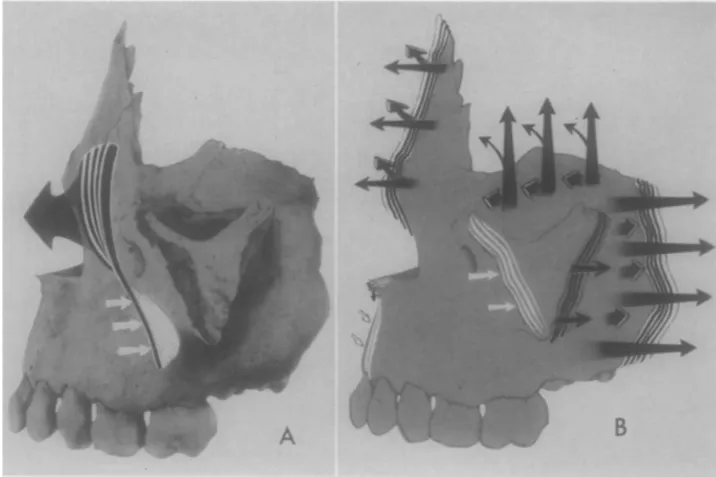
3. since for cranio-facial bones remodeling occurs by resorption at one place and subsequent deposition at another place (see picture below), it could happen that activating the temporal pattern creates a specific kind of resorption/deposition pattern that ultimately results in additional bone growth in the posterior alveolar process.
2. What's the role of the tongue that you suggest? Lightly suctioning in the back? Pushing upwards? Anterior vs posterior engagement? I notice that on the mandible, we have forces acting on it from the masseter pushing it up and forwards, and from the temporalis pushing it up and backwards. Consequently, we need some balancing force pushing downwards. This could come either from the tongue, pushing on the roof of the mouth, or the immediate dental forces of teeth resting against each other, or some combination. That being said, I don't think anyone is advocating for clenching.
This is still a little unclear. For me, suctioning in the back does seem to complement the temporal pattern very well, lip suction too. Pushing with the tip of the tongue, however, feels awkward. I think the weight of the head acts as the kind of balancing downwards force you mention. It's essentially this that the temporal pattern together with tongue seeks to counter.
And also, could you elaborate on the specifics of how to engage the temporalis vs the masseter, both when chewing and when at rest?
If you are asking how to engage temporalis in practice, I visualize it as biting up and backward with the mandible, so that the premolars and molars lock against each other. Of course though, when you are actually chewing something, both muscles will be activated by default and it would be very difficult to completely isolate either one.
For the most part, the scope of my post concerns default posture, i.e. the one you would hold during waking hours. How you chew is probably of lesser significance, so you should feel free to chew however feels natural to you. I'm inclined to think that the jaws are designed so that no major structural movements would occur during chewing, and that instead the jaws would seek to preserve the existing form during mastication. Having said that, it's probably worth experimenting with masseter-dominant and temporalis-dominant chewing alike and see how your occlusion feels afterwards.
I definitely agree that the masseter-zygo axis is overly compressed in most everyone, but I don't think this is because our masseters are suddenly more active than our ancestors. I think the masseters are just more active than the temporalis, but still both muscles are less active than in our ancestors. This is likely due, like you said, to improper chewing pattern and resting pattern.
Ah yes, I agree, it's about relative activity, that part may have been a bit unclear.
Also, I think this theory accounts for Mew's observation in gonial angle changes that the relative distance between the pogonion and the condyle is constant. The compression along the masseter-zygo axis would not affect that distance, but rather the angle of the mandible, as the masseter's insertion point is at the angle/bottom of the ramus.
In another thread I was just mentioning that it may be more important to keep the incisors in contact versus the molars. Wouldn't this type of bite activate the temporal pattern more? For me, a strong incisor type of bite has been a natural byproduct of mewing. Of course if I had a healthy and normal oral structure, the incisors and the molars would all connect evenly.
When I was chewing gum a moment ago, it seemed like the masseters were less active when I chewed the gum with the front teeth. Perhaps that is a way to activate the temporal pattern?
You can try which pattern is activated by putting your thumbs on the masseters and other fingers on the temporalii, then biting a little harder so that the muscles activate properly. It may be that the theory plays out a little differently depending on one's type of occlusion. In my case, chewing with the front teeth (be it edge-to-edge or side-to-side) results in almost pure masseter activation. I have deep overbite with class 3 molar relationship, which is kind of a contradictory classification since class 3 usually equals underbite. Incisor contact just never really worked out for as much as it made sense on an intuitive level.
From my personal observations with myself, temporalis activation seems to be linked with my mandibles position in the skull. My jaw is quite set back and results in a very active and strong temporalis that gave me headaches. When I mew with my jaw jutted forward however I get more masseter activity in ratio and less pressure in my skull from temporalis activation. This has helped a lot with my headaches. And shows me functionally that my maxilla needs to come forward if I dont want a Tyler1 head
By the logic of this theory I may very well have recessed myself with my temporal meat smh
@Progress With an abundance of people (men, especially) who have proper facial development and yet have unimpressive dental arches, would you say this temporal activation could be more important than tongue posture?
I've been trying it for a few hours and my midface was burning after a while. It seems like cuspids and premolars together is where the pressure happens for me, and I felt like expansion needed to happen in this area more than gaining further intermolar space, so it's promising to get a response there. My bite is class 2 div 1, which echos what you said about incisor contact being intuitive (because these teeth have never touched each other) but not doing anything.
@Progress With an abundance of people (men, especially) who have proper facial development and yet have unimpressive dental arches, would you say this temporal activation could be more important than tongue posture?
I've been trying it for a few hours and my midface was burning after a while. It seems like cuspids and premolars together is where the pressure happens for me, and I felt like expansion needed to happen in this area more than gaining further intermolar space, so it's promising to get a response there. My bite is class 2 div 1, which echos what you said about incisor contact being intuitive (because these teeth have never touched each other) but not doing anything.
I suspect John Mew is right when he states that the tongue creates expansion and that teeth contact determines jaw positioning. One would not necessarily more important than the other, rather they are responsible for different (lateral vs sagittal) aspects of facial development. The cuspids and premolars are where the strongest point of contact is for me too. Usually, after remembering to maintain this position for an hour or so, my overbite feels a little less deep judging by the amount of internal surface of the upper incisors that the lower incisors allow to be palpated.
From my personal observations with myself, temporalis activation seems to be linked with my mandibles position in the skull. My jaw is quite set back and results in a very active and strong temporalis that gave me headaches. When I mew with my jaw jutted forward however I get more masseter activity in ratio and less pressure in my skull from temporalis activation. This has helped a lot with my headaches. And shows me functionally that my maxilla needs to come forward if I dont want a Tyler1 head
By the logic of this theory I may very well have recessed myself with my temporal meat smh
There likely are unhealthy extremes for both activation patterns. In addition, head and neck posture should also influence the nature of forces that each pattern generates throughout the skull. Temporalis activation with loose forward head posture could well do more harm than good. I try to combine the temporalis pattern with gentle chin tucking and neck elongation, since all three of these are generally viewed as natural parts of the spinal postural chain.
I suspect John Mew is right when he states that the tongue creates expansion and that teeth contact determines jaw positioning. One would not necessarily more important than the other, rather they are responsible for different (lateral vs sagittal) aspects of facial development. The cuspids and premolars are where the strongest point of contact is for me too. Usually, after remembering to maintain this position for an hour or so, my overbite feels a little less deep judging by the amount of internal surface of the upper incisors that the lower incisors allow to be palpated.
Once the overbite is set in development it's hard as hell to change it back to its proper form. Where what feels "natural" is just a feedback loop enforcing bad habits. Where pressures should be more or less equal across all teeth, we find ourselves with molar contact with nothing to show for the front canines and incisors. This is my case especially and I believe it is mostly responsible for lack of forward projection for myself and many users, where is seems like the maxilla has folded into a higher angle, where the belief is that the palate should be relatively flat. Instead of needing "new growth" what we really need is to unfold the maxilla thus solving the problem of "deep bites" we see everywhere. This would also include a very considerable amount of midface protrusion, where the teeth from the side profile are sightly ahead of the nasion as seen in the most attractive people, and if you notice their bites, its almost always close to the ideal, almost an edge to edge bite.
Form follows function, and when the front maxilla and its teeth arent functional, our body neglects them, as they are unneeded. And our muscles follow suit with compensations. Taking a functional approach to these issues seems beneficial, and I'll share an exercise that could be very helpful.
Get a flannel or a towel, roll it up, and bite into it with the whole front complex of your dentition, apply as much pressure as youre comfortable with, "chew" it. I have experiences strong sensations around all the areas I am deficient in namely, around my nose, under my eyes and in my inner zygos. Right at the sutural connections. You can apply some pull to further simulate how the front teeth were intended to be used.
I think it's likely that proper muscular use in the temporalis and masseter will come naturally once the framework they're attached to are in full functional order. Once the teeth connect to eachother from the molars to incisors, and once the tongue slots into the roof of the mouth like they were made for eachother. It's just so damn difficult to achieve these things when your body has programmed itself to your lifelong habits. Dysfunctional chewing forces may be of significant importance in skull form. This comes back to Progress' central point
In another thread I was just mentioning that it may be more important to keep the incisors in contact versus the molars. Wouldn't this type of bite activate the temporal pattern more? For me, a strong incisor type of bite has been a natural byproduct of mewing. Of course if I had a healthy and normal oral structure, the incisors and the molars would all connect evenly.
When I was chewing gum a moment ago, it seemed like the masseters were less active when I chewed the gum with the front teeth. Perhaps that is a way to activate the temporal pattern?
You can try which pattern is activated by putting your thumbs on the masseters and other fingers on the temporalii, then biting a little harder so that the muscles activate properly. It may be that the theory plays out a little differently depending on one's type of occlusion. In my case, chewing with the front teeth (be it edge-to-edge or side-to-side) results in almost pure masseter activation. I have deep overbite with class 3 molar relationship, which is kind of a contradictory classification since class 3 usually equals underbite. Incisor contact just never really worked out for as much as it made sense on an intuitive level.
I made the mistake of saying incisors, when I really should have presented the possible importance of the canines meeting together. I would say that is where the majority of the bite pressure is for me. It seems like exerting more bite force in the front of the mouth would create more facial upswing. I think the canines also play an important in stabilizing the side to side movement of the jaw.
It is interesting to think about how different types of bites activate different muscles, but the concept is little confusing to me. There is only one way I can close my teeth together comfortably, and I think it may be important to allow proper tongue posture and swallowing pattern to naturally move the jaw into the correct position. Then again, my myobrace moves my lower jaw forward so that my incisors are aligned. But keeping that alignment without it on, feels totally unnatural at the moment.
Get a flannel or a towel, roll it up, and bite into it with the whole front complex of your dentition, apply as much pressure as youre comfortable with, "chew" it
Facepulling as I understand it is hooking the edge of a towel behind the back of the last molars at the maxilla, biting down and pulling in the hopes of disarticulating sutures and pulling everything forward. I've experimented with this and don't recommend it, I think its too forceful and potentially damaging.
This exercise is functional force applied to the front maxilla and teeth that encourages natural ripping, tearing and cutting movements that the front teeth and skull were designed for, with intention that over time the skull adapts to this new function. And you dont need to use a towel. You can rip into a slab of meat If you want to be a true neolithic naturalist, but a towel or flannel works just fine.
It's only pulling in the respect that humans without a knife and fork would bite and pull on tough foods, which is what I'm trying to emulate. Its the first part of the process of eating, without the molar use and subsequent bolus and swallow, which I believe many of us are deficient as most of our food is too soft or cut up for us, so we only really need to use the molars. Resulting in overbite from under utilized incisors and canines.
Realistically a consistent molar contact is found in many short faced people. But they also have overbites and flat/weak profiles where the teeth in profile are significantly behind the nasion and the lower third is weak. In other words, the consistent molar pressure prevented the skull from growing down the way it needs to. These bites may even come with a wide skull, but often they come with vertical deficiency.
This is why I am a proponent of chewing with all teeth.
Realistically a consistent molar contact is found in many short faced people. But they also have overbites and flat/weak profiles where the teeth in profile are significantly behind the nasion and the lower third is weak. In other words, the consistent molar pressure prevented the skull from growing down the way it needs to. These bites may even come with a wide skull, but often they come with vertical deficiency.
This is why I am a proponent of chewing with all teeth.
If the temporal pattern being activated is upwards, how would that encourage the maxilla to move down? (in terms of remodelling as an adult, that is) Deficient lower thirds in people with short faces need to elongate, though, I agree.
Once the overbite is set in development it's hard as hell to change it back to its proper form. Where what feels "natural" is just a feedback loop enforcing bad habits. Where pressures should be more or less equal across all teeth, we find ourselves with molar contact with nothing to show for the front canines and incisors. This is my case especially and I believe it is mostly responsible for lack of forward projection for myself and many users, where is seems like the maxilla has folded into a higher angle, where the belief is that the palate should be relatively flat. Instead of needing "new growth" what we really need is to unfold the maxilla thus solving the problem of "deep bites" we see everywhere. This would also include a very considerable amount of midface protrusion, where the teeth from the side profile are sightly ahead of the nasion as seen in the most attractive people, and if you notice their bites, its almost always close to the ideal, almost an edge to edge bite.
Form follows function, and when the front maxilla and its teeth arent functional, our body neglects them, as they are unneeded. And our muscles follow suit with compensations. Taking a functional approach to these issues seems beneficial, and I'll share an exercise that could be very helpful.
Get a flannel or a towel, roll it up, and bite into it with the whole front complex of your dentition, apply as much pressure as youre comfortable with, "chew" it. I have experiences strong sensations around all the areas I am deficient in namely, around my nose, under my eyes and in my inner zygos. Right at the sutural connections. You can apply some pull to further simulate how the front teeth were intended to be used.
I think it's likely that proper muscular use in the temporalis and masseter will come naturally once the framework they're attached to are in full functional order. Once the teeth connect to eachother from the molars to incisors, and once the tongue slots into the roof of the mouth like they were made for eachother. It's just so damn difficult to achieve these things when your body has programmed itself to your lifelong habits. Dysfunctional chewing forces may be of significant importance in skull form. This comes back to Progress' central point
Agree about the towel method. I have used it intermittently and it does stimulate the whole anterior maxilla. According to the following stress simulation, loading the canines creates the largest maxillary strain of all teeth (possibly due to residing right at the premaxillary suture?), which ties well with @shakti_om 's thoughts:
Realistically a consistent molar contact is found in many short faced people. But they also have overbites and flat/weak profiles where the teeth in profile are significantly behind the nasion and the lower third is weak. In other words, the consistent molar pressure prevented the skull from growing down the way it needs to. These bites may even come with a wide skull, but often they come with vertical deficiency.
This is why I am a proponent of chewing with all teeth.
If the temporal pattern being activated is upwards, how would that encourage the maxilla to move down? (in terms of remodelling as an adult, that is) Deficient lower thirds in people with short faces need to elongate, though, I agree.
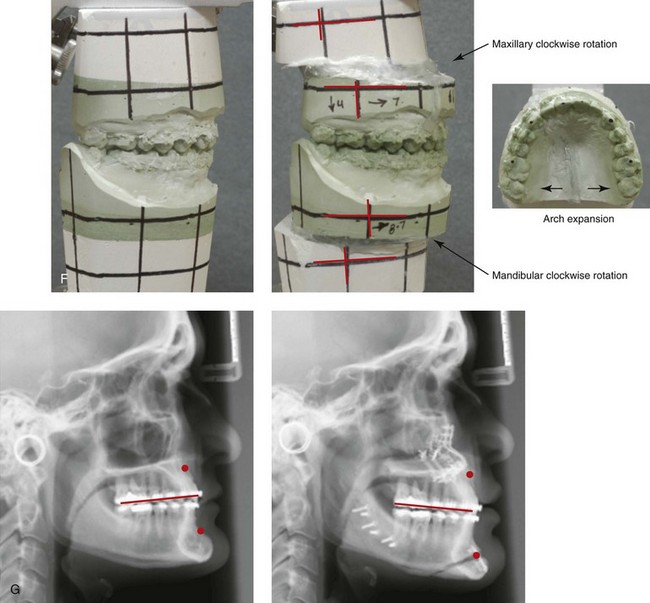
What is a short face, really? Google gives scarce results on this topic. I found one site with several cases that were labelled as "short face growth pattern" -- but here is the catch: the treatment consisted of rotating the jaws clockwise, which paradoxically is what @eddiemoney says should already have taken place naturally due to the excessive molar contact that short-faced people have. The question is, why does excessive molar contact result in CCW rotation?
So in some sense, the temporalii and masseters could be thought of as antagonistic muscles, in that an imbalance in either of them affects the other and messes up the system. Perhaps that can be used to explain “short-faced” people who have low gonial angle? A different type of imbalance?
So in some sense, the temporalii and masseters could be thought of as antagonistic muscles, in that an imbalance in either of them affects the other and messes up the system. Perhaps that can be used to explain “short-faced” people who have low gonial angle? A different type of imbalance?
Yes, something like that. Not fully antagonistic, but clearly serving separate purposes.
To @shakti_om and others who were having difficulties isolating the two patterns from each other, I realized that instead of being defined as just up-forward or up-backward motion, the difference between the patterns is perhaps more accurately defined as horizontal vs vertical motion. The masseter, with its origin residing between the TM joints, can mostly only engage vertically. Temporalis, with its origin residing outside the TM joints, can also engage horizontally. This horizontal motion takes place when you grind sideways with your teeth. I am just trying it with a rolled up sock and it feels... nice. Grinding back and forth from side to side, roots of the teeth become sore fast, hinting towards a strain pattern that the teeth are not accustomed to. It may be that such sideways grinding motion is something that many are lacking in their mastication pattern, unwittingly opting for the vertical-dominant crushing motion of the masseters instead, thus ending up with deeper bites.
Also, I wonder what the optimal duration and force of engaging the temporal pattern during resting posture is. Is it simply a matter of strengthening the temporalii if they’re weak due to underutilization during mastication, and the duration doesn’t especially matter? I suspect like most other bone-related movements, a sufficient duration would be important as well as strengthening them.
As for force, I’ve found that a slight clenching is best for me to engage the temporalii, but this might just be because my temporalii are especially weak. It might vary for the individual. But I don’t think this is sustainable for me in the long term, if it’s always going to require some clenching-I’m worried about this leading to tooth wear or bruxism. And I know that more than 4-8 hours of teeth together leads to dental intrusion. Hopefully as the muscles strengthen, less time and force might be needed as the temporalii will be able to exert more force without needing to have my teeth clenching as hard.
Are any of you getting any feelings from this? During a 1-2 hour session, I sometimes (it’s happened thrice now) get feelings from within my skull, right above the back of mouth, right above the center of your soft palate. Like something’s trying to come down or move around. It might be where the temporalis muscle connects to the maxilla, and as the muscle’s strengthening, I get this feeling. Also, I sometimes get sensations on the left side of my skull/scalp, leading me to believe the left temporalis might be more underdeveloped.
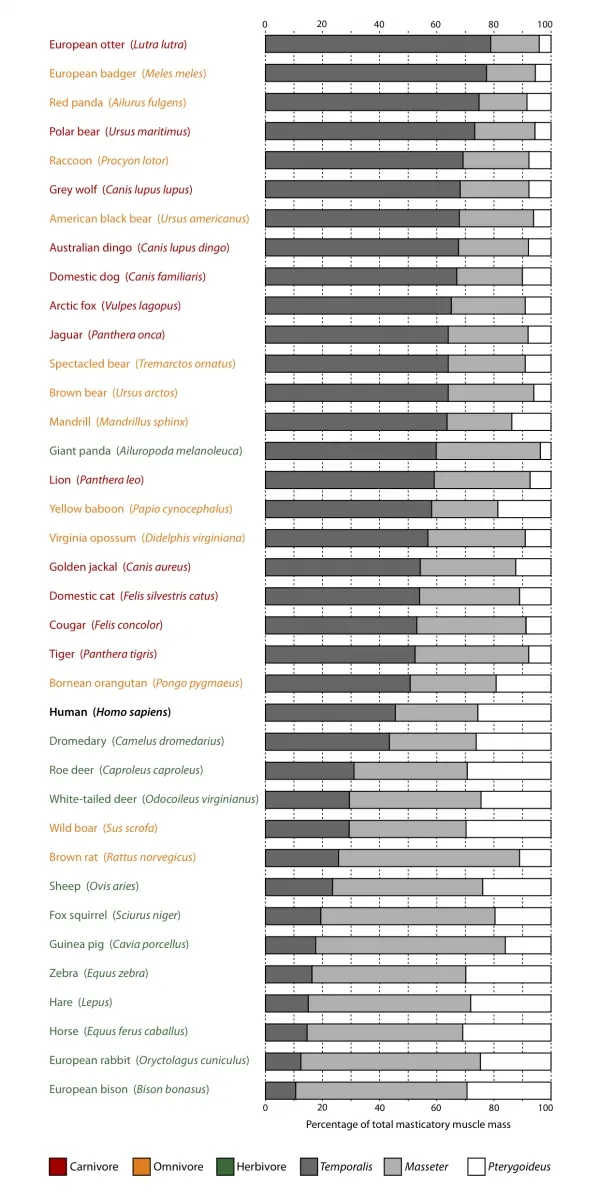
Found an interesting study that affirms the premises of this thread. A couple of bits:
An orthognathic[=normal] maxilla is also present in individuals with a large temporalis muscle proportion, suggesting a key role of the form of the maxilla in the production and resistance of masticatory loads.
...a large temporalis proportion is associated with a relatively antero-posteriorly elongated neurocranium and mandibular ramus, wider upper face and less prognathic, narrower, vertically shorter maxilla compared to those individuals with small temporalis proportions
...there is evidence of a weak relationship between temporalis muscle CSA and skull and face shape that is at least consistent with the location, anatomy and function of this muscle and anatomical space required to accommodate it.
Thus, Weijs and Hillen (1986) have also noted that temporalis and masseter CSA appear to be positively correlated with facial width. With regard to the relationship found between a relatively small temporalis proportion and a vertically elongated skull and face, van Spronsen (2010) noted such an association and suggested that a long face is the result of a diminished muscle force
Interestingly, increased temporalis proportion was also associated with more narrow palates, though this relationship was deemed more inconclusive than the other more positive aspects of large temporalis proportion:
In relation to the relationship suggested by the present analyses between larger temporalis proportion and narrower maxillae, there are few and inconclusive studies addressing the mechanical impact of variations in maxillary width on masticatory mechanics. In women, a wide dental arch has been noted to be associated with a (medio-laterally) thicker masseter (Kiliaridis et al., 2003), whereas no relationship between bite force and dental arch width was found in pre-adolescents (Sonnesen and Bakke, 2005). It should be borne in mind, however, that a combination of an orthognathic, less prognathic and wide maxilla at the posterior teeth (and vice versa) may result in deviations from the normally found elliptic–parabolic (in rough terms) maxillary arch (Burris and Harris, 2000; Ferrario et al., 1994), and therefore a narrowmaxilla in individuals with a large temporalis proportion may not necessarily be functionally significant
So in some sense, the temporalii and masseters could be thought of as antagonistic muscles, in that an imbalance in either of them affects the other and messes up the system. Perhaps that can be used to explain “short-faced” people who have low gonial angle? A different type of imbalance?
Yes, something like that. Not fully antagonistic, but clearly serving separate purposes.
To @shakti_om and others who were having difficulties isolating the two patterns from each other, I realized that instead of being defined as just up-forward or up-backward motion, the difference between the patterns is perhaps more accurately defined as horizontal vs vertical motion. The masseter, with its origin residing between the TM joints, can mostly only engage vertically. Temporalis, with its origin residing outside the TM joints, can also engage horizontally. This horizontal motion takes place when you grind sideways with your teeth. I am just trying it with a rolled up sock and it feels... nice. Grinding back and forth from side to side, roots of the teeth become sore fast, hinting towards a strain pattern that the teeth are not accustomed to. It may be that such sideways grinding motion is something that many are lacking in their mastication pattern, unwittingly opting for the vertical-dominant crushing motion of the masseters instead, thus ending up with deeper bites.
That's probably why bruxism patients are sometimes cited as having great facial appearances. I assume there would still be some kind of "balance" kept with excessive usage of both areas if the person already has a class 1 occlusion (a habit formed in childhood, in that case), compared to those who are grinding with only their masseters while in a malocclusion. I tried mild side to side clenching a few months ago and had early beneficial feelings that quickly reversed into discomfort; it was likely 90% masseter activation because my bite felt deeper.
I'm not advocating bruxism at all, to clarify.
I think the side to side mastication is hard to get with overbites/overjets because even doing it with molars feels mostly like a masseter response.
@qwerty135 For the past two days, I'll lay in bed on my side and hear a couple of cracks in my skull after having spent the prior hours activating the temporal area. I also get an intermittent buzzing sensation behind my nose throughout the day when doing it.
Also, I wonder what the optimal duration and force of engaging the temporal pattern during resting posture is. Is it simply a matter of strengthening the temporalii if they’re weak due to underutilization during mastication, and the duration doesn’t especially matter? I suspect like most other bone-related movements, a sufficient duration would be important as well as strengthening them. As for force, I’ve found that a slight clenching is best for me to engage the temporalii, but this might just be because my temporalii are especially weak. It might vary for the individual.
You are probably right. In the study I posted above, it was said that when there was a correlation between a small temporalis and an elongated face, the muscle consisted of slow-twitch fibers, i.e. it was geared for strength but not stamina. This suggests that there has to be some level of engagement throughout the day in order to reap benefits. I think that once you have established a good mind-muscle connection between the temporalis & the rest of your postural musculature, the force will be automatically determined by your physical needs during any activity. I'm noticing that a certain amount of firmness is needed to stabilize the neck during swift head movements.
But I don’t think this is sustainable for me in the long term, if it’s always going to require some clenching-I’m worried about this leading to tooth wear or bruxism. And I know that more than 4-8 hours of teeth together leads to dental intrusion. Hopefully as the muscles strengthen, less time and force might be needed as the temporalii will be able to exert more force without needing to have my teeth clenching as hard.
What feels like clenching now will probably feel like mere firm contact later on. It's the muscle that is working hard, not the enamel. Likely tongue suction and intra-oral vacuum should also balance the load a little so that you won't find yourself clenching excessively. Since It is said that teeth are the strongest bones in the body, I think that it is going to require deliberate strenuous clenching and grinding in order to wear them down. Simple firm contact is likely exactly what they were made to withstand. Caution and common sense are of course virtues though.
Are any of you getting any feelings from this? During a 1-2 hour session, I sometimes (it’s happened thrice now) get feelings from within my skull, right above the back of mouth, right above the center of your soft palate. Like something’s trying to come down or move around. It might be where the temporalis muscle connects to the maxilla, and as the muscle’s strengthening, I get this feeling. Also, I sometimes get sensations on the left side of my skull/scalp, leading me to believe the left temporalis might be more underdeveloped.
Does it feel like a temporary change in pressure, as if something was about to unwind? If so I have felt it too.
Are any of you getting any feelings from this? During a 1-2 hour session, I sometimes (it’s happened thrice now) get feelings from within my skull, right above the back of mouth, right above the center of your soft palate. Like something’s trying to come down or move around. It might be where the temporalis muscle connects to the maxilla, and as the muscle’s strengthening, I get this feeling. Also, I sometimes get sensations on the left side of my skull/scalp, leading me to believe the left temporalis might be more underdeveloped.
Does it feel like a temporary change in pressure, as if something was about to unwind? If so I have felt it too.
Yes, like something is trying to unfurl from within my skull. It feels weird, almost like somethings caught in my throat, but it's not in my throat, instead it's a little higher. I never get the feeling of satisfaction that it has unfurled. I sometimes get the same sensation when I pull lightly on my maxilla with my thumbs, but very rarely does it happen.
So in conclusion, temporalis activity correlates with:
longer ramus
longer skull
shorter maxilla
wider face
(narrower maxilla)
But are these necessarily ideal scenarios from an aesthetics standpoint? These skulls would lack vertical height and would have less lip support with an overall less forward maxilla. This just creates a profile where the chin is strong, but the upper lip has 0 projection. Aka the profile of many people who Mew to get "upswing". When in reality these maxillae need to grow more downward to achieve balance between soft tissue and bony prominence. That orthognathic profile in reality could just have face that is too vertically short due to no maxilla height.
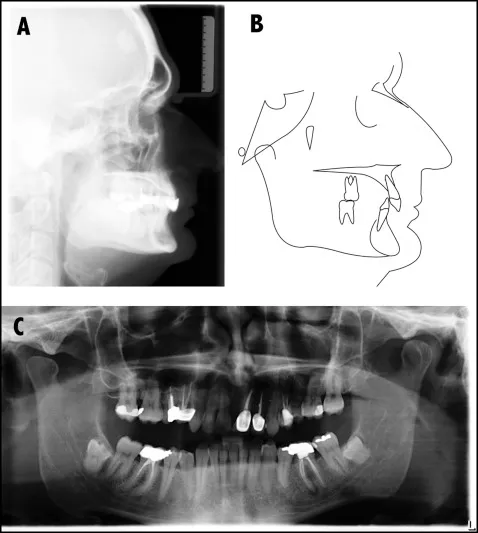
Classic short face profile. Notice the low near 90° genial angle. Like I said above, these skulls can have width, but sometimes they need length. We're just moving in another direction toward somr sort of shorter faced ideal. But really it's all about balance. A "neutral maxilla". Not short nor long but ideal development. Sometimes the lack of lip support in maxillae that are too short creates a too long philtrum, too.
So in conclusion, temporalis activity correlates with:
longer ramus
longer skull
shorter maxilla
wider face
(narrower maxilla)
But are these necessarily ideal scenarios from an aesthetics standpoint? These skulls would lack vertical height and would have less lip support with an overall less forward maxilla. This just creates a profile where the chin is strong, but the upper lip has 0 projection. Aka the profile of many people who Mew to get "upswing". When in reality these maxillae need to grow more downward to achieve balance between soft tissue and bony prominence. That orthognathic profile in reality could just have face that is too vertically short due to no maxilla height.
[attach]1231[attach]
Classic short face profile. Notice the low near 90° genial angle. Like I said above, these skulls can have width, but sometimes they need length. We're just moving in another direction toward somr sort of shorter faced ideal. But really it's all about balance. A "neutral maxilla". Not short nor long but ideal development. Sometimes the lack of lip support in maxillae that are too short creates a too long philtrum, too.
These would be beneficial improvements for those suffering from the long face growth pattern, which I understand to be majority of CFD cases, since sedentary lifestyle should encourage slackjaw more than it encourages clenching. As of now, it's hard to conclude what exactly causes the short face pattern. Leaning too hard into the temporalis pattern? Temporalis pattern with poor posture? Other kind of clenching with poor posture? Wrong combination of jaw & tongue action, as suggested by @noises? And so on. Hopefully experimentation by us in this thread will shed some light on this.
One possible solution is that those with a short face pattern should engage their masseters more in order to create the kind of CW rotation that was surgically given to patients in the link I posted above. From studies like this we know that with masseter development anterior maxilla shifts downwards, which could bring one closer to that balance between soft tissue and bony prominence that you mention. I agree that it is about balance (neutral maxilla in my view is synonymous to orthognathic maxilla).
So in conclusion, temporalis activity correlates with:
longer ramus
longer skull
shorter maxilla
wider face
(narrower maxilla)
But are these necessarily ideal scenarios from an aesthetics standpoint? These skulls would lack vertical height and would have less lip support with an overall less forward maxilla. This just creates a profile where the chin is strong, but the upper lip has 0 projection. Aka the profile of many people who Mew to get "upswing". When in reality these maxillae need to grow more downward to achieve balance between soft tissue and bony prominence. That orthognathic profile in reality could just have face that is too vertically short due to no maxilla height.
[attach]1231[attach]
Classic short face profile. Notice the low near 90° genial angle. Like I said above, these skulls can have width, but sometimes they need length. We're just moving in another direction toward somr sort of shorter faced ideal. But really it's all about balance. A "neutral maxilla". Not short nor long but ideal development. Sometimes the lack of lip support in maxillae that are too short creates a too long philtrum, too.
These would be beneficial improvements for those suffering from the long face growth pattern, which I understand to be majority of CFD cases, since sedentary lifestyle should encourage slackjaw more than it encourages clenching. As of now, it's hard to conclude what exactly causes the short face pattern. Leaning too hard into the temporalis pattern? Temporalis pattern with poor posture? Other kind of clenching with poor posture? Wrong combination of jaw & tongue action, as suggested by @noises? And so on. Hopefully experimentation by us in this thread will shed some light on this.
One possible solution is that those with a short face pattern should engage their masseters more in order to create the kind of CW rotation that was surgically given to patients in the link I posted above. From studies like this we know that with masseter development anterior maxilla shifts downwards, which could bring one closer to that balance between soft tissue and bony prominence that you mention. I agree that it is about balance (neutral maxilla in my view is synonymous to orthognathic maxilla).
I don't know that most CFD sufferers have long faces. Most I have seen posted on this forum have short lower thirds, and overall flat orthognathic profiles and Class 2 relationships. In fact it seems many people that Mew think their face is long, when in reality their middle third seems too long compared to the lower third.
And while I agree that an orthognathic profile where upper and lower jaws are aligned with proper occlusion is neutral (as opposed to prognathic or worse retrognathic), I don't know that a short vertical height is necessary to achieve an aesthetic balance. Being that adult jaws grow forward and downward, a short vertical maxilla may be lacking in a bit of downward growth and can make the face look too short and compressed.
Also do you know how a Class 3 person can engage their temporalis more? My wisdom teeth can't touch each other due to being Class 3.
In my case I feel temporalis activation when I jut my jaw forwards and bite with less with my molars and more with my canines. I have open bite and deep bite so the only way i have to bite with my front teeth is to jut my jaw forwards. Also this helps me with the sucktion hold.
Do you think permanently closing my mouth by jutting my jaw forwards is beneficial? I have a slight overbite and my side profile looks way better when i jut.
Also do you know how a Class 3 person can engage their temporalis more? My wisdom teeth can't touch each other due to being Class 3.
I can only speak for myself as a Class 3, but I’ve found that biting upwards and backwards with the premolars and canines allows me to engage the temporalii without engaging the masseters. In contrast, biting with the molars that do touch (1st molars and right side 2nd molars) leads to strong masseter usage. So I really do think it depends on the occlusion of the individual. Try to bite upwards and backwards, and see if you can move your teeth around so that temporalii but not masseters are activated. If it’s not the molars but some other teeth that feel pressure, it should be fine considering every individual has teeth that have erupted differently.
Also do you know how a Class 3 person can engage their temporalis more? My wisdom teeth can't touch each other due to being Class 3.
I can only speak for myself as a Class 3, but I’ve found that biting upwards and backwards with the premolars and canines allows me to engage the temporalii without engaging the masseters. In contrast, biting with the molars that do touch (1st molars and right side 2nd molars) leads to strong masseter usage. So I really do think it depends on the occlusion of the individual. Try to bite upwards and backwards, and see if you can move your teeth around so that temporalii but not masseters are activated. If it’s not the molars but some other teeth that feel pressure, it should be fine considering every individual has teeth that have erupted differently.
How do you bite backwards with canines? Retract your jaw as you bite?
These would be beneficial improvements for those suffering from the long face growth pattern, which I understand to be majority of CFD cases, since sedentary lifestyle should encourage slackjaw more than it encourages clenching. As of now, it's hard to conclude what exactly causes the short face pattern. Leaning too hard into the temporalis pattern? Temporalis pattern with poor posture? Other kind of clenching with poor posture? Wrong combination of jaw & tongue action, as suggested by @noises? And so on. Hopefully experimentation by us in this thread will shed some light on this.
One possible solution is that those with a short face pattern should engage their masseters more in order to create the kind of CW rotation that was surgically given to patients in the link I posted above. From studies like this we know that with masseter development anterior maxilla shifts downwards, which could bring one closer to that balance between soft tissue and bony prominence that you mention. I agree that it is about balance (neutral maxilla in my view is synonymous to orthognathic maxilla).
I don't know that most CFD sufferers have long faces. Most I have seen posted on this forum have short lower thirds, and overall flat orthognathic profiles and Class 2 relationships. In fact it seems many people that Mew think their face is long, when in reality their middle third seems too long compared to the lower third.
That is exactly what the long face pattern is, no? Consider how practically all illustrations and common examples of CFD feature a classic down-swung long-face pattern, such as this one from the Mews:
The lower third is mostly a reflection of occlusion, which makes mandibular proportions not so important in regard to identifying growth patterns. Though, there does exist an important marker of growth within the mandible: the antegonial notch. I'd go as far as asserting that anytime there is an ante-gonial notch present, you are dealing with a long face pattern.
Why?
Because not a single short-face case example listed >here< or elsewhere features an ante-gonial notch (instead, many of their jaws feature a convex curve!). In fact, some of them were left with notches as a result of the osteotomical treatment itself, because their maxillae were now a little longer. The short-face pattern must thus be an antithesis to concave jaw curvature i.e. the antegonial notch.
And while I agree that an orthognathic profile where upper and lower jaws are aligned with proper occlusion is neutral (as opposed to prognathic or worse retrognathic), I don't know that a short vertical height is necessary to achieve an aesthetic balance. Being that adult jaws grow forward and downward, a short vertical maxilla may be lacking in a bit of downward growth and can make the face look too short and compressed.
Note that I am not talking of shortness as an absolute term here. The study I quoted found out that those with strong temporalis muscle tone had shorter maxillae than those with weaker temporalis. Hence the conclusion I'm drawing here is that slack in the temporalis may cause unfavourable lengthening of the face --- not that a short maxilla is a virtue unto itself.
Do you think permanently closing my mouth by jutting my jaw forwards is beneficial? I have a slight overbite and my side profile looks way better when i jut.
Also do you know how a Class 3 person can engage their temporalis more? My wisdom teeth can't touch each other due to being Class 3.
I'm afraid I can't give an answer here. Most of what I have written in this thread is based on my own experiential knowledge (deep bite). In my shortsightedness I did not realize that there would be this much variation in activation patterns between us.
I think overuse of the temporalis causes overly short faces amd overuse of the masseters lengthens the face. So I think balancing your biting with molar, premolars, canine, and incisor contact is the best route to balance out the face.
I wonder if the stronger temporalis skulls had stronger lip seals as a result of mandibular retraction? That may tighten the lip seal after all, causing the maxilla to avoid growing too far forward.
The long faced person probably needs some flattening of their occlusal plane whereas the short faced person needs their maxilla to come down a bit.
Maybe a description of my personal case and of the poor posture that led to my CFD will add something to the "short face" vs. "long face" dichotomy:
Although I thought that I understood it, this "short face" vs. "long face" terminology is becoming increasingly confusing to me. When I first became interested in mewing, I naively assumed that everyone had the same type of CFD - just of varying degree - and I held to Dr. Mew's belief that poor development was caused by downward growth leading to a "long face". I've quite recently realized that there are different categories of CFD, and I'm not all too sure if mine could be described as a "long face".
It is true that my mid-face appears long, but it's likely because my lower third is short and retruded. The combined effect of my CFD is actually that from the front-view, my face appears fairly round, and my nose very prominent. I have a broad forehead and brow, but my jawline is narrow in comparison, and its obfuscated further by my fat cheeks (even though I'm quite skinny, I have a lot of loose skin on my face). So, again, my face appears more round than long. Plus, my gonial angle, though not ideal in the absolute sense, is actually decent for a modern face. It seems that what I need in order to return to a more natural facial form is not for the entire face to shorten, but only for the midface to shorten, and for the mandible to actually obtain more height, width and forward projection.
Now, what led to this type of CFD was the fact that since childhood I had been a mouth-breather. I would let my jaw slack all day, with my lips open, and with my tongue on the bottom of my mouth (I didn't even keep the tip of it up, and it seemed completely alien to me when I first learned that a proper oral posture involves the tongue kept on the roof of the mouth). I would sleep with my mouth open and my face pressed into the pillow, and wake up with drool on the bed sheet in the morning. I never clenched my jaw, and I would chew food very little before slowing.
I presume that upon hearing of my poor oral posture, and knowing nothing else, many would assume that my face grew very long - but it didn't. It actually grew round. And while my midface is long, it would be more correct to describe my whole face as inward-grown, rather than downward-grown.
This discussion makes me question how a short-faced person should hold their teeth at rest. I, like many others, cannot bite down to connect both my molars and my front teeth simultaneously. This is because my maxillary canines and incisors slope downward (and protrude forward), while my molars are positioned higher up. So, I've got two choices: I can either jut my mandible forward a little to form a bite with my front teeth, leaving a small gap between my molars; or retrude my mandible a bit to connect my top and bottom molars, thus creating a greater overbite. Just to be clear, I'm not talking about chewing here; I'm talking about the position at rest, and in my case, I can't maintain a tongue suction hold without teeth contact. Personally, I prefer jutting my jaw toward my front teeth, as this feels more comfortable and slightly improves my profile. If @eddiemoney is correct about his hypothesis (and I'm not misunderstanding it), then this should over time allow the maxillary molars to move downward in relation to the front teeth and "level" my bite.
Furthermore, if that's the mechanism, then I wonder what effect it would have on the midface: would it rotate CCW, decreasing the prominence of the nose?
I have Class 2 malocclusion, but like you, I can only stimulate the temporal muscles by biting up and backwards. When doing this, I do not feel any significant masseter stimulation (unlike when I bite up and forward, which produces a lot of masseter stimulation and but hardly any temporal stimulation). @progress seems correct about the difference of stimulation between the two muscle groups, but I'm skeptical as to whether biting backwards would be beneficial for someone with a Class 2-related CFD...seems, counter-intuitive? I'm open to being corrected, though :)
I have Class 2 malocclusion, but like you, I can only stimulate the temporal muscles by biting up and backwards. When doing this, I do not feel any significant masseter stimulation (unlike when I bite up and forward, which produces a lot of masseter stimulation and but hardly any temporal stimulation). @progress seems correct about the difference of stimulation between the two muscle groups, but I'm skeptical as to whether biting backwards would be beneficial for someone with a Class 2-related CFD...seems, counter-intuitive? I'm open to being corrected, though :)
Yeah, seems like the upwards and backwards direction results in almost pure temporalis activation just because that vector is along the temporal muscle’s direction of pull(which is what Progress outlined in his first post) and it’s perpendicular to the masseter muscle’s direction of pull, leading to almost 0 activation from that. That should be independent of Class 1,2,3,4 occlusion I believe. Just as Mew says everyone’s maxilla is too far down and back regardless of occlusion, Progress is saying everyone with long face’s temporal axis(containing the temporalis and maxilla palate) is too long due to underutilization of the temporalis and thus we must use the temporalis more, regardless of your occlusion Class.
And actually wouldn’t biting up and back seem to rectify Class 2 occlusion? Because the maxilla is being pushed up and back, while the reciprocal force on the mandible is forward? Class 3 on the other hand might not be intuitive...but I described Progress’s claim that it’s independent of occlusion above. I might be reasoning wrong here. It’s late and I’m tired :)
By the way, I was thinking about this being correlation vs causation. What evidence do we have that it’s causation and not just correlation linking the temporalis size/usage/other characteristics and sagittal position of the maxilla? Any thoughts? I’ll think about it and update tomorrow if I come up with anything.
Good point about correlation vs causation. Who is to say that the temporalis caused faces to lack vertical height or if faces that didn't grow downward caused someone to use their temporalis more since their mandible stayed in a retracted position.
Also, I know Class 3 is technically prognathism BUT it is prognathism of the mandible not the maxilla. So I wonder if I am more like the skull with heavy temporalis usage? My maxilla is non projecting and I never felt my midface was particularly long. Also, my palate was narrow when I started (like 36mm or so) and yet my temples have always seemed to have good development. Sometimes when I would try on sunglasses, they would fit tight at the temples.
Also, on comparing my face to others, I never felt it was too vertically long. So my maxilla is weak, my temples broad, my face seems not long, and also I feel like my skull is long from front to back. I think when I measured my skull a while back I came out to be hyperdolichocephalic (much more long than broad). But, my occiput while prominent isn't horribly rounded. I wonder if my prominent brow affects how "long" my skull is. My skull is mostly flat at the back but from above it looks more egg shaped as opposed to round. I wonder if I had a flat forehead would my skull measure as more short and broad rather than long and narrow?
Plus isn't a Class 3 maxilla pretty much like the overused temporalis one? CCW rotated, strong mandible projection, and overall short facial height with long ramus length? And of course the maxilla projects weakly in profile. Plus Class 3 cases usually have a narrow palate. Maybe class 3 cases use their temporalis too much? I gotta be honest I always felt my temporalis looked quite developed where my masseters non existent, even if I had a decent ramus length.
And actually wouldn’t biting up and back seem to rectify Class 2 occlusion? Because the maxilla is being pushed up and back, while the reciprocal force on the mandible is forward? Class 3 on the other hand might not be intuitive...but I described Progress’s claim that it’s independent of occlusion above.
I can visualize the maxilla being pushed up and back, but I'm skeptical of the reciprocal force on the mandible being forward. On the one hand, CCW rotation of the maxilla allows the lower jaw more space to project forward. On the other hand, if the mandible is continuously being trained to bite backwards, how does this new forward space ever become filled by the mandible?
Furthermore, my occlusion is such that the upper teeth at the front droop down in relation to the molars, and also procline forward. So, while biting backwards with my molars, my front teeth do not touch (they just hang over the edge of the lower front teeth). My question is then: would biting according to the temporal pattern (up and backwards for me) exacerbate the discrepancy between my molars and my front teeth?
Again, it's not my goal to dispute the theories being discussed here; I'm just trying to better understand them. For the record, I do think that Progress is onto something, because despite having a weak jaw, my masseters are fairly prominent (as confirmed by a myofascial practitioner), and my temporal region seems...under-developed (self-judgement, so I could be wrong here).
Good point about correlation vs causation. Who is to say that the temporalis caused faces to lack vertical height or if faces that didn't grow downward caused someone to use their temporalis more since their mandible stayed in a retracted position.
Also, I know Class 3 is technically prognathism BUT it is prognathism of the mandible not the maxilla. So I wonder if I am more like the skull with heavy temporalis usage? My maxilla is non projecting and I never felt my midface was particularly long. Also, my palate was narrow when I started (like 36mm or so) and yet my temples have always seemed to have good development. Sometimes when I would try on sunglasses, they would fit tight at the temples.
Also, on comparing my face to others, I never felt it was too vertically long. So my maxilla is weak, my temples broad, my face seems not long, and also I feel like my skull is long from front to back. I think when I measured my skull a while back I came out to be hyperdolichocephalic (much more long than broad). But, my occiput while prominent isn't horribly rounded. I wonder if my prominent brow affects how "long" my skull is. My skull is mostly flat at the back but from above it looks more egg shaped as opposed to round. I wonder if I had a flat forehead would my skull measure as more short and broad rather than long and narrow?
Plus isn't a Class 3 maxilla pretty much like the overused temporalis one? CCW rotated, strong mandible projection, and overall short facial height with long ramus length? And of course the maxilla projects weakly in profile. Plus Class 3 cases usually have a narrow palate. Maybe class 3 cases use their temporalis too much? I gotta be honest I always felt my temporalis looked quite developed where my masseters non existent, even if I had a decent ramus length.
@eddiemoney Do you have an antegonial notch? What's your gonial angle?
And do you have an example of a Class 3 with CCW rotated maxilla and short facial height you could share? I usually see Class 3s with longer facial heights(especially lower 3rd), overly CW rotated maxillas, and high gonial angles/antegonial notches present. So I'd be interested in seeing if I'm mischaracterizing here.
Good point about correlation vs causation. Who is to say that the temporalis caused faces to lack vertical height or if faces that didn't grow downward caused someone to use their temporalis more since their mandible stayed in a retracted position.
Also, I know Class 3 is technically prognathism BUT it is prognathism of the mandible not the maxilla. So I wonder if I am more like the skull with heavy temporalis usage? My maxilla is non projecting and I never felt my midface was particularly long. Also, my palate was narrow when I started (like 36mm or so) and yet my temples have always seemed to have good development. Sometimes when I would try on sunglasses, they would fit tight at the temples.
Also, on comparing my face to others, I never felt it was too vertically long. So my maxilla is weak, my temples broad, my face seems not long, and also I feel like my skull is long from front to back. I think when I measured my skull a while back I came out to be hyperdolichocephalic (much more long than broad). But, my occiput while prominent isn't horribly rounded. I wonder if my prominent brow affects how "long" my skull is. My skull is mostly flat at the back but from above it looks more egg shaped as opposed to round. I wonder if I had a flat forehead would my skull measure as more short and broad rather than long and narrow?
Plus isn't a Class 3 maxilla pretty much like the overused temporalis one? CCW rotated, strong mandible projection, and overall short facial height with long ramus length? And of course the maxilla projects weakly in profile. Plus Class 3 cases usually have a narrow palate. Maybe class 3 cases use their temporalis too much? I gotta be honest I always felt my temporalis looked quite developed where my masseters non existent, even if I had a decent ramus length.
@eddiemoney Do you have an antegonial notch? What's your gonial angle?
And do you have an example of a Class 3 with CCW rotated maxilla and short facial height you could share? I usually see Class 3s with longer facial heights(especially lower 3rd), overly CW rotated maxillas, and high gonial angles/antegonial notches present. So I'd be interested in seeing if I'm mischaracterizing here.
Most of the occlusal planes are flat and some CCW rotated toward the front of the maxilla.
But I retract my statement about temporalis usage and Class 3. I retract it fully. A Class 3 seems to be more masseter activated since it has CCW rotation near the front whereas the temporalis activated skull had the CCW rotation starting from the molars.
And I know this because I just chewed on some carrots and bit backwards, and now feel my temples activated more. Also this may be placebo but I feel like my teeth fit better after biting backwards. I started combining biting forward and backward movements as opposed to just left and right. So now it's biting in all directions plus clockwise/counterclockwise transfer of food. I think from birth to 31 I only used to bite on the right which is why my face was asymmetrical and hypotonic. Lots of unused muscles on either side.
Maybe it isn't about which teeth to bite on but instead in what direction(s) the mandible pulls on the maxilla. I think people who have the best palate development will be able to pull their maxilla in all directions for it to grow to its full potential. The masseter pushes the maxilla forward, the temporalis pulls it down, and the tongue expands it. All of these actions move the maxilla away from the face while the facial muscles such as the lips keep the teeth from tipping. In the way the maxilla is able to be in its ideal position due to being moved in all directions in a balanced way. Sort of how you if you lift, you try and work all muscles equally.
Maybe it isn't about which teeth to bite on but instead in what direction(s) the mandible pulls on the maxilla. I think people who have the best palate development will be able to pull their maxilla in all directions for it to grow to its full potential. The masseter pushes the maxilla forward, the temporalis pulls it down, and the tongue expands it. All of these actions move the maxilla away from the face while the facial muscles such as the lips keep the teeth from tipping. In the way the maxilla is able to be in its ideal position due to being moved in all directions in a balanced way. Sort of how you if you lift, you try and work all muscles equally.
Yeah, agreed. I think it's mainly muscle usage and signaling that guides bone growth and remodeling. And different muscles have different functions. Like, I don't think the tongue will do much for vertical or sagittal growth and positioning, at least not quickly or reliably in most people, as evidenced by the few and far between mewing results. It's different muscles that control those.
Chewing and using the mandible to affect the maxilla is interesting, in that a lot of people who chew seem to exacerbate their situation. Long faced people with antegonial notches get worse notches. Chewing seems to reduce the lower third size in short faced people. Yet the few mewing successes we have were chewers. Perhaps for most, chewing without thinking about muscle usage leads to falling into bad habits and worsening/exacerbating existing CFD, while for the few successes, something changed in their muscle usage and chewing became beneficial? I don't know. But I think we need to look into muscles beyond the tongue, and @progress is very correct in thinking about masticatory muscles like the temporalis/masseter relationship in a new light. I don't believe nature would condemn adults to live with CFD forever: there must be some way of correcting CFD through muscle usage, strengthening hypotonic muscles, and we just have to find out which muscle(s) are important and correct whatever went wrong. Well, easier said than done.
Interesting to hear about your occlusion fitting better. Would you be able to tell if that was due to a change in sagittal positioning, vertical positioning, or transverse positioning? It seems similar to what Progress said above about his deep bite feeling less deep after engaging the temporalis for an hour in resting posture.
I believe one of the people depicted as having temporalis-dominant (or balanced) masticatory muscle activation is Henry Cavill. I recently took notice of his palate as being one that has wide intermolar width and narrow intercanine width, with retroclined incisors. I don't know if there's some official medical explanation for this but I believe it's caused by a tongue posture imbalance in which the posterior makes palatal contact but the tip of the tongue is hanging low in the mouth, allowing lip seal to pull the incisors inward. However I wonder if masticatory muscle imbalance would contribute to this condition?
Another example of a similar palate is Dolph Lundgren but interestingly his anterior palate is curving upward with no incisor tipping. This seems to somewhat play into the posterior pull/anterior push hypothesis with Lundgren possibly demonstrating what happens when only the mid-tongue is slacking but I'd be curious to hear alternative explanations.
Regarding positioning the answer is: all of the above. Sagittal, transverse, and vertical positioning have all changed. My maxilla has its right side up higher than the left side. I would bite exclusively all on my right side and it didn't have any counterbalance. I have all but fixed my midline deviation but my upper right teeth from incisor to molars are all way up higher so my chewing backwards has made the upper teeth feel like they can move forward and down to occlude with the lower ones. This backward biting sensation has made me feel like the cusps of the lower arch as pulling the cusps of maxillary teeth down towards themselves whenever I bite. I feel like this aspect was missing in my chewing but it helps me to see how teeth can begin to self align.
I believe one of the people depicted as having temporalis-dominant (or balanced) masticatory muscle activation is Henry Cavill. I recently took notice of his palate as being one that has wide intermolar width and narrow intercanine width, with retroclined incisors. I don't know if there's some official medical explanation for this but I believe it's caused by a tongue posture imbalance in which the posterior makes palatal contact but the tip of the tongue is hanging low in the mouth, allowing lip seal to pull the incisors inward. However I wonder if masticatory muscle imbalance would contribute to this condition?
Another example of a similar palate is Dolph Lundgren but interestingly his anterior palate is curving upward with no incisor tipping. This seems to somewhat play into the posterior pull/anterior push hypothesis with Lundgren possibly demonstrating what happens when only the mid-tongue is slacking but I'd be curious to hear alternative explanations.
I gotta be honest and say these two men have very opposite palates to me. Cavill looks deep bite/retroclined Class 2 Div 2 with a CW rotation while Lundgren looks more masseter heavy with his front upper arch curving outward in a CCW rotation. Look:
Wouldn't even be surprised if he had a more Class 3 leaning. And from this angle you can see his incisors are far more proclined than Cavill. I chalk up to the classic Nordic vs British palate where Brits have more of the overbite Which Nordic don't tend to
Yes but they both have wide intermolar width and narrow intercanine width as opposed to a consistently wide arch. Why does that happen? Do they both have posterior-only tongue posture with the tip hanging low but Lundgren's anterior palate is like that because of his masseter action? I forgot that sucking on the incisors while swallowing could also contribute to retroclination, just to map out all the potential variables.
Yes but they both have wide intermolar width and narrow intercanine width as opposed to a consistently wide arch. Why does that happen? Do they both have posterior-only tongue posture with the tip hanging low but Lundgren's anterior palate is like that because of his masseter action? I forgot that sucking on the incisors while swallowing could also contribute to retroclination, just to map out all the potential variables.
I started out with a relatively wide palate (41 mm), yet a low tongue posture/Class 3 edge-to-edge bite. What I suspect is that I had a proper swallow(I had atrophied buccinators to start out and never had to learn a proper swallow yet now I swallow without engaging my facial muscles improperly). That led to a decent intermolar width, but narrow intercanine width. Yet I still have a narrow-ish face, I suspect mostly because of weak muscle tone, which shows to me that intermolar width doesn't always correlate to facial width or forward growth.
Oh, by the way, I just remembered that yesterday I noticed when I turn my head to look left and right over and over(like when shaking my head no), I hear this sort of grinding sound from within my skull, from near the back of my head. It's kind of hard to describe. It's almost as if my skull is rubbing against my scalp/neck skin, or else like 2 bones are grinding against each other. It's not painful in any way, nor does it sound bad. Has anyone else felt this?
Also, I've been getting pops from within my nose sometimes when I tilt my nose upwards like I have a bloody nose. If I do it repeatedly, the pops repeatedly come. This does not sound anything like bone movement, more like some flap from within my nose is popping due to a pressure difference. But it only started happening recently, last day or two.
Has anyone seen these sensations start to emerge while engaging the temporalis or mewing? These sounds are encouraging, but I'm hoping to see actual bony change in the upcoming months :)
I don't know, I don't think their intercanine width seems super narrow. I mean it is hard to push on the canines with as much pressure as the molars IMO
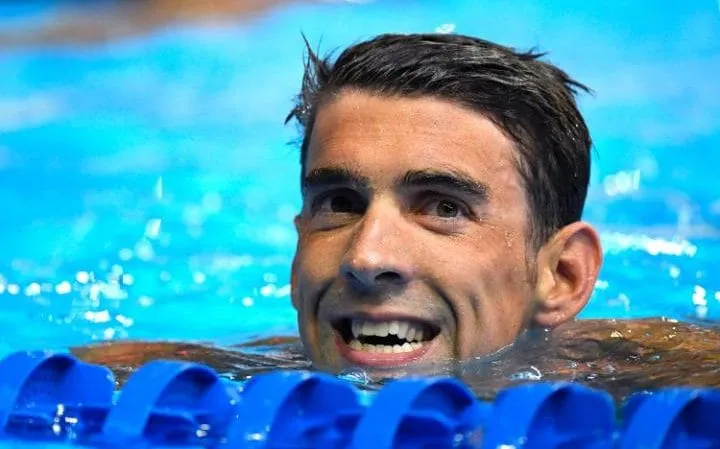
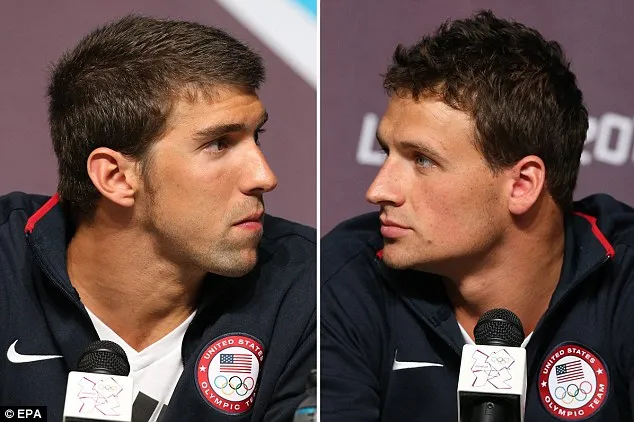
Guys like Cavill or Lundgren I wouldn't classify as having narrow intercanine width. Average maybe, but I think Lundgren has decent spacing. Narrow intercanine width is seen in Michael Phelps otoh
He is another example of a CCW rotated maxilla with Class 3 dentition. His palate is narrow and he has a long face, but I don't know that his masseters are very developed.
I have been thinking about this thread for a while now and I have some Ideas I'd like the share:
To oversimplify:
The Temporalis pattern is responsible for a wide and short face The Masseter pattern for a narrow and long face The tongue pattern is essential for a functionally wide and long palate fitting the tongue and all teeth, The skull to a degree forms around the tongue while the buccinators and lips hold occlusion of the teeth. However this doesn't account for the palates position forward/backward on the skull.
Now
Place your hands on the sides of your head as if you were blocking your ears but a little forward, so that the tips of your fingers touch the temporalis muscle and the bottom of your palms rest on the masseters. Now push your tongue upward and those muscles will activate in different ratios depending on your mandible position. This is a practical example but you will notice that backward pulling is temporalis dominant while jutting forward is masseter dominant.
Since bad habits with the tongue during childhood got us here in the first place, it has set a presedent for incorrect use of the masticory muscles Which we have brought into years of our development. We need to stop the spiral that we have set for ourselves.
Muscle wins over bone, and bone will adjust around muscle use.
Fix your tongue, fix your jaw placement, and everything will slowly fall into place. This is much easier said than done however, as the teeth have occluded to your habits, and now have to reocclude into a healthy muscle pattern. via tongue and chewing forces.
This all falls under the category of muscular posture, which translates into movement. Good movement is essential for functioning in a world where you and all around you is material. Even the non-material world of conciousness is affected by the material reality of its existence inside a braincase.
We need to come up with some practical methods now for curing different forms of CFD.
Chewing posture is ofcourse of paramount importance, it will be beneficial to overcompensate in the opposite direction of temporalis/masseter ratio to increase the rate of skull adjustment. Meaning if you are masseter dominant then you want to bite backwards, and vice versa for temporal skulls.
It makes sense that if one bites with their mandible jutted forward, they are activating the masseter pattern, It seems true that the forward position on the bottom jaw is where the top jaw would have to meet for that pattern of mastication to occur naturally. However, its impossible to bite with correct force through your teeth and into your skull from these artifical positions. Our CFD anatomies simply arent designed for correct mandible placement and it's bite forces.
But, you can use your tongue as the force that engages the muscles of mastication, this will also aid in the process of the palate modeling around the mouth, which is the basis of mewing, however mewing isn't nearly the whole picture here.
We can't bite, or chew properly, only improperly. Chewing comfortably in our anatomy will only set the bad habits harder, we need to chew as if we had a different skull, atleast, push the mandible forward as if the maxilla were set forward with it, or set the mandible back for long faced individuals. and now bite, or simulate a bite with the tongue pushing against the forces of mastication.
If the muscles activate as if the jaw is in correct alignment, then it will apply forces of correct alignment. Luckily, these forces are controlled by the jaw, and one can move the jaw freely within its ROM.
Now, chewing exercises. Mastic gum, towels, foods, whatever. Now you need to chew in your new uncomfortable, unnatural, but correct jaw position. I don't think the tongue itself will be purely sufficient to reshape the skull at any rate that matters, Since chewing applies much more force, and bone adjusts to force.
Overcompensating the mandible may be useful to get the process started faster however if you stick with it into real progress you will most likely just end up with the opposite CFD pattern than the one your started with, whats important is balance once you reach the correct anatomic skull form that fits your tongue and soft tissue format.
I wouldn't worry too much about occlusion as your tongue and lips/cheeks keep tipping in check provided you have correct enough mouth posture.
I don't know how long change will take nor do I know that this works
HOWEVER
I will given time, as I am experimenting with this hypothesis and correcting my body posture according to similar philosophies that @Progress follows, ie. Building an understanding and connection with the body and it's movement through focused and mindful exercise, stretching and active contorting. Hopefully this combined yields something of worth.
I hope at least that this post gives your mind something to play with
I have been thinking about this thread for a while now and I have some Ideas I'd like the share:
To oversimplify:
The Temporalis pattern is responsible for a wide and short face The Masseter pattern for a narrow and long face The tongue pattern is essential for a functionally wide and long palate fitting the tongue and all teeth, The skull to a degree forms around the tongue while the buccinators and lips hold occlusion of the teeth. However this doesn't account for the palates position forward/backward on the skull.
Now
Place your hands on the sides of your head as if you were blocking your ears but a little forward, so that the tips of your fingers touch the temporalis muscle and the bottom of your palms rest on the masseters. Now push your tongue upward and those muscles will activate in different ratios depending on your mandible position. This is a practical example but you will notice that backward pulling is temporalis dominant while jutting forward is masseter dominant.
Since bad habits with the tongue during childhood got us here in the first place, it has set a presedent for incorrect use of the masticory muscles Which we have brought into years of our development. We need to stop the spiral that we have set for ourselves.
Muscle wins over bone, and bone will adjust around muscle use.
Fix your tongue, fix your jaw placement, and everything will slowly fall into place. This is much easier said than done however, as the teeth have occluded to your habits, and now have to reocclude into a healthy muscle pattern. via tongue and chewing forces.
This all falls under the category of muscular posture, which translates into movement. Good movement is essential for functioning in a world where you and all around you is material. Even the non-material world of conciousness is affected by the material reality of its existence inside a braincase.
We need to come up with some practical methods now for curing different forms of CFD.
Chewing posture is ofcourse of paramount importance, it will be beneficial to overcompensate in the opposite direction of temporalis/masseter ratio to increase the rate of skull adjustment. Meaning if you are masseter dominant then you want to bite backwards, and vice versa for temporal skulls.
It makes sense that if one bites with their mandible jutted forward, they are activating the masseter pattern, It seems true that the forward position on the bottom jaw is where the top jaw would have to meet for that pattern of mastication to occur naturally. However, its impossible to bite with correct force through your teeth and into your skull from these artifical positions. Our CFD anatomies simply arent designed for correct mandible placement and it's bite forces.
But, you can use your tongue as the force that engages the muscles of mastication, this will also aid in the process of the palate modeling around the mouth, which is the basis of mewing, however mewing isn't nearly the whole picture here.
We can't bite, or chew properly, only improperly. Chewing comfortably in our anatomy will only set the bad habits harder, we need to chew as if we had a different skull, atleast, push the mandible forward as if the maxilla were set forward with it, or set the mandible back for long faced individuals. and now bite, or simulate a bite with the tongue pushing against the forces of mastication.
If the muscles activate as if the jaw is in correct alignment, then it will apply forces of correct alignment. Luckily, these forces are controlled by the jaw, and one can move the jaw freely within its ROM.
Now, chewing exercises. Mastic gum, towels, foods, whatever. Now you need to chew in your new uncomfortable, unnatural, but correct jaw position. I don't think the tongue itself will be purely sufficient to reshape the skull at any rate that matters, Since chewing applies much more force, and bone adjusts to force.
Overcompensating the mandible may be useful to get the process started faster however if you stick with it into real progress you will most likely just end up with the opposite CFD pattern than the one your started with, whats important is balance once you reach the correct anatomic skull form that fits your tongue and soft tissue format.
I wouldn't worry too much about occlusion as your tongue and lips/cheeks keep tipping in check provided you have correct enough mouth posture.
I don't know how long change will take nor do I know that this works
HOWEVER
I will given time, as I am experimenting with this hypothesis and correcting my body posture according to similar philosophies that @Progress follows, ie. Building an understanding and connection with the body and it's movement through focused and mindful exercise, stretching and active contorting. Hopefully this combined yields something of worth.
I hope at least that this post gives your mind something to play with
How are you supposed to chew with your jaw jutted out?
How are you supposed to chew with your jaw jutted out?
The same as you would regularly just with your jaw jutted
I understand what you mean though, It's extremely uncomfortable especially around the anterior teeth. and pretty ineffective as the teeth dont serve their function nearly as well, Like I said for most of us the way our teeth occlude comfortably isnt correct in relation to the musculature, if we dont change it we'll keep enforcing the situation.
The chewing exercise I mentioned earlier in the thread is what I mean
Get a flannel or a towel, roll it up, and bite into it with the whole front complex of your dentition, apply as much pressure as youre comfortable with, "chew" it. I have experiences strong sensations around all the areas I am deficient in namely, around my nose, under my eyes and in my inner zygos. Right at the sutural connections. You can apply some pull to further simulate how the front teeth were intended to be used.
This alters the chewing musculature ratio into more masseter dominance but not by much (from overbite to edge to edge), but to overcompensate into a class 3 is extremely uncomfortable on teeth when biting into anything tough.
I don't know, push through the pain, edge to edge for less dramatic muscle use or rely on the force of your tongue with your jaw jutted or pulled back to tip the ratio into a more favourable one without chewing forces accelerating change.
There's no easy answer and everyone's case is different, seems most here have down-recessed masseter-dominant faces while I have an upward recession from hyperactive temporalis, Which gave me headaches btw so watch for that.
I know thats a lot for a single sentence question but fuck it
So if temporalis activation leads to a longer skull, it seems Vin Diesel has that shape. But his face is also strongly downward grown and his masseters don't seem to have created prognathism since his profile has negative projection.
The Rock has a skull that looks like it is shaped by masseter activity (flat and tall) yet his jaws seem ideally aligned (orthognathic) and he has a shorter face than Vin Diesel. I don't know what may be happening here.
As a side note it's very interesting that these Hollywood leading male action stars have 0 brow projection and have flat near bulbous foreheads. Scarlett Johansson has a stronger forehead slope than either of these guys.
It looks like vin lacks much of either masseter or temporalis and as such seems to have developed neither forward or upward or much of anywhere, I would bet his tongue is slack. He's a good example of underdevelopment.
He's also a complete fkwit of a person and I wonder if the two are correlated, if his brain would work properly if he grew right. I've observed myself that I have become more braindead after bad posture and orthodontic work throughout my teens.
It's interesting that mr. johnson doesn't appear to have projected temporal muscles either, but has good masseters. and has a higher than ideal but not unnatractive gonial angle. He has good width in his face, I have a feeling his tongue posture is good and he's only underdeveloped from lack of chewing. Which might explain the lack of brow ridge too
It looks like vin lacks much of either masseter or temporalis and as such seems to have developed neither forward or upward or much of anywhere, I would bet his tongue is slack. He's a good example of underdevelopment.
He's also a complete fkwit of a person and I wonder if the two are correlated, if his brain would work properly if he grew right. I've observed myself that I have become more braindead after bad posture and orthodontic work throughout my teens.
It's interesting that mr. johnson doesn't appear to have projected temporal muscles either, but has good masseters. and has a higher than ideal but not unnatractive gonial angle. He has good width in his face, I have a feeling his tongue posture is good and he's only underdeveloped from lack of chewing. Which might explain the lack of brow ridge too
The brow grows from chewing?? I have a prominent brow (much more than either of these two) and I barely chew. It was never a habit of mine and that hasn't changed. I thought brow projection was just genetic?
...if the two are correlated, if his brain would work properly if he grew right.
I have nothing to say regarding Vin Diesel, but I have previously wondered about the possible impact of facial bone development on the brain and cognition. I see two possible mechanisms:
1. Poor facial development frequently causes a sub-optimal airway, which compromises breathing, and this, over a sufficiently long period of time causes a decline in cognitive function. I don't have the time to look for them now, but there are several research studies which demonstrate that insufficient breathing (which most people suffer from, probably), and the constant breathing of stale air (if you never open windows in your house) can lower IQ over a period of months and years. Users of this forum will be most concerned with how a good posture can improve breathing, but it is worth mentioning on a side note that we often spend a great deal of our time in indoor environments which have higher-than-healthy levels of CO2 (1,000 - 2,000 ppm, when they should be 250-400 ppm). This is an overlooked issue, but it has an effect, too. Anyway, from personal experience I've observed that, after mewing improved my breathing, my episodes of brainfog and early-morning-grogginess also became less frequent, and less severe.
2. Poor development compromises the growth of the skull in such a way that the brain doesn't have enough room to grow, and / or is forced to grow differently. I have no idea if this is true, but if it is, then my guess would be that the effect of this mechanism has to be limited, because the vast majority of people who suffer from CFD - even severe CFD - aren't mentally challenged. Still, it could be that poor skull development restricts a person's ability to reach their cognitive, genetic potential.
I've observed myself that I have become more braindead after bad posture and orthodontic work throughout my teens.
I'm not necessarily disagreeing with you, but there are many factors that can affect a person's cognitive development throughout teenage years. Bad posture (+ insufficient breathing) is a major possible factor, certainly, but there's a great deal of things that we do as teenagers that we consider par-for-the-course, but which actually hurt us: insufficient sleep (6 hours is NOT enough for most people), poor diet, smoking marijuana (I'm not making a judgement about adults smoking weed, cause hell, I do it from time to time, but we do know now that children who begin smoking it before their brain fully develops around 25 do not develop to the same cognitive level as their counterparts who have not smoked MJ as teenagers), frequent watching of pornography (I expect that this will be unpopular here, so Google "porn hypofrontality" if you don't believe me). All these things can add up, and when we engage with them as teenagers while our brains are still growing, they affect us more so than adults.
It's interesting that mr. johnson doesn't appear to have projected temporal muscles either, but has good masseters. and has a higher than ideal but not unnatractive gonial angle. He has good width in his face, I have a feeling his tongue posture is good and he's only underdeveloped from lack of chewing. Which might explain the lack of brow ridge too
Yeah, it could be, but I think that the lack of a brow ridge could also be a result of his ethnicity or just his own, individual genetics. I had a Greek co-worker who had great facial development, with no CFD that I could spot, and he still lacked a brow ridge. Funnily enough, the profile view of his face looked much like that of an ancient Greek statue. Sort of like this, but with a more prominent jawline:
I have a slight overbite and receding chin. In order to activate the temporal pattern I have to excaberate my overbite and further receed my chin as I move my mandible inwards.
Wouldn't this be bad as it might help to accentuate my deficiencies by spending so much time in this position? (my overbite and receding chin)
I believe incisor/canine contact is a strong component for both prognathic jaws and a defined brow ridge
Does your class 3 mean your chewing pattern is more frontal?
Earlier in the post was cited a paper "The Anterior Dental Loading Hypothesis" which is a very interesting read Also the wikipedia for Brow Ridge is insightful
I believe incisor/canine contact is a strong component for both prognathic jaws and a defined brow ridge
Does your class 3 mean your chewing pattern is more frontal?
Earlier in the post was cited a paper "The Anterior Dental Loading Hypothesis" which is a very interesting read Also the wikipedia for Brow Ridge is insightful
I don't know, I see lots of people with prognathism and no brow ridge just as I see many orthognathic individuals with a strong brow. Plus, there has to be a genetic and hormonal component since they are seen more in men than women.
Most of my life my chewing was all on my right molars. But I think I ended up Class 3 due to resting my tongue on my lower palate. That or maybe because while I didn't have forward head posture, I did have my neck shortened with my chin up all the time. It probably caused my midface to collapse, which is essentially what Class 3 is (midface hypoplasia with an overgrown mandible).
To add to what @Elwynn and @Authority were saying, I do feel like from an aesthetic standpoint, the masseter heavy skull would produce more facial aesthetics due to the palate being wider, jaw growing forward and down more, and overall broader facial features. The temporalis skull was wider, true, but the palate narrow and the face vertically short. It didn't have prominent zygos either and it was vertically short.
I think men can probably benefit from more masseter usage if those skulls show accurate representations of how the face develops.
I have class 2 and while biting back and up with my temporalis I feel the sutures on my weaker developed side, to the point that it hurts, not sure if its tmj. do you guys think it is possible to push through this pain until this side is developed like the other or am I doing sth wrong and the pain should not be there. When stoping and placing my jaw a bit more forward, how it feels natural with my recessed faced it take a few minites untill the pain on my jaw joint(weaker side) stops
If anyone has the chisell 2.0 temporalis activation is quite easy. Just clench on it as hard as you can and the temporalii start to vigorously burn within 10 seconds. If you want to develop the masseter pattern instead, simply biting down on the product hard and then releasing gives the masseter the same burn. The owners also claim this product has 180 lbs of resitance (90lbs for each tab). and each tab is placed on the molars.
i dont know the names, but i can feel sth i the canal of the left ear and also a surure going up and 1 forward from the earcanal. how do i know if i am pushing into my inner ear?
If your jaw is at all messing with your ears I'd be very careful.
Use this as a reference to find where you're feeling adjustment, if your jaw is backward much it'll start imposing on your hearing.
Interestingly I have a very set-back mandible and suffered from vertigo attacks, ear infection type pain as well as headaches almost every day (got worse with hard mewing), all of which have gone away since I've made an effort to release tension in my jaw, and return it to it's natural forward position.
Interestingly I have a very set-back mandible and suffered from vertigo attacks, ear infection type pain as well as headaches almost every day (got worse with hard mewing), all of which have gone away since I've made an effort to release tension in my jaw, and return it to it's natural forward position.
Would you mind explaining what you have done to release tension from your jaw, how you're mewing now and what you were doing before that was making your TMJ-like problems worse (were you clenching, for instance)?
I held my molars together in their comfortable occlusion and had my tongue on my palate cluelessly in the beginning, I was clenching a lot, I had a habit of bruxing. Even before The Mew I'd chew my food way harder than I needed to and it sometimes hurt my teeth, inner ear and felt like doing reps on the sides of my head. As a result I've got a dummy thick temporalis that looks completely bunk. Look at Tyler1 for reference.
Most days I'd come down with a light to mad pulsing headache in my temples and behind my eyes which lasted the rest of the day. I always thought it was just dehydration or something, these headaches became much more regular while I was hardmewing with my jaws clenched. Eventually I made the connection that it was directly related to my headaches and ear pain, the more I clenched, the worse it got. I'd been having unexplained pain for ages and I finally figured out why, hallelujah.
Resting my molars together lightly or even slightly apart contracts my temporalis, Leading to a headache after a full day of contracted temporalis. Being in this position my TMJ was backing up into my inner ear which applied pressure and would sometimes hurt. I also believe this gave me occasional bouts of vertigo. I had an sizeable amount of tension in my skull for a decent portion of my day to day.
I noticed that jutting my mandible forward relieves my head and ears of the pressure, opens up my airway and feels very relaxed and comfortable. Stretching my jaw forward feels really nice. In this position (basically a class 3) the recession of face becomes much more obvious, But I can mew fine and I'm almost certain this is the correct position of my jaw, usually I stretch my jaw further forward to eliminate as much temporal activation as I can, hoping for atrophy to return to a normal looking head shape.
My current mewing regime is experimenting with forward tongue force with my jaw jutted, anterior chewing, and softmewing at night. My main focus is on maxilla/midface protraction.
Hope this tedious as freak* story answered your questions blud
From my personal observations with myself, temporalis activation seems to be linked with my mandibles position in the skull. My jaw is quite set back and results in a very active and strong temporalis that gave me headaches. When I mew with my jaw jutted forward however I get more masseter activity in ratio and less pressure in my skull from temporalis activation. This has helped a lot with my headaches. And shows me functionally that my maxilla needs to come forward if I dont want a Tyler1 head
By the logic of this theory I may very well have recessed myself with my temporal meat smh
I haven't read the entire thread. That being said, discussing about the roles of different mastication muscles in jaw physiology is very interesting. To support your point maxiller, I had the same caused headaches when my mandible was very retracted. It connected when I read this overwhelming article https://mskneurology.com/true-cause-solution-temporomandibular-dysfunction-tmd/ , on the "headaches" part, I quote:
"The most common cause of TMD-related headaches are caused by the temporalis muscle, in my experience. Continuous retraction of the mandible will cause great imbalances between the muscles of mastication, often leaving the very strong masseter (a muscle that protracts the jaw) underused, overburdening the temporalis muscle (that pulls the mandible back / retraction). In addition to further the compressive forces in the TMJ, it will often cause trigger points in the temporalis muscles that cause headaches." I experienced the same trigger points, but they were actually lethal trigger point. It would make me cry each time I push them, and when walking I felt like my head was heavily compressed between 2 pistons.
To adress directly the topic by anecdotal experience, my degeneration has been in pair with decreasing masseter volume. Now that I somehow took things back in control, I was able to work on my masseters, and chewing, resting mandible position, temporalis-caused headaches, all are 10x more confortable. I even gained some low third credibility, more width and structure.
Also, for what it's worth, short & wide faced people often have strong voluminous masseters. I still think they have a lot to do in bone structure and overall shape of the face.
I like to balance chewing by protracting and retracting as I get closer to the molars. This way my biting is balanced between the two. I do this going clockwise and counterclockwise while I chew. It causes all cusps of my teeth to touch and involves balance between temporalis and masseters.
I like to balance chewing by protracting and retracting as I get closer to the molars. This way my biting is balanced between the two. I do this going clockwise and counterclockwise while I chew. It causes all cusps of my teeth to touch and involves balance between temporalis and masseters.
To answer your previous post (which I think you might have deleted ?) I read a bit the first page and I have to assume this all look still mysterious to me. However in my case and in many others I guess, it might not be a concern since both masseters and temporalis are used when chewing. As always it is about balance.
It's obvious to say but it depends on each case; I personally had long face pattern with non-existing masseters, now that I have some my face is more harmonious. In the same time, I grew some ramus on each side, and eventhough we could think of it as "elongating my face" since it means vertical growth, it results in a much more masculine, proportionate face.
But in my case my bite is near perfect, except for 1 mm between incisors, all my teeth, front and rear are in contact.
I like to balance chewing by protracting and retracting as I get closer to the molars. This way my biting is balanced between the two. I do this going clockwise and counterclockwise while I chew. It causes all cusps of my teeth to touch and involves balance between temporalis and masseters.
To answer your previous post (which I think you might have deleted ?) I read a bit the first page and I have to assume this all look still mysterious to me. However in my case and in many others I guess, it might not be a concern since both masseters and temporalis are used when chewing. As always it is about balance.
It's obvious to say but it depends on each case; I personally had long face pattern with non-existing masseters, now that I have some my face is more harmonious. In the same time, I grew some ramus on each side, and eventhough we could think of it as "elongating my face" since it means vertical growth, it results in a much more masculine, proportionate face.
But in my case my bite is near perfect, except for 1 mm between incisors, all my teeth, front and rear are in contact.
I couldn't figure how to link the post so I deleted it. But my original point was that a balance should probably be achieved since it seems that temporalis activation widens the cheekbones even if doesn't widen the palate.
I wonder if I have heightened temporalis activation since my cheekbones are broad. But then again my face has prognathism so I have no idea. But this prognathism isn't even maxillary and my face doesn't match either of those skulls in the post anyway. And my palate isn't even wide, either. I am one of those lucky people (I suppose) who managed to have decent facial width with a palate that started in the high 30s.
I'm a bit confused with what I should be taking from this to be honest. This stuff about how to use your masseters and temporalis properly.
Chew backwards to shorten the face.
Chew forwards to project the maxilla.
I think a balance is always needed. Some favor one over the other and that's when you run into problems.
The "neutral" maxilla is always ideal. Not too long, short, or wide. Just enough growth balance in all directions. Temporalis skull looks too short, masseter skull too long.
Hope this tedious as freak* story answered your questions
It definitely did, thank you.
I find it very interesting that your temporalis muscles contract whenever you have your teeth in contact, even if very lightly. This does not happen to me. As I said earlier, I have Class II with a retruded mandible, and when I make light contact with my front teeth (which is what I try to do at rest), I feel virtually no stimulation of my temporalis. If I bite down with my front teeth, I feel minor stimulation of my temporalis. In both cases, the muscles that are activated most strongly are the masseters. This is in complete contrast to what happens when I bite down with my back teeth - especially when I bite down backwards. In that situation, it is my temporalis that activate, while my masseters remain almost entirely at rest.
It follows that if you've got over-developed temporalis, you should employ an occlusion and a posture that limits stress on the temporalis, maybe in favor of the masseters. Conversely, if you've got over-developed masseters, you should employ an occlusion and a posture that limits stress on the masseters, maybe in favor of the temporalis. It makes sense logically, but I am not sure if it's so simple in practice.
For example, I have well-developed masseters and they're quite large when I flex them. I can't really tell whether my temporalis are well-developed or not, but they're certainly not over-developed. My above reasoning suggests that I should be biting backwards, in order to activate my temporalis, but this seems conter-intuitive considering that my mandible is already positioned too far back. Hmm...
Anyway, all this further supports the observation that not everyone here has the same type of CFD. And if our cases are different, it follows that our methods of treatment should also possibly be. I'm glad that you have figured out that constant teeth contact was causing problems for you. For me, however, I suspect that I'll need to take a different approach.
What would you say that a person with a retracted mandible should do? On the one hand, I could use some shortening of the mid-section. On the other hand, I am concerned about developing TMJ problems as a result of biting backwards. I've never had any TMJ problems before, but I believe that I am at risk for it due to my CFD.
What would you say that a person with a retracted mandible should do? On the one hand, I could use some shortening of the mid-section. On the other hand, I am concerned about developing TMJ problems as a result of biting backwards. I've never had any TMJ problems before, but I believe that I am at risk for it due to my CFD.
I like to chew like I workout. An even balance between all teeth in biting. Rotate the bolus from molars to bicuspids to canines to incisors back to canines, bicuspids, and molars on the other side.
Now some people do this entirely with one muscle so to even it out, when you get closer to the front teeth begin protraction (masseter activation) and when you go to the back begin to pull with your temporalis is retraction.
This works for me and I feel a balance. But sometimes I can do it entirely with my temporalis. Not that I recommend that.
I would seriously advice against chewing when you have overly retruded mandible, temporalis tension and so on. I know the jaws are made for chewing, but a bad condyle place will only destroy them by applying way to much force in non physiological directions. The condyle placement must be adressed before getting into chewing tough stuff. This is adressed by nose breathing h24, closing your jaw during day & night and other stuff that a specialist could help you with
By this logic wouldn't most people mess themselves up from chewing? Or do you think that CFD is common but not always in the form of a retruded mandible?
Btw do you think if all wisdom teeth erupted that the mandibular placement is ideal?
By this logic wouldn't most people mess themselves up from chewing? Or do you think that CFD is common but not always in the form of a retruded mandible?
Btw do you think if all wisdom teeth erupted that the mandibular placement is ideal?
It just depends on the case. Lots of people don't seem to have too much retruded mandible and it won't pose any problem. I might be wrong but as an example, if you have such a retruded mandible that you have big trigger points in temporalis, I definitely think chewing tough foods will be a problem. It was in my case. It is just because the joint is in a bad restricted place. Just protrude your mandible a few mm, or eat with a retainer, and it won't jam up the condyle.
I do also think that lots of people who have greatly retruded mandible don't eat tough foods, as must of the population.
Indeed, CFD is common but not always in the form of a retruded mandible. It is one of the many "symptoms" but nature is so diversified, some may not have retruded mandibles.
If all wisdom teeth erupted without any previous extractions, it is not a sign of "ideal" but at least a sign that something went good. It sure is most of the time a good indicator of jaw health if all teeth have their place
I would seriously advice against chewing when you have overly retruded mandible, temporalis tension and so on. I know the jaws are made for chewing, but a bad condyle place will only destroy them by applying way to much force in non physiological directions. The condyle placement must be adressed before getting into chewing tough stuff. This is adressed by nose breathing h24, closing your jaw during day & night and other stuff that a specialist could help you with.
I appreciate your concern, but I think that I'll be fine. I have no temporalis tension, and my oral posture has greatly improved over the past year. I've also chewed tough foods before without any problems.
Great to see that this thread has generated so much discussion. Here is a possibly relevant study I came across today. This study was based on the hypothesis that the temporal bones are at the center of the dynamics of the craniofacial complex, which I think could be a misguided notion, because the sphenoid is more likely to be the actual "keystone" of the skull around which the other bones revolve. In spite of this, the study proposes a very interesting model, because it both complements and contradicts the ideas discussed in this thread while also shedding some further light into the craniofacial dynamics.
"According to Sato’s hypotheses regarding the dynamic functional anatomy of the craniofacial complex (Fig. 1), an increased flexion of the skull base promotes a clockwise rotation of the sphenoid bone. This rotation transfers a downward vertical force, through the vomer bone to the maxillary complex, leading to the vertical elongation of this complex. This vertical elongation limits the antero-posterior growth of the maxillary complex, causing posterior discrepancy (crowding), which in turn motivates an excessive eruption of the maxillary molars, creating an excessively horizontal maxillary (upper) posterior occlusal plane. The mandible then has to adapt to this occlusal plane in order to keep occlusal function, and does so by anterior rotation.
This anterior rotational adaptation of the mandible promoted by the neuromuscular system has two effects. On one hand, it leads to a decompression of the condyles, which then grow secondary, and at the same time it diminishes the compression exerted on the mandibular fossa of the temporal bone, which in combination with the traction effect exerted by the chewing muscles (masseter and temporal) suffers external rotation. The skull thus assumes a greater transverse dimension.
This external rotation of the temporal bone, through its direct connection with the sphenoid and occipital bones near the midline, influences flexion of the spheno-occipital synchondrosis. This bending of the midline bones determines a smaller anterior–posterior skull base, while influencing further clockwise rotation of the sphenoid bone, which again drives this cycle. An increased extension of the cranial base would have the reverse effect on the craniofacial complex: a steeper upper posterior occlusal plane, lower vertical dimension, a more retrognathic mandible and internal rotation of the temporal bones, accompanied by an anterior–posteriorly longer and transversally narrower skull base."
What I take away from this is that masticatory muscle usage could theoretically rotate the temporal bones externally, which would urge the sphenoid bone to rotate clockwise, increasing maxillary length, widening the face and swinging the mandible forward. Ironically this downward shift of the maxilla causing the maxillary molars to erupt further is deemed "excessive", even though this eruption triggers the favorable mandibular rotation and encourages the ramii to lengthen. However, the originator for the neurocranial movement described above is viewed as being the result of flexion vs extension of the cranial base, which is generally deemed impossible to influence in adulthood by cranial osteopaths.
What role do you think the lateral and medial pterygoid play? If you view the temporal bone rotation as the originator of this favorable cranial restructuring, then I guess their role is not much. If the sphenoid has a major part in causing this restructuring, then their action must be considered, right? Iirc they act along with the masseter, so if the goal is to increase temporalis proportion and decrease masseter proportion, their action would be minimized along with the masseter's action.
What role do you think the lateral and medial pterygoid play? If you view the temporal bone rotation as the originator of this favorable cranial restructuring, then I guess their role is not much. If the sphenoid has a major part in causing this restructuring, then their action must be considered, right? Iirc they act along with the masseter, so if the goal is to increase temporalis proportion and decrease masseter proportion, their action would be minimized along with the masseter's action.
That's a good question. Since they connect the maxilla, mandible and sphenoid to each other, I'm willing to bet that the pterygoids do play an important role in cranial dynamics and I've speculated about this role in some of my earlier posts. Ultimately it is very difficult to determine which bone or muscle is a slave and which one a master because there are so many factors to consider. Possibly the intra-cranial dynamics form a feedback loop? This is what was suggested in the above study:
Internal (a) or external (b) rotation of the temporal bones influences extension or flexion of the spheno-occipital synchondrosis. The altered spatial positioning of the sphenoid bone then influences, through the vomer bone, the maxillary complex. The vertical dimension of this complex together with the inclination of the posterior upper occlusal plane influence anterior–posterior positioning of the mandible, which in turn further influences the temporal bones and again stimulates the cycle.
In this case, there probably would be no single clear originator. You would just have to disrupt the cycle at some juncture in order to change its course.
Found an interesting study that affirms the premises of this thread. A couple of bits:
An orthognathic[=normal] maxilla is also present in individuals with a large temporalis muscle proportion, suggesting a key role of the form of the maxilla in the production and resistance of masticatory loads.
...a large temporalis proportion is associated with a relatively antero-posteriorly elongated neurocranium and mandibular ramus, wider upper face and less prognathic, narrower, vertically shorter maxilla compared to those individuals with small temporalis proportions
...there is evidence of a weak relationship between temporalis muscle CSA and skull and face shape that is at least consistent with the location, anatomy and function of this muscle and anatomical space required to accommodate it.
Thus, Weijs and Hillen (1986) have also noted that temporalis and masseter CSA appear to be positively correlated with facial width. With regard to the relationship found between a relatively small temporalis proportion and a vertically elongated skull and face, van Spronsen (2010) noted such an association and suggested that a long face is the result of a diminished muscle force
Interestingly, increased temporalis proportion was also associated with more narrow palates, though this relationship was deemed more inconclusive than the other more positive aspects of large temporalis proportion:
In relation to the relationship suggested by the present analyses between larger temporalis proportion and narrower maxillae, there are few and inconclusive studies addressing the mechanical impact of variations in maxillary width on masticatory mechanics. In women, a wide dental arch has been noted to be associated with a (medio-laterally) thicker masseter (Kiliaridis et al., 2003), whereas no relationship between bite force and dental arch width was found in pre-adolescents (Sonnesen and Bakke, 2005). It should be borne in mind, however, that a combination of an orthognathic, less prognathic and wide maxilla at the posterior teeth (and vice versa) may result in deviations from the normally found elliptic–parabolic (in rough terms) maxillary arch (Burris and Harris, 2000; Ferrario et al., 1994), and therefore a narrowmaxilla in individuals with a large temporalis proportion may not necessarily be functionally significant
So in conclusion, temporalis activity correlates with:
longer ramus
longer skull
shorter maxilla
wider face
(narrower maxilla)
Wow, this is very interesting. I happen to have a 'small' neurocranium. Basically the upper half of my head is just as wide as my zygos. I' ve never seen any man with optimal craniofacial development have this, so I have always been suspicious. Now this confirms everything.
@Progress Do you think that most people require CCW rotation or CW rotation of the temporal bones? Or does it depend on the case? Because in modern populations, we see a lot of retruded mandibles and compressed condyles across the board (regardless of facial type, occlusion, short faced, long faced etc), suggesting that most people have their temporal bones rotated too much CW, and could benefit from CCW rotation shown on the right.
Possibly the intra-cranial dynamics form a feedback loop? ... In this case, there probably would be no single clear originator. You would just have to disrupt the cycle at some juncture in order to change its course.
That could explain why many chewing results are unimpressive, resulting in hypertrophy but lack of skeletal change or even unfavorable change, and yet why a select few chewing results are incredibly impressive. They managed to disrupt the feedback loop you posit.
@qwerty135 It probably depends on the case. For example, when I was a child I underwent a retractive orthodontic treatment where my maxilla was pulled back, the aim of which I suspect was to compensate for the effects shown in 'a)'. However this kind of treatment would not be common enough to describe 'most people'. Though on the other hand, the forward rotation of the maxilla illustrated by 'a)' appears like it could also be the product of insufficient lip seal, which is a common problem. If this was a meaningful factor, it could mean that CCW rotation of the temporalii is just the final consequence of lip sealed maxilla pushing against the sphenoid.
Found an interesting study that affirms the premises of this thread. A couple of bits:
An orthognathic[=normal] maxilla is also present in individuals with a large temporalis muscle proportion, suggesting a key role of the form of the maxilla in the production and resistance of masticatory loads.
...a large temporalis proportion is associated with a relatively antero-posteriorly elongated neurocranium and mandibular ramus, wider upper face and less prognathic, narrower, vertically shorter maxilla compared to those individuals with small temporalis proportions
...there is evidence of a weak relationship between temporalis muscle CSA and skull and face shape that is at least consistent with the location, anatomy and function of this muscle and anatomical space required to accommodate it.
Thus, Weijs and Hillen (1986) have also noted that temporalis and masseter CSA appear to be positively correlated with facial width. With regard to the relationship found between a relatively small temporalis proportion and a vertically elongated skull and face, van Spronsen (2010) noted such an association and suggested that a long face is the result of a diminished muscle force
Interestingly, increased temporalis proportion was also associated with more narrow palates, though this relationship was deemed more inconclusive than the other more positive aspects of large temporalis proportion:
In relation to the relationship suggested by the present analyses between larger temporalis proportion and narrower maxillae, there are few and inconclusive studies addressing the mechanical impact of variations in maxillary width on masticatory mechanics. In women, a wide dental arch has been noted to be associated with a (medio-laterally) thicker masseter (Kiliaridis et al., 2003), whereas no relationship between bite force and dental arch width was found in pre-adolescents (Sonnesen and Bakke, 2005). It should be borne in mind, however, that a combination of an orthognathic, less prognathic and wide maxilla at the posterior teeth (and vice versa) may result in deviations from the normally found elliptic–parabolic (in rough terms) maxillary arch (Burris and Harris, 2000; Ferrario et al., 1994), and therefore a narrowmaxilla in individuals with a large temporalis proportion may not necessarily be functionally significant
So in conclusion, temporalis activity correlates with:
longer ramus
longer skull
shorter maxilla
wider face
(narrower maxilla)
Wow, this is very interesting. I happen to have a 'small' neurocranium. Basically the upper half of my head is just as wide as my zygos. I' ve never seen any man with optimal craniofacial development have this, so I have always been suspicious. Now this confirms everything.
Is it optimal to have an upper half of the head that is greater in width than your zygos? I think that would make one look like they have a giant head. Usually guys with optimal facial development don't tend to have super wide upper skulls. I think facial width matters way more than how far out your temples go. A head that is broader than cheekbones would surely look overly neotenous.
@qwerty135 It probably depends on the case. For example, when I was a child I underwent a retractive orthodontic treatment where my maxilla was pulled back, the aim of which I suspect was to compensate for the effects shown in 'a)'. However this kind of treatment would not be common enough to describe 'most people'. Though on the other hand, the forward rotation of the maxilla illustrated by 'a)' appears like it could also be the product of insufficient lip seal, which is a common problem. If this was a meaningful factor, it could mean that CCW rotation of the temporalii is just the final consequence of lip sealed maxilla pushing against the sphenoid.
That's interesting to hear. For me, when I have my teeth together along the temporal vector and my tongue suctioned up, my lip seal strengthens greatly. Though I wonder how this mechanism (CCW rotation of temporal bone) would increase midfacial protrusion. Perhaps the vertical eruption of the posterior maxillary molars and decrease of the depth of the palate would trigger favorable remodeling around the mandibular angle, allowing for decompression of the masseter-zygo axis.
But in terms of a potential originator of this favorable change, I do think proper usage of the masticatory muscles is the key. For one, as I mentioned above, when I engage the temporal pattern, my lip seal increases. But also, just using critical thinking, someone with even mild CFD dropped into the Paleolithic world would either survive or die on the basis of their masticatory muscles. The average maximum bite force of even brachyfacial individuals in a modern population is 1/10th of the MBF of Inuit natives. Either the body would adapt quickly, or the individual would die due to an inability to chew the requisite hours. The body must have a self-correcting mechanism for CFD, at least when it's relatively mild, and when it's placed in the proper environment, that mechanism would be triggered. Lip seal, sphenoid rotation, etc would come as a result of the environmental changes (ie the proper usage of the masticatory muscles). Just my two cents.
Ideally, the upper half of the head should be only somewhat larger than the zygos, at least that's what many people with good craniofacial development seem to have in common. Yeah, obviously it shouldn't be noticeably wider either.
I don't know how I could take a pic of this because my mouth would be closed but I feel like my molars "attract" each other while doing the lip seal. When I let it loose my teeth (obviously) just hang there. But honestly this contact vs no contact debate has been going on for quite a while now. We should just ask successful mewers what they do. In my case when I started mewing I followed the "instructions", which included light clenching of the molars. I got some results from it, so why not stick to it?
That's interesting to hear. For me, when I have my teeth together along the temporal vector and my tongue suctioned up, my lip seal strengthens greatly. Though I wonder how this mechanism (CCW rotation of temporal bone) would increase midfacial protrusion. Perhaps the vertical eruption of the posterior maxillary molars and decrease of the depth of the palate would trigger favorable remodeling around the mandibular angle, allowing for decompression of the masseter-zygo axis.
But in terms of a potential originator of this favorable change, I do think proper usage of the masticatory muscles is the key. For one, as I mentioned above, when I engage the temporal pattern, my lip seal increases. But also, just using critical thinking, someone with even mild CFD dropped into the Paleolithic world would either survive or die on the basis of their masticatory muscles. The average maximum bite force of even brachyfacial individuals in a modern population is 1/10th of the MBF of Inuit natives. Either the body would adapt quickly, or the individual would die due to an inability to chew the requisite hours. The body must have a self-correcting mechanism for CFD, at least when it's relatively mild, and when it's placed in the proper environment, that mechanism would be triggered. Lip seal, sphenoid rotation, etc would come as a result of the environmental changes (ie the proper usage of the masticatory muscles). Just my two cents.
Yeah, that seems like the strongest premise at the moment. I notice the same thing about lip seal & temporalis synergy.
@horatio Same here. That's essentially the nature of vacuum, it pulls things together. How does it feel if you try to fight against it by keeping your teeth slightly apart? Weird/natural?
It feels forced , like I have to engage the muscles of my mouth area to keep the molars apart. When the molars are in contact these muscles seem to be more relaxed.
Ideally, the upper half of the head should be only somewhat larger than the zygos, at least that's what many people with good craniofacial development seem to have in common. Yeah, obviously it shouldn't be noticeably wider either.
I quoted the wrong post. Got pics of heads like this?
@Progress Do you think chewing (dynamic, intermittent load) vs gentle clenching (static, intermittent load) makes a difference in how the bone reacts to this activation of the temporalii and this force on the maxilla along the temporal axis? I'm not familiar with the intricacies of Wolff's Law, but I assume that a dynamic load at 1-2 Hz would induce a different response than a static load.
@Progress Do you think chewing (dynamic, intermittent load) vs gentle clenching (static, intermittent load) makes a difference in how the bone reacts to this activation of the temporalii and this force on the maxilla along the temporal axis? I'm not familiar with the intricacies of Wolff's Law, but I assume that a dynamic load at 1-2 Hz would induce a different response than a static load.
I don't know to be honest. Hypothetically, even if static loading was more effective than chewing, chewing does increase your unconscious capability for static loading by improving muscle tone. It does seem that the only thing some achieve with chewing is excessive muscular hypertrophy with little changes in bone. I'm inclined to think that static forces, even when generated by weak musculature, would be more powerful than strong intermittent forces, though I have no real reasoning to back this up with. It just makes more intuitive sense that the skull is gently guided to the right direction rather than abruptly forced.
@Progress Do you think chewing (dynamic, intermittent load) vs gentle clenching (static, intermittent load) makes a difference in how the bone reacts to this activation of the temporalii and this force on the maxilla along the temporal axis? I'm not familiar with the intricacies of Wolff's Law, but I assume that a dynamic load at 1-2 Hz would induce a different response than a static load.
I don't know to be honest. Hypothetically, even if static loading was more effective than chewing, chewing does increase your unconscious capability for static loading by improving muscle tone. It does seem that the only thing some achieve with chewing is excessive muscular hypertrophy with little changes in bone. I'm inclined to think that static forces, even when generated by weak musculature, would be more powerful than strong intermittent forces, though I have no real reasoning to back this up with. It just makes more intuitive sense that the skull is gently guided to the right direction rather than abruptly forced.
Makes sense, thanks.
By the way, are you still able to engage solely the temporalii and not the masseters at all when biting along the temporal vector? For the first week or so, I was able to, but now my occlusion meets much more evenly (curve of spee absolutely gone), and my molars touching means that regardless of how I bite, my masseters are activated to some degree. My temporalii are still engaged when I bite upwards and backwards, but now my masseters engage with them. I’m trying to adjust my technique to minimize masseter recruitment, but I wonder if it’s inevitable to some degree (as even short faced people with larger temporlis proportion have greater masseter strength in absolute terms than long faced people with greater masseter proportion).
@Progress Do you think chewing (dynamic, intermittent load) vs gentle clenching (static, intermittent load) makes a difference in how the bone reacts to this activation of the temporalii and this force on the maxilla along the temporal axis? I'm not familiar with the intricacies of Wolff's Law, but I assume that a dynamic load at 1-2 Hz would induce a different response than a static load.
I don't know to be honest. Hypothetically, even if static loading was more effective than chewing, chewing does increase your unconscious capability for static loading by improving muscle tone. It does seem that the only thing some achieve with chewing is excessive muscular hypertrophy with little changes in bone. I'm inclined to think that static forces, even when generated by weak musculature, would be more powerful than strong intermittent forces, though I have no real reasoning to back this up with. It just makes more intuitive sense that the skull is gently guided to the right direction rather than abruptly forced.
Makes sense, thanks.
By the way, are you still able to engage solely the temporalii and not the masseters at all when biting along the temporal vector? For the first week or so, I was able to, but now my occlusion meets much more evenly (curve of spee absolutely gone), and my molars touching means that regardless of how I bite, my masseters are activated to some degree. My temporalii are still engaged when I bite upwards and backwards, but now my masseters engage with them. I’m trying to adjust my technique to minimize masseter recruitment, but I wonder if it’s inevitable to some degree (as even short faced people with larger temporlis proportion have greater masseter strength in absolute terms than long faced people with greater masseter proportion).
I think a balanced bite should be ideal vs a temporalis heavy bite or masseter heavy one. The body never does well with an imbalance.
By the way, are you still able to engage solely the temporalii and not the masseters at all when biting along the temporal vector? For the first week or so, I was able to, but now my occlusion meets much more evenly (curve of spee absolutely gone), and my molars touching means that regardless of how I bite, my masseters are activated to some degree. My temporalii are still engaged when I bite upwards and backwards, but now my masseters engage with them. I’m trying to adjust my technique to minimize masseter recruitment, but I wonder if it’s inevitable to some degree (as even short faced people with larger temporlis proportion have greater masseter strength in absolute terms than long faced people with greater masseter proportion).
I can isolate the temporalii only when I'm not chewing on anything. Interesting that your curve of spee has reduced so quickly. Does this mean that your posterior molars have erupted more, or that your premolars have dug into the gums? Having the masseters and temporalii engage together probably is a sign of improved masticatory balance and not necessarily a bad thing.
I can isolate the temporalii only when I'm not chewing on anything. Interesting that your curve of spee has reduced so quickly. Does this mean that your posterior molars have erupted more, or that your premolars have dug into the gums? Having the masseters and temporalii engage together probably is a sign of improved masticatory balance and not necessarily a bad thing.
I shouldn't have said the curve of spee is absolutely gone, because my posterior 2nd molars still don't meet...but the curvature of the teeth in front of them is negligible now. I think one part of that is that my upper left 1st molar erupted a bit, as it now makes solid contact with the lower, when before they were slightly apart even when the rest of teeth were in contact. Probably my premolars intruded a little to help with flattening out the occlusal plane. But interestingly, I still feel the main strain in my premolars when I engage temporal pattern, even though the rest of my occlusion is now meeting when it didn't before.
Also, that line at the roof of my maxilla, that runs along it sagittally and divides it into two halves and slightly pokes out from the roof, that line's become sore. I forget the name for it though.
Also, that line at the roof of my maxilla, that runs along it sagittally and divides it into two halves and slightly pokes out from the roof, that line's become sore. I forget the name for it though.
Also, that line at the roof of my maxilla, that runs along it sagittally and divides it into two halves and slightly pokes out from the roof, that line's become sore. I forget the name for it though.
The mid-palatal suture?
I don't know, does the midpalatal suture actually protrude downwards from the palate, and form a ridge? But yeah, the same spot. I thought it could be something located above the alveolar ridge pushing down onto the upper palate.
I can isolate the temporalii only when I'm not chewing on anything. Interesting that your curve of spee has reduced so quickly. Does this mean that your posterior molars have erupted more, or that your premolars have dug into the gums? Having the masseters and temporalii engage together probably is a sign of improved masticatory balance and not necessarily a bad thing.
I shouldn't have said the curve of spee is absolutely gone, because my posterior 2nd molars still don't meet...but the curvature of the teeth in front of them is negligible now. I think one part of that is that my upper left 1st molar erupted a bit, as it now makes solid contact with the lower, when before they were slightly apart even when the rest of teeth were in contact. Probably my premolars intruded a little to help with flattening out the occlusal plane. But interestingly, I still feel the main strain in my premolars when I engage temporal pattern, even though the rest of my occlusion is now meeting when it didn't before.
Also, that line at the roof of my maxilla, that runs along it sagittally and divides it into two halves and slightly pokes out from the roof, that line's become sore. I forget the name for it though.
Ah I see. I seem to end up with the opposite of spee when I align my molars. Not sure how to illustrate this but here is an attempt, the first one depicts regular overbite position and the second one rearmost molars in alignment:
Weirdly, retracting the jaw like this combines well with lip suction, and I think over time it should pull the upper alveolar ridge inward and close the gaps around my upper canines. In this position the depth of my overbite is also reduced and biting down results in pure temporalis activation. I'm not sure if I have some hidden anterior open bite or class 3 that has collapsed into an overbite, because the relationship between my jaws is pretty weird and does not resemble typical overbite.
Weirdly, retracting the jaw like this combines well with lip suction, and I think over time it should pull the upper alveolar ridge inward and close the gaps around my upper canines.
You know, this synergy between temporalis pattern and lip seal is interesting. Lip seal makes me think of the proclined incisors we were talking about in the "Assorted Stories from the Web" thread, as well as the fact that the anterior maxilla experiences resorption as part of normal growth and development, as per these diagrams:
I note a couple things about these diagrams. For one, the A diagram explains how undereye support and cheekbone prominence would increase as a result of the temporal pattern pulling the alveolar process backwards.
But also, the B diagram shows how lip seal along with bone deposition in the posterior maxilla would lead to a wider, longer arch. The resorption of the anterior alveolar ridge would result in seemingly proclined incisors, while the deposition in the posterior maxilla would make one think that the teeth tipped forward while the sagittal position of the maxilla remained the same, when in reality the tips of the incisors were left behind and the maxilla "migrated" backwards. This would mean that the tongue pushing against the incisors isn't necessary. What do you all think?
Weirdly, retracting the jaw like this combines well with lip suction, and I think over time it should pull the upper alveolar ridge inward and close the gaps around my upper canines.
You know, this synergy between temporalis pattern and lip seal is interesting. Lip seal makes me think of the proclined incisors we were talking about in the "Assorted Stories from the Web" thread, as well as the fact that the anterior maxilla experiences resorption as part of normal growth and development, as per these diagrams:
I note a couple things about these diagrams. For one, the A diagram explains how undereye support and cheekbone prominence would increase as a result of the temporal pattern pulling the alveolar process backwards.
But also, the B diagram shows how lip seal along with bone deposition in the posterior maxilla would lead to a wider, longer arch. The resorption of the anterior alveolar ridge would result in seemingly proclined incisors, while the deposition in the posterior maxilla would make one think that the teeth tipped forward while the sagittal position of the maxilla remained the same, when in reality the tips of the incisors were left behind and the maxilla "migrated" backwards. This would mean that the tongue pushing against the incisors isn't necessary. What do you all think?
Only reason I personally push on my incisors and canines is because they were retroclined by treatment. Thus far they still remain retroclined so I doubt my tongue has overpowered my lips. If anything things may just be balancing out.
In the last few days, I've found that as I bite backwards, if I adjust my bite in a certain way, I can minimize activation of the masseters while maintaining an active temporalis. However, as I minimize my masseter activation, a muscle under my chin starts to contract and activate. I suspect it to be the digastric muscle, which is an antagonist of the masseter and temporalis (as it opens the jaw). It's also a muscle activated during hard mewing and leads to a bulge under the chin.
So I assume that after continuing this for some weeks, the digastric muscle/temporalis antagonistic muscle system will strengthen. What's interesting is that the digastric muscle attaches to the mastoid process of the temporal bone, located in the posterior of the temporal bone.
Theoretically, if the digastric muscle shortens, it would pull the mastoid process forward and downward, causing a CCW rotation of the temporal bone as per this diagram, diagram b:
That would lead to favorable CW rotation of the sphenoid. I recall that helmutstrebl said when he hard mewed, the underside of his chin burned. Well, when one hard mews, both the temporalii and the digastric muscle activate. This could explain why some were able to get successful results from hard mewing.
This is a little odd and tangential, but somewhat curious: I have always been able to wiggle my ears, but over the past few months, their range of motion has gotten significantly greater, and I can now raise them higher than I've been able to before. In fact, when I strongly flex the muscles around my ears, I feel the muscles at the back of my neck activate - this used to not happen before. I suspect that this is an unexpected but direct result of my facial musculature developing. I have clearly observed growth of my masseters and toning around my temples, brow, and cheekbones...so, it's not all that crazy that my ear muscles would be affected as well.
This isn't necessarily important but having good muscle control around the ears, back of the head, and front; helps circulate blood through the top and crown of the head which is hypothesized to be a factor in pattern baldness. Hair follicles die off as the blood supply is cut from them and it's thought that instead of DHT being the prime culprit its actually poor circulation.
Lately I have been periodically contracting my head muscles and can pull my hairline back and forward like 1.5 cm which is quite amusing. Reminds me of when I was a kid watching Steve Irwin mess with some monkeys that do the same thing trying to communicate with them lmao
The end of that article says "Craniofacial development plays an important role in hair loss: indeed it is the real underlying cause that gives predisposition to baldness. Predisposition means that it is possible to see people with a poor craniofacial development and no signs of hair loss, but it is not possible to see bald people with a good craniofacial development. If spotting a bald person, you will be 100% sure that he has jaw problems to some extent."
What about Jeremy Meeks? (the "hot felon" viral mugshot)
It's possible to have good facial development and balding. It may be tied to blood circulation but I don't see how posture improvement can make hair grow better. Willing to have my mind changed.
I agree with Eddie, but I also think that a lack of circulation plays a big role in hairloss - it's an important factor, but not the only one. Besides, does good facial development by itself guarantee good scalp circulation, or just increase the chances of good scalp circulation (assuming that it even does this)?
Anyway, I think that a more immediate method of increasing circulation in the scalp is micro-needling. With tools like this, you can create tiny punctures in your scalp, which promote blood-flow. If it seems a bit out-there, know that it's fairly safe, and reasonably well-known within the "hairloss community".
His eyebrows are receding too, very interesting. He has good features but without seeing his teeth/palate I can't make judgement on his personal level of growth relative to what It could be. There are more factors to circulation, too, such as head posture allowing or disallowing free blood flow to the head, muscle tightness in the neck, ability to use all related muscles properly.
There are many factors, maybe he smokes a lot of cigarettes? Maybe he's had fillers or implants, unlikely, but possible. You see what I mean.
I do agree it looks weird now that you've pointed out he has a boomer hairline, it doesn't suit his face at all. Thanks for pointing it out, I can't explain it though.
I discovered that when I bite backwards, along the temporal axis and then jut my mandible, and bite forward, along the masseter axis, I hear cracks throughout the maxilla or sphenoid (hard to tell which, exactly). To be clear, I do not hear cracks when I simply bite forwards; however, when I bite forwards right after having just bitten backwards, I do hear cracks. In fact, this happens almost every time that I perform this action.
I've been a mouth-breather my whole childhood and developed an overbite early on, so when I got into mewing I thought that the best strategy would be to keep my teeth closed at rest, with my mandible moved as far to the front as possible while maintaining occlusion. Biting backwards seems counter-intuitive at face value (especially considering my overbite), but this thread and my experience with those cracking noises makes me question it - maybe I should be biting backwards after all? I'd like to try it, but I'm worried that it may lead to TMJ problems.
I discovered that when I bite backwards, along the temporal axis and then jut my mandible, and bite forward, along the masseter axis, I hear cracks throughout the maxilla or sphenoid (hard to tell which, exactly). To be clear, I do not hear cracks when I simply bite forwards; however, when I bite forwards right after having just bitten backwards, I do hear cracks. In fact, this happens almost every time that I perform this action.
I've been a mouth-breather my whole childhood and developed an overbite early on, so when I got into mewing I thought that the best strategy would be to keep my teeth closed at rest, with my mandible moved as far to the front as possible while maintaining occlusion. Biting backwards seems counter-intuitive at face value (especially considering my overbite), but this thread and my experience with those cracking noises makes me question it - maybe I should be biting backwards after all? I'd like to try it, but I'm worried that it may lead to TMJ problems.
Any thoughts?
Biting backwards for me makes me feel like my maxilla has more room from front to back. I feel a long range of motion if I retract all the way until my wisdom teeth touch followed immediately by protracting all the way until my incisors touch. This long range of motion I feel is new because when I used to protract this much I would go into an underbite right away.
So for me, biting backwards has seemingly lengthened my maxilla from front to back. Maybe this happens through the clockwise rotation of the neurocranium shown above. It may end up stretching the skull from front to back, making the maxilla longer.
So I seem to now have an even range of motion for retraction as I do for protraction. If I move my mandible back, it seems to go as far (in millimeters) as it does when I move it all the way forward. Where previously pulling it back there was minimal ROM. This is why I believe the maxilla lengthened. I used to have crazy ROM going forward in a jut where now keeping my teeth in slight overbite is a true medium between full retraction and full protraction. My old midpoint between full retraction and full protraction was still an underbite for the longest time.
I know that you advocate for using all teeth while chewing. I'm guessing that you also believe that we should chew in all directions.
I used to think that just keeping my teeth in contact towards the front would result in some sort forward growth, but if that only actives my masseters, and Progress is right about that being a "closed system", then obviously some different approach is needed. As your experience suggests, perhaps it's forward and backward chewing put together that promotes forward expansion.
I know that you advocate for using all teeth while chewing. I'm guessing that you also believe that we should chew in all directions.
I used to think that just keeping my teeth in contact towards the front would result in some sort forward growth, but if that only actives my masseters, and Progress is right about that being a "closed system", then obviously some different approach is needed. As your experience suggests, perhaps it's forward and backward chewing put together that promotes forward expansion.
I also notice that after long bouts of temporalis chewing, if I go into masseter chewing motions of up and down, I hear lots of popping in my right jaw. I don't know if it's something suture related. It doesn't hurt at all. It feels kind of good, actually.
My posterior open bite is concentrated mostly on my right side, which gives me a canted smile. Hopefully this leads to my teeth on the right side coming down to meet the lower jaw so the posterior open bite can close and I can have my incisal midlines coincide with all my teeth in contact. Currently only my left teeth are all in contact with my midlines aligned.
I've thought for a long time that the masseter activation is the way to go. Going temporalis made me think that my front teeth would tip forward and increase the deficit in chin.
Good thing I found this thread. Now let me share my own experience:
-With the masseter activation pattern I noticed an improvement in my Ogee curve when in 3/4 view. (The outerline of cheekbone curve when looking diagonally at someone)
As for my bite. It did seem to have a more U instead of V shape. Also more forward.
My asymetries didnt feel like improving (although Im not sure) and my masseter hypertrophy did make my lower 3rd more angular in comparison.
- Now since I've recently changed my bite for the temporalis activation these are some things I've noticed (Alrhough the time period is still too few)
My under eye area has improved slightly, even when at the expense of my ogee curve. I look less tired and the 'bulb' on the zygo did also decrease.
My eyes look more symmetrical. I always haf my right eye with a more relative positive canthal tilt compared to the left. Not sure if it worsened or the left one bettered.
I have a feeling my front view did improve somewhat even while at the expense of sharp lower 3rd.
Another weird thing is that I can wiggle my ears with much more ease like someone else posted here.
My right wisdom tooth seems to alternare between almowt coming out to hiding under the gum. With the temporalis it seems to have hidden more.
Mewing also seems to be much easier and deeper.
I also feel more of a sensation in the back middle of my neck.
So that's that. Btw I have a pretty recessed maxilla with a good bite but my left side is more developed with a longer ramus too.
Only thing Im worried about is wheter temporalis activation will soak up the blood supply of my skull and make me go bald but I dont know.
Sorry for the long post. It's my first one and I hope to have added some value over here. Please be cauteous that the differences I noted could be correlated and not necessarily caused since Im not an expert on this.
Going temporalis made me think that my front teeth would tip forward and increase the deficit in chin.
Just curious: are your front teeth proclined?
Also, when you adopted the temporalis activation pattern, did you forgo chewing according to the masseter activation pattern? You've listed what you believe to be improvements resulting from temporalis activation, but you also say that these improvements came with a relapse on the positive changes that you had gained through masseter activation. Perhaps it would be better to keep these two categories of improvements at a balance, though? I think that CFD tends to arise when a person significantly prefers one activation pattern over another. What are your thoughts on this?
Only thing Im worried about is wheter temporalis activation will soak up the blood supply of my skull and make me go bald but I dont know.
Personally, I think that the connection between CFD and hairloss is weak. There may be something to it, but it's definitely not the only factor, considering that there are men with very well-developed faces who go bald at an early age, and conversely, men with significant CFD who manage to keep most of their hair into old age. Blood flow throughout the scalp (or lack thereof) plays an important part in male pattern baldness, but I'm not sure whether improving your CFD will increase scalp blood flow to a level sufficient for mitigate baldness. I think that a more effective way of achieving this goal is microneedling.
Wether my front teeth are proclined. No I dont think so. My bottom teeth are rather proclined I'd say. The top teeth cover the half of my bottom teeth right at the upper part where gums stop. I did have the feeling of proclined teeth at the masseter activation. Probably because of a sudden contrast to what I was used to. Seems less now.
My chewing pattern is currently at the temporalis pattern with a ccw grinding motion.
My thoughts about preferring one side leading to CFD, well...
As mentioned earlier in the thread, having a mouth breather profile would lead me to think that the temporalis pattern (preffered by short faced, long ramus people) is what I need to adopt in order to reduce the CFD. I do agree that balance is ultimately the best way in the long term.
My strategy regarding this is that I would first need to adopt temporalis pattern for some time (maybe 1-2 year, im 21 currently) and after fixing or at least reducing the mouth breather profile I'd focus more on masseter and bring my whole midface forward. Im still experimenting with this and Im aware I could be delusional with this reasoning (I dont know at this point really) but Im willing to see where this journey lands me. So in short, fix the contours of the face first. And then bring the whole face forward. This seems easier than doing it in reverse, since using temporalis pattern gives me more of a grip in bite and makes mewing easier. I believe this is some sort of nature's self balancing mechanism. Once achieving temporalis pattern aesthetics and function, masseter activation will be much easier. Down the line I'd focus more on both.
As for hairloss, I also don't see a strong link between the two really. I do know that Minoxidil improves circulation and therefore helps reduce hairloss and can even regrow hair. I do believe that even a slight improvement in CFD and blood flow could help stall MPB by at least some time. Just like wearing a hat all the time makes you go bald faster. I haven't heard about microneedling but will surely look into that, thanks.
Could it be beneficial to bite down onto socks with the canines and pull anteriorly? Or perhaps driving your tongue into the alveolar ridge area? Doing this I feel pressure all over the front of my face, however, I don't know if it will be beneficial or damaging...
Good example of what I believe to be skulls with heavy masseter vs temporalis use. Left shows the longer face and right the shorter face pattern.
Left also has a Class 3 anterior bite with an exaggerated curve of spee
That seems accurate.
I thought I'd share this primitive gif I created in order to illustrate a possible way to resolve the issues of an user who was suffering from open bite and antegonial notch. This is how I imagine the temporalis pattern could bring the jaws into balance in certain cases of CFD.
Good example of what I believe to be skulls with heavy masseter vs temporalis use. Left shows the longer face and right the shorter face pattern.
Left also has a Class 3 anterior bite with an exaggerated curve of spee
That seems accurate.
I thought I'd share this primitive gif I created in order to illustrate a possible way to resolve the issues of an user who was suffering from open bite and antegonial notch. This is how I imagine the temporalis pattern could bring the jaws into balance in certain cases of CFD.
Correct me if I am wrong but doesn't heavy temporalis use lengthen the skull too?
Good example of what I believe to be skulls with heavy masseter vs temporalis use. Left shows the longer face and right the shorter face pattern.
Left also has a Class 3 anterior bite with an exaggerated curve of spee
That seems accurate.
I thought I'd share this primitive gif I created in order to illustrate a possible way to resolve the issues of an user who was suffering from open bite and antegonial notch. This is how I imagine the temporalis pattern could bring the jaws into balance in certain cases of CFD.
Correct me if I am wrong but doesn't heavy temporalis use lengthen the skull too?
The way the cranium changes is unintentional, I drew the two pictures by hand and superimposed them. Hence 'primitive', ha. The focus was on jaw balance only.
Good example of what I believe to be skulls with heavy masseter vs temporalis use. Left shows the longer face and right the shorter face pattern.
Left also has a Class 3 anterior bite with an exaggerated curve of spee
That seems accurate.
I thought I'd share this primitive gif I created in order to illustrate a possible way to resolve the issues of an user who was suffering from open bite and antegonial notch. This is how I imagine the temporalis pattern could bring the jaws into balance in certain cases of CFD.
Correct me if I am wrong but doesn't heavy temporalis use lengthen the skull too?
The way the cranium changes is unintentional, I drew the two pictures by hand and superimposed them. Hence 'primitive', ha. The focus was on jaw balance only.
Why do people with CFD always have their ears rotated so much backwards?
To me it seems like people with CFD have a red pattern of growth and people with a good profile a blue pattern of growth :
Good example of what I believe to be skulls with heavy masseter vs temporalis use. Left shows the longer face and right the shorter face pattern.
Left also has a Class 3 anterior bite with an exaggerated curve of spee
That seems accurate.
I thought I'd share this primitive gif I created in order to illustrate a possible way to resolve the issues of an user who was suffering from open bite and antegonial notch. This is how I imagine the temporalis pattern could bring the jaws into balance in certain cases of CFD.
Correct me if I am wrong but doesn't heavy temporalis use lengthen the skull too?
The way the cranium changes is unintentional, I drew the two pictures by hand and superimposed them. Hence 'primitive', ha. The focus was on jaw balance only.
Why do people with CFD always have their ears rotated so much backwards?
To me it seems like people with CFD have a red pattern of growth and people with a good profile a blue pattern of growth :
That's a good question, I have wondered about it too. With some people it looks like their splanchocranium is properly positioned, while their cranium on the other hand has collapsed backwards. It isn't always convenient to dismiss this as a matter of head posture, because their head may already be in a somewhat neutral tilt. It's kind of contradictory to how we traditionally understand craniofacial downswing.
Good example of what I believe to be skulls with heavy masseter vs temporalis use. Left shows the longer face and right the shorter face pattern.
Left also has a Class 3 anterior bite with an exaggerated curve of spee
That seems accurate.
I thought I'd share this primitive gif I created in order to illustrate a possible way to resolve the issues of an user who was suffering from open bite and antegonial notch. This is how I imagine the temporalis pattern could bring the jaws into balance in certain cases of CFD.
Correct me if I am wrong but doesn't heavy temporalis use lengthen the skull too?
The way the cranium changes is unintentional, I drew the two pictures by hand and superimposed them. Hence 'primitive', ha. The focus was on jaw balance only.
Why do people with CFD always have their ears rotated so much backwards?
To me it seems like people with CFD have a red pattern of growth and people with a good profile a blue pattern of growth :
That's a good question, I have wondered about it too. With some people it looks like their splanchocranium is properly positioned, while their cranium on the other hand has collapsed backwards. It isn't always convenient to dismiss this as a matter of head posture, because their head may already be in a somewhat neutral tilt. It's kind of contradictory to how we traditionally understand craniofacial downswing.
If I fully make my ears straight, my eyes would literally be at their maximum range of motion and I'd still not be looking straight, but downwards. Maybe it's genetic, but maybe my temporal is rotated as hell? Another theory is that the temporal doesn't rotate, but the whole front face does and the eyes follow it. So instead of assuming the eyes remain static, maybe changes to the front face move the eyes as well with them, eventually you might have a head tilt even while looking straight ahead with your eyes.
Here's the only comparison of bad CF-growth vs good CF-growth I could find, notice how the eyes sockets seem rotated as well, wouldn't the eyes be rotated as well then?
If so then what another user on this forum told me is ridicilous, If I have CFD there'd be no way for me to not tilt my head without straining my eyes.
It doesn't even look like the ramus is deficient in length in the CFD case, it's literally rotated inwards, I have the same thing.
In this video you can see that the gorilla is chewing by grinding the food by moving his mandible from side to side, like you described. When you look at his forehead you can very clearly see his enormous temporalis muscles doing quite a lot of work. The masseters aren't as noticeable it seems. However, it's obviously completely unfair to compare gorilla's to humans, especially in this case, as their forehead literally consists of muscle. You can see this when looking at their skulls.
But there might be something to take away from this. Gorillas do have great forward growth :)
EDIT: I want to add that while the temporalis does have fibers pulling backwards, when my teeth make gentle contact I can only feel the front of the temporalis contract when I run my finger along it. I can only feel the rest contract when I clench or bite. So it would make sense that that might cause forward growth.
In this video you can see that the gorilla is chewing by grinding the food by moving his mandible from side to side, like you described. When you look at his forehead you can very clearly see his enormous temporalis muscles doing quite a lot of work. The masseters aren't as noticeable it seems. However, it's obviously completely unfair to compare gorilla's to humans, especially in this case, as their forehead literally consists of muscle. You can see this when looking at their skulls.
But there might be something to take away from this. Gorillas do have great forward growth :)
EDIT: I want to add that while the temporalis does have fibers pulling backwards, when my teeth make gentle contact I can only feel the front of the temporalis contract when I run my finger along it. I can only feel the rest contract when I clench or bite. So it would make sense that that might cause forward growth.
Gorilla skull looks like heavy masseter usage though. Look at how long the maxilla is vertically.
Gorilla skull looks like heavy masseter usage though. Look at how long the maxilla is vertically.
I don't know, he does have very long ramus, and is obviously very forward grown. But it's harder to say because there have been no (known) cases of Gorillas having CFD to use as a reference.
With the image I wanted to show the sagittal crest, which is completely filled up with the temporalis muscle, and how large that seems to make the muscle in comparison to his head and the masseters. A google search tells me that this is because of the vegetation that they eat, and how they need to grind their food by moving their jaw laterally. This can also be seen in the video I linked.
@progress This supports what you said, about grinding causing temporalis activation, and so does this study:
The higher mandibular rami of other hominids may reduce effectiveness of the temporalis when rotating the mandible about the transverse axis. However, during sustained chewing, which involves lateral or anteroposterior mandibular translation, the role of the temporalis is secondary to those of the masseteric and pterygoid musculature. A TMJ positioned further above the occlusal plane may provide greater area for muscle attachment for masseteric and pterygoid musculature, as well as a more even spread of occlusal forces, and there is strong correlation between ramus height and the degree of translation in anthropoid primates.
So like you said, just chewing is probably not enough to affect growth. So it could either be teeth in contact, activating the temporalis at all times, but I also have another theory:
So recently I was looking up how to repair the fallen arch in my foot. Every article or video I looked at said the same thing: because of wearing shoes, your foot muscles aren't used as much. This causes them to weaken, and lengthen. What I had to do to fix it was train a certain muscle, strengthen it and the muscle would shorten. This would pull the bones together, shortening the entire foot, and increase the height of the arch.
So what if the temporalis muscle works in a similar way? By exercising it, it would strengthen, shorten and pull on the bone, and create the effect described in the OP.
Yes it is. When I get correct posture (thorasic and neck) i can't breath. No wonder that i went thru vicious cycle of worsening posture and craniofacial developement to save my breath. Interesting thing is, there are some people with bad posture, that still look good - but i would suspect that it is not sustainable.
Gorilla skull looks like heavy masseter usage though. Look at how long the maxilla is vertically.
I don't know, he does have very long ramus, and is obviously very forward grown. But it's harder to say because there have been no (known) cases of Gorillas having CFD to use as a reference.
With the image I wanted to show the sagittal crest, which is completely filled up with the temporalis muscle, and how large that seems to make the muscle in comparison to his head and the masseters. A google search tells me that this is because of the vegetation that they eat, and how they need to grind their food by moving their jaw laterally. This can also be seen in the video I linked.
@progress This supports what you said, about grinding causing temporalis activation, and so does this study:
The higher mandibular rami of other hominids may reduce effectiveness of the temporalis when rotating the mandible about the transverse axis. However, during sustained chewing, which involves lateral or anteroposterior mandibular translation, the role of the temporalis is secondary to those of the masseteric and pterygoid musculature. A TMJ positioned further above the occlusal plane may provide greater area for muscle attachment for masseteric and pterygoid musculature, as well as a more even spread of occlusal forces, and there is strong correlation between ramus height and the degree of translation in anthropoid primates.
So like you said, just chewing is probably not enough to affect growth. So it could either be teeth in contact, activating the temporalis at all times, but I also have another theory:
So recently I was looking up how to repair the fallen arch in my foot. Every article or video I looked at said the same thing: because of wearing shoes, your foot muscles aren't used as much. This causes them to weaken, and lengthen. What I had to do to fix it was train a certain muscle, strengthen it and the muscle would shorten. This would pull the bones together, shortening the entire foot, and increase the height of the arch.
So what if the temporalis muscle works in a similar way? By exercising it, it would strengthen, shorten and pull on the bone, and create the effect described in the OP.
There's already evidence that temporalis shortens the face and widens zygos considerably. All kinds of pressure cause bone resorption.
Just look at bruxism cases, all the evidence you need, even bruxism developed in adults will show strong effects. No one knows exactly how fast facial bones remodel, I know that the palate soft tissue has some of the fastest protein synthesis in the body and heals extremely fast, wouldn't it make sense that the bones around it should also have fast metabolism?
@adam I agree on that statement. However with proper posture on the whole body and cranium. The musculature will balance out evenly and thus everything will haramonize and the body will recognize as its natural state.
In my opinion, the best-looking people on average are the ones with the most balanced and harmonious faces and most of them you will see will have very good posture.
Good balance of masseter to temporalis is ideal. Too long or short of a face are neither good outcomes. This is why you need a good of width to balance your facial length.
Personally I feel when the muscularature of the whole face is rested and balanced. The tongue all needs to do is to push the maxilla forwards and upwards gradually and give the facial upswing that Mike Mew talks about.
Problem is that most people with CFD have imbalances everywhere and causes different types of CFD of different face patterns that @Elwynn talks about. The tongue can't really function properly and reverse the damage that has been done to the face with out the assistance of fixing the balance and support of muscles that allows the tongue to fully utilize its function.
For me, I have a recessed maxilla and chin with a class 2 malocclusion and narrrow palate. Despite me mewing and chewing for 2 months. I do seen changes that my face is more symmetrical, my ramus slight lengthen, and my cheekbones looking a bit wider. However foward growth of the maxilla seems unlikely with the tongue alone. It seems most celebs with good facial growth tend to have strong muscles. That's my 2 cents
@Progress Do you think chewing (dynamic, intermittent load) vs gentle clenching (static, intermittent load) makes a difference in how the bone reacts to this activation of the temporalii and this force on the maxilla along the temporal axis? I'm not familiar with the intricacies of Wolff's Law, but I assume that a dynamic load at 1-2 Hz would induce a different response than a static load.
I don't know to be honest. Hypothetically, even if static loading was more effective than chewing, chewing does increase your unconscious capability for static loading by improving muscle tone. It does seem that the only thing some achieve with chewing is excessive muscular hypertrophy with little changes in bone. I'm inclined to think that static forces, even when generated by weak musculature, would be more powerful than strong intermittent forces, though I have no real reasoning to back this up with. It just makes more intuitive sense that the skull is gently guided to the right direction rather than abruptly forced.
This isn't true at all, I don't know how chewing works, all I know is it does for sure change your bone structure, it makes your face way shorter.
Before I chewed I had fWHR 1.65, after I chewed I got a dummy thick but sexy fWHR of 1.85, I got TMJ issues and stopped chewing for 3 months to now and my fWHR is 1.75
My zygos seem even wider right now than they were, however my nose is way longer, I also noticed in my pictures that my nose right now is smaller horizontally but longer vertically, I thought it had something to do with camera, but it's actually changes from chewing.
I also stopped chewing cause my side profile was completely messed up, I had even worse turkey neck than right now, even though it seemed like my mandible rotated CCW.
I don't think there's much camera distortion in these pictures, eyes have the same vertical length and horizontal width in pixels. In the newer pictures distance between eye-zygo is actually even bigger, confirming that my zygos are actually bigger in the newer picture. My whole face is just longer because I stopped chewing.
So no, chewing isn't just masseter hypertrophy, I swear to god just a few weeks of chewing makes my face way shorter and gives me TMJ/headaches eventually. I don't know why, even though mandible is CCW rotated, my neck looks like a turkey from chewing.
Chewing gives the fastest change I've ever seen in bone, if only someone here figured out EXACTLY how to chew for perfect facial growth that'd be damn great.
@auxiliarus Emphasis on some, if you are replying to this sentence: "It does seem that the only thing some achieve with chewing is excessive muscular hypertrophy with little changes in bone." I'm not disputing that chewing can result in skeletal change.
Your photo from January is flipped, right? I superimposed them, it does look like your zygomatic area may have changed.
@auxiliarus Emphasis on some, if you are replying to this sentence: "It does seem that the only thing some achieve with chewing is excessive muscular hypertrophy with little changes in bone." I'm not disputing that chewing can result in skeletal change.
Your photo from January is flipped, right? I superimposed them, it does look like your zygomatic area may have changed.
Sorry, I misread, I'm kinda dyslexic, have same thing happen on my exams.
Yep, the pictures are mirrored, one of them is taken in a mirror, another isn't. Also the after picture is taken from a slightly closer distance.
By the way my hair grew a lot as well, it's hiding the shape of my head a bit.
The changes in the zygos are mostly changes to it's position. The angle from widest point of zygo to my eye was 31 degrees in before picture(during chewing), however after stopping chewing for 3 months the angle became 26 degrees. Also in the before picture the widest point of the zygos is closer to the middle of my ear, in the after picture the widest point of the zygos is closer to the upper ear, so the widest points of my zygos have moved upwards from not chewing for 3 months. It's not that the actual zygos moved upwards, it's actually the bone between the zygos and the temporal, this bone is very fragile and very plastic, it's angle changes fast. So my theory is that my actual zygo bone became lower after I stopped chewing, this caused the back of the zygo/temporalis(the widest point) to go upwards, basically there was a clockwise rotation of the zygos without chewing.
This caused a clockwise rotation of the maxilla, explaining the lengthening of the face, lowering of the fWHR and the shortening of the frontal prominence of the mandible.
Now personally I think a higher fWHR looked better on me, and the slightly better mandible prominence looked better as well, but why stop chewing then? Because my jawline slowly started looking like this :
The way I see it, CCW rotation of the maxilla is undesirable for aesthetics, CW rotation is preferred, while at the same time a CCW rotation of the lower maxilla should happen. Basically the bone shape needs to change, not the angle of the whole bone.
The maxilla or the zygo didn't change from the actual force of the chewing, instead the temporalis muscle being hypertrophied pushed the zygo forwards, rotated it CCW and caused CCW rotation of the maxilla, this causes the widest point of the zygos to become lower in height, giving the appearance of "low cheekbones".
This also explains the dorsaml hump, CCW rotation of maxilla simply makes the nasal bone too prominent, you want the palate to move upwards without the maxilla rotating CCW, but with the shape of the lower maxilla changing fully.
Unfortunately the only muscle capable of pushing the lower maxilla out while keeping the maxilla either unrotated or even rotating it clock-wise is the masseter. The superficial head of the masseter in theory should pull your nasal bone backwards, while pushing your palate forwards. People with CFD usually have a very prominent nasal bone, I think from CCW maxilla rotation.
Jonh Mew was probably right all along, the way you tense the superficial masseters is molars together... Light tension over time, changes shape of all bones, high tension hypertrophies them though and makes them more resistance to change.
EDIT : By the way my chewing patterns was predominantly deep masseter and temporalis instead of superficial masseters like I'm suggesting. Maybe it's time to keep molars together and see what happens, bloated face look will suck though, all that soft tissue compressing on itself...
Benefits of chewing have a lot to do with your starting point. If you are class 2 with an overbite and chewing causes TMJ you’re likely going backwards. Look at people who need total joint replacement. They either have a rare joint disease or they’ve suffered from TMJ and joint clicking for a long time which degrades the joint and pulls the jaw back.
@auxiliarus Emphasis on some, if you are replying to this sentence: "It does seem that the only thing some achieve with chewing is excessive muscular hypertrophy with little changes in bone." I'm not disputing that chewing can result in skeletal change.
Your photo from January is flipped, right? I superimposed them, it does look like your zygomatic area may have changed.
Never-mind, it was camera distortion after all. I retook the picture with the same lens, distance and position, through a mirror and the fwHR was 1,88. This means chewing leads to a long-lasting fWHR increase.
For reference before chewing I have an ID photo and another picture I took from the mirror both showing fWHR 1,65.
Seems incredible you draw conclusions from two such different pictures man. I personally have taken hundreths of photos since I've started mewing and believe me that from one photo to another differences may seem huge for one reasons or another.
I recomend you to take photos more often so that you realise how much they can vary from one day to another and how complicated it is to actually spot any changes. People who take lots of photos will know what I'm saying. How one day you might think there is noticeable changes and the next day you just take different photos and realise there was actually no changes.
With this being said, I personally find it hard to believe the changes you claim from just a couple of months of chewing since in my case, after pretty much a whole year of hard chewing + clenching I've had practically 0 changes (even though comparing some photos I seem different persons).
Seems incredible you draw conclusions from two such different pictures man. I personally have taken hundreths of photos since I've started mewing and believe me that from one photo to another differences may seem huge for one reasons or another.
I recomend you to take photos more often so that you realise how much they can vary from one day to another and how complicated it is to actually spot any changes. People who take lots of photos will know what I'm saying. How one day you might think there is noticeable changes and the next day you just take different photos and realise there was actually no changes.
With this being said, I personally find it hard to believe the changes you claim from just a couple of months of chewing since in my case, after pretty much a whole year of hard chewing + clenching I've had practically 0 changes (even though comparing some photos I seem different persons).
1) I already said that because I used different lenses the camera distortion played a role between the pictures.
2) My fWHR went from 1,65 to 1,88+ over 2 years from chewing. Also why would you clench? That's bad for your teeth. And there's a specific way to force zygos to grow with chewing, not any chewing. If you want wider zygos, just chin-tuck and open-mouth chew with your temporalis, though this has huge potential for TMJ and it's aesthetics are limited.
You're better off just focusing on mewing to decrease facial height rather than try to increase facial width. You don't want chipmunk zygos anyways.
What I have noticed since reading this thread . Is that the Temporalis provides width to the upper portion of the skull, reduces facial height, leverage for saggital growth. While the Massesters provides width to the jaws, lengthens the lower third as Auxillary says, and leverage for recession.
For most people who have open bites like I do and just chew their back teeth or have a recessed face. IMO going to Temporalis chewing will even the bite a lot and provide a force for the maxilla and soft tissue to upswing. While increasing facial width( primarily cheekbones), while guiding the maxilla to be up and other muscles to be down to create balance facial thirds.
Also I believe that Inter cannie width is better info to see if someone palates wide or not. And that I believe when someone reaches a high IMW; they will eventually overtime expand the anterior of the maxilla and create the wide balance arch/smile that we all deem very attractive.
What I have noticed since reading this thread . Is that the Temporalis provides width to the upper portion of the skull, reduces facial height, leverage for saggital growth. While the Massesters provides width to the jaws, lengthens the lower third as Auxillary says, and leverage for recession.
For most people who have open bites like I do and just chew their back teeth or have a recessed face. IMO going to Temporalis chewing will even the bite a lot and provide a force for the maxilla and soft tissue to upswing. While increasing facial width( primarily cheekbones), while guiding the maxilla to be up and other muscles to be down to create balance facial thirds.
Also I believe that Inter cannie width is better info to see if someone palates wide or not. And that I believe wNever hen someone reaches a high IMW; they will eventually overtime expand the anterior of the maxilla and create the wide balance arch/smile that we all deem very attractive.
You're only talking about the pros of both, why don't you also say the cons? Masseters shorten mid-face too much. Temporalis pulls the palate backwards too much. Both temporalis and masseter causes maxilla clockwise rotation which is undesirable.
What I have noticed since reading this thread . Is that the Temporalis provides width to the upper portion of the skull, reduces facial height, leverage for saggital growth. While the Massesters provides width to the jaws, lengthens the lower third as Auxillary says, and leverage for recession.
For most people who have open bites like I do and just chew their back teeth or have a recessed face. IMO going to Temporalis chewing will even the bite a lot and provide a force for the maxilla and soft tissue to upswing. While increasing facial width( primarily cheekbones), while guiding the maxilla to be up and other muscles to be down to create balance facial thirds.
Also I believe that Inter cannie width is better info to see if someone palates wide or not. And that I believe wNever hen someone reaches a high IMW; they will eventually overtime expand the anterior of the maxilla and create the wide balance arch/smile that we all deem very attractive.
You're only talking about the pros of both, why don't you also say the cons? Masseters shorten mid-face too much. Temporalis pulls the palate backwards too much. Both temporalis and masseter causes maxilla clockwise rotation which is undesirable.
Where did you get this that they both cause CW rotation? Also, CW rotation is favorable for Class 3 cases
What I have noticed since reading this thread . Is that the Temporalis provides width to the upper portion of the skull, reduces facial height, leverage for saggital growth. While the Massesters provides width to the jaws, lengthens the lower third as Auxillary says, and leverage for recession.
For most people who have open bites like I do and just chew their back teeth or have a recessed face. IMO going to Temporalis chewing will even the bite a lot and provide a force for the maxilla and soft tissue to upswing. While increasing facial width( primarily cheekbones), while guiding the maxilla to be up and other muscles to be down to create balance facial thirds.
Also I believe that Inter cannie width is better info to see if someone palates wide or not. And that I believe wNever hen someone reaches a high IMW; they will eventually overtime expand the anterior of the maxilla and create the wide balance arch/smile that we all deem very attractive.
You're only talking about the pros of both, why don't you also say the cons? Masseters shorten mid-face too much. Temporalis pulls the palate backwards too much. Both temporalis and masseter causes maxilla clockwise rotation which is undesirable.
Where did you get this that they both cause CW rotation? Also, CW rotation is favorable for Class 3 cases
There's a few arguments to make for that :
1) I've seen changes from chewing with masseter vs temporalis that both rotate my maxilla CW, which is only anecdotal.
2) Since most chewing is done on the back of the teeth, it seems logical that the back of the teeth will be pushed upwards vertically.
3) Studies show correlations between masseter and temporalis CSA and maxilla angle in humans.
4) Bruxism patients seem to always have their upper maxilla very forward-set relative to their eyes. IMO if the upper maxilla is backward-set then you have that deep-eye look that most aesthetic people have.
Well I’m class 2 with a recessed chin and short ramus and I’m trying to upswing my mid face and mandible forward since that’s my goal of mewing and posture work is to reduce facial height to be balance my facial thirds and forward growth to have better breathing since I used to think I was breathing my nose by sealing my lips with mentalis muscle and not the tongue and or is muscles. Which gave my recessed chin look and that I have been mouth breathing my entire life. Although I guess my genetics,hormones, and eye area saved my looks somewhat even though I’m overweight.
Since I have an overbite and mostly chew with my back teeth as a class 2. What type of chewing should I do to reduce facial height and increase projection?
I have been thinking about this thread for a while now and I have some Ideas I'd like the share:
To oversimplify:
The Temporalis pattern is responsible for a wide and short face The Masseter pattern for a narrow and long face The tongue pattern is essential for a functionally wide and long palate fitting the tongue and all teeth, The skull to a degree forms around the tongue while the buccinators and lips hold occlusion of the teeth. However this doesn't account for the palates position forward/backward on the skull.
Now
Place your hands on the sides of your head as if you were blocking your ears but a little forward, so that the tips of your fingers touch the temporalis muscle and the bottom of your palms rest on the masseters. Now push your tongue upward and those muscles will activate in different ratios depending on your mandible position. This is a practical example but you will notice that backward pulling is temporalis dominant while jutting forward is masseter dominant.
Since bad habits with the tongue during childhood got us here in the first place, it has set a presedent for incorrect use of the masticory muscles Which we have brought into years of our development. We need to stop the spiral that we have set for ourselves.
Muscle wins over bone, and bone will adjust around muscle use.
Fix your tongue, fix your jaw placement, and everything will slowly fall into place. This is much easier said than done however, as the teeth have occluded to your habits, and now have to reocclude into a healthy muscle pattern. via tongue and chewing forces.
This all falls under the category of muscular posture, which translates into movement. Good movement is essential for functioning in a world where you and all around you is material. Even the non-material world of conciousness is affected by the material reality of its existence inside a braincase.
We need to come up with some practical methods now for curing different forms of CFD.
Chewing posture is ofcourse of paramount importance, it will be beneficial to overcompensate in the opposite direction of temporalis/masseter ratio to increase the rate of skull adjustment. Meaning if you are masseter dominant then you want to bite backwards, and vice versa for temporal skulls.
It makes sense that if one bites with their mandible jutted forward, they are activating the masseter pattern, It seems true that the forward position on the bottom jaw is where the top jaw would have to meet for that pattern of mastication to occur naturally. However, its impossible to bite with correct force through your teeth and into your skull from these artifical positions. Our CFD anatomies simply arent designed for correct mandible placement and it's bite forces.
But, you can use your tongue as the force that engages the muscles of mastication, this will also aid in the process of the palate modeling around the mouth, which is the basis of mewing, however mewing isn't nearly the whole picture here.
We can't bite, or chew properly, only improperly. Chewing comfortably in our anatomy will only set the bad habits harder, we need to chew as if we had a different skull, atleast, push the mandible forward as if the maxilla were set forward with it, or set the mandible back for long faced individuals. and now bite, or simulate a bite with the tongue pushing against the forces of mastication.
If the muscles activate as if the jaw is in correct alignment, then it will apply forces of correct alignment. Luckily, these forces are controlled by the jaw, and one can move the jaw freely within its ROM.
Now, chewing exercises. Mastic gum, towels, foods, whatever. Now you need to chew in your new uncomfortable, unnatural, but correct jaw position. I don't think the tongue itself will be purely sufficient to reshape the skull at any rate that matters, Since chewing applies much more force, and bone adjusts to force.
Overcompensating the mandible may be useful to get the process started faster however if you stick with it into real progress you will most likely just end up with the opposite CFD pattern than the one your started with, whats important is balance once you reach the correct anatomic skull form that fits your tongue and soft tissue format.
I wouldn't worry too much about occlusion as your tongue and lips/cheeks keep tipping in check provided you have correct enough mouth posture.
I don't know how long change will take nor do I know that this works
HOWEVER
I will given time, as I am experimenting with this hypothesis and correcting my body posture according to similar philosophies that @Progress follows, ie. Building an understanding and connection with the body and it's movement through focused and mindful exercise, stretching and active contorting. Hopefully this combined yields something of worth.
I hope at least that this post gives your mind something to play with
So Maxiller for me as a class 2 malocclusion with weak temporalis and masseter muscles and with a cross bite on my left side. What type of chewing should I do to bring balance in my occlusion and facial thirds? And should I focus more on tongue posture than chewing as a beginner mewing along with postural work?
I found this site that features depictions of skeletal changes related to bruxism which caught my eye. Here's compression of the masseter axis and consequent antegonial notching.
Apparently temporalis contraction can lead to elongation of the coronoid process.
I guess this underlines the importance of relying on resting muscle tone rather than active contraction to keep the jaws closed because too much force can lead the remodeling process to take adverse shortcuts to accommodate it.
To me it seems like the purpose of the latter animation was to isolate the effect on coronoid process but I doubt it would occur like that with the rest of the mandible unaffected. I suspect that some upward retraction of the jaws would also occur like I suspected earlier in the thread.
I guess this underlines the importance of relying on resting muscle tone rather than active contraction to keep the jaws closed because too much force can lead the remodeling process to take adverse shortcuts to accommodate it.
But how exactly does a muscle apply enough force to remodel bone without active contraction? And how is that force affected by development/hypertrophy of the muscle?
Exercising the muscles will increase resting muscle tone which is passive contraction. It might be too hyperbolic to condemn active contraction altogether since it can be done very moderately but remodeling should occur so long as the force is consistent and the optimal intended muscle tone of the temporalii is designed to hold the skull together. I’ve done hard chewing and experimented with trying to relax into proper posture instead of forcing it and with certain adjustments to posture and breathing I can induce corrective tension in the skull without actively contracting muscles. It seems like a good strategy to me.
Interesting, I do wonder though how exactly this works when masseter development causes ramus lengthening. If it's true (like someone said in this thread I believe) that the dominant chewing side usually possesses a larger ramus, and the other side more cheekbone projection due to temporalis hypertrophy increasing the zygomatic arch I can't see how the temporalis then can affect the ramus on the other side.
I'm probably going to make a post on this topic in the future, but when looking at mammals there is a very clear relation between ramus length and masseter size
dark gray: temporalis, gray: masseter, white: pterygoideus
So the question is, is this correlation or causation? It probably isn't due to passive contraction, as that would only shorten/compress the ramus like in the gif. The masseters aren't postural muscles either, I believe? I think that the process of the ramus increasing in size is different from mewing as mewing is repositioning the bones, and when the ramus grows it might not be due to any pulling/pushing forces.
It's a well known phenomenon that when you grow a muscle the bones it's attached to grow in density.
The first image of the forearm bones a tennis player with clearly demonstrates how big of a difference muscle usage can have on the bones they're attached to. The increased density of the dominant arm thickens the bones.
I think this is how the masseter ramus relationship works. While there are a lot of cases where the masseter grows but the ramus doesn't, this could either be due to lack of nutrients/oxygen for bone growth, or because the masseters grow too much due to high intensity usage like chewing falim gum which I think shouldn't be condoned. I don't think it's as natural or common as Mike says it is when he talks about our ancestors. If we do look at our ancestors, the hominid with by far the widest zygomatic and dental arch and biggest rami is the Paranthropus boisei, which had the lowest quality diet of all hominids. This means copious amounts of grass and sedges, which were very soft but required a lot of grinding down. This is the result:
Well yeah, masseter hypertrophy seems to affect ramus length by increasing bone mass in the gonion. I found this picture:
What we’re seeing here looks like skeletal consequences of masseter hypertrophy and atrophy. Notice how the inner length and angle of the ramus don’t seem to change though, I believe those attributes are determined by temporalis activity. So the masseter effect isn’t necessarily that relevant, just kind of a peripheral thing. When it comes to passive contraction, there are differences between masseters and temporalii. Enhanced muscle tone of the masseters may simply mean that the muscles are more rigid and shorter at rest but stationary. The temporalii however will be malrotated in relation to the mandible and thus inflict an active rotational effect on the skull at rest. Furthermore there’s a video by Mike Mew in which he proposes tongue posture as a cure for bruxism because it acts as an antagonistic force to the jaw closing muscles and that would cancel out the compressing effect of the masseter.
Interestingly, I think I used to chew on my right side and my right ramus is considerably shorter. I thought this thread explained it, because it really looks as if the masseter and temporalis on the right side have been tighter and compressing that side of my face like this:
Interesting if the ramus being longer on the dominant side is considered to be the standard.
Either way,Chewing by itself works out both the masseter and Temporalis muscle at the same time anyway. However what I have realized from Mike Mew videos and this thread. It seems to suggest to close the jaws properly and get increase in lip seal, jaw width, etc with no side effects is to increase muscle tone.
By increasing muscle tone, bones will adapt to the stress placed upon and remodeling occurring. I think this explain why people don’t get much change in their gonial angle while doing masseter hypertrophy.
Also the animals between the masseter dominated(European Bison) and the Temporalis dominated(Red Panda). Clear observations to be made that the Bison has a longer ramus, midface, and more chin projection. While the Panda has a wider face, more cheekbone projection, and interestingly has a larger skull proportionally to their body.
This observation proves that chewing can reshape your whole skull of the outer U. However I have theory because I am a little bit recesssed on my maxilla, I have always been chewing gum and meat most of my life. However I don’t have very strong masseter or temporalis muscle. I do have a short midface but not wide and balanced as I thought. I believe that having a recessed jaw and maxilla produces less bite force than a person with a forward maxilla. As the pterygoid muscle(lateral and medial) is inhibited due to the jaw being swung down and back. And the condyles not hinged forward prevents long chewing sessions and tmj problems
I think for anyone who is class 2 or recessed should jut their jaw forward to active the pterygoid muscle and increase the effectiveness of chewing( do not clench it will cause tmj or jaw joint problems)
Might be a bit off-topic but I think I'm experiencing the effects of "overactive" masseters as OP mentions them. When I'm mewing, I always feel tension on my masseters (I keep my teeth slightly apart) and how their tensing up slightly. Doing this for longer periods seems to pull my cheekbones back a bit and maybe down because my under eye support worsens. I'm not trying to hard mew, I just swallow several times until there's a "harder suction" and I'm also actively pressing a tiny bit. Mouth breathing/ having a bigger distance in between teeth while mewing undoes those effects. I'm I mewing wrong?
@straightforward you probably have an imbalance of your masseter to temporalis muscle ratio. Overused masseter does lead to a longer face and your cheekbones will go down if you don’t have the balance to match with the temporalis. Try Temporalis chewing and soft mewing is better than hard mew long term. Just hard mew certain times during the day it will strengthen your tongue gradually.
This is interesting because I actually disagree completely and think masseter activation is ideal for forward facial growth. I have a recessed maxilla where my bottom front teeth rest right behind my top front teeth and my molars don't quite touch and when I chew it activates probably 70% temporal muscle and 30% masseter muscle.
I just found this progress story from the Orthotropic Reddit page and the OP said changing to a masseter pattern from a temporal pattern (with the aid of Chisell) was key in his forward growth. It also makes sense if you look at the direction of muscle action as the lower jaw is coming up and moving in the direction we want the maxilla to go. Over time it would make sense that chewing in a masseter pattern would encourage bone growth upward and forward.
I am going to try to get to 60% masseter 40% temporal activation while chewing and I suspect it will be very beneficial in moving the maxilla upward and forward. Right now with how my teeth rest I can't really isolate the masseter while chewing gum or food but I figure trying Chisell while chewing in a slight underbite will allow me to. Thoughts?
That wouldn’t make sense that the Masseters would cause forward growth instead of temporalis. The Masseters are in the jaw in a closed position with no leverage to maxilla or mandible. It’s pushes downward to mandible and rotates the mandible upwards with no support not the maxilla. Where Temporalis are postural muscles and have direct connections to the maxilla. By using your front teeth more often through the temporal vector I feel my lip seal is stronger after a workout with a towel and my jaw automatically slides more forward while having pressure across my midface. Plus if you have a overbite/class 2, your front teeth are tipped forward and no stability in the alveolar ridge and pressure comes from the Masseters muscles . Which leads to back teeth touching,front teeth open and a weaker lip seal. Lastly if you are recessed your Masseters are limited because the jaw is set back and the pytergoid muscles are not active anymore and creates less bite force. That weakens your ability to grow the Masseters at all. I do agree that chewing with a slight underbite works because you are actively using the pytergoid muscles and the Masseters more effectively. But don’t overlook the importance of the temporalis. There should be a balance between the 2. And creating a perfect straight occlusion from molar to incisiors.
I think you can intepret it this way. Think of bone as structure which has to resist stress and muscle as tissue which does stressing.
Now with very very strong masseters bone needs to be biggeer in order to resist force they apply. Makes sense?
Cheekbones get weider cause you are stressing over them with temporal muscle. Bones respond to muscles. Sometimes they get bigger (temporalis case) sometimes they get smaller due to too much preassure on them (masseteer case).
I think some animals use masseters primarily and thus need strong bones in order so that they don't colapse under preassure of muscle. Stronger muscles require bigger bones to resist them. When you overuse muscle your bones shorten due to too much preassure exerted on them.
If those animals wanted biger muscles they would need bigger bones to support them in order to stay in balanced. If you do it too much disbalance causes too much bone loss.
In my opinion fix for CFD is dependent on your muscle imbalance. Fix overused muscle and try to strenghetn underused muscle.
I think now i need to include temporal muscle exercies then. I still don't know how to do it after reading whole thread. I guess it has to do with my lack of muscle connection.
I think you can intepret it this way. Think of bone as structure which has to resist stress and muscle as tissue which does stressing.
Now with very very strong masseters bone needs to be biggeer in order to resist force they apply. Makes sense?
Cheekbones get weider cause you are stressing over them with temporal muscle. Bones respond to muscles. Sometimes they get bigger (temporalis case) sometimes they get smaller due to too much preassure on them (masseteer case).
I think some animals use masseters primarily and thus need strong bones in order so that they don't colapse under preassure of muscle. Stronger muscles require bigger bones to resist them. When you overuse muscle your bones shorten due to too much preassure exerted on them.
If those animals wanted biger muscles they would need bigger bones to support them in order to stay in balanced. If you do it too much disbalance causes too much bone loss.
In my opinion fix for CFD is dependent on your muscle imbalance. Fix overused muscle and try to strenghetn underused muscle.
I think now i need to include temporal muscle exercies then. I still don't know how to do it after reading whole thread. I guess it has to do with my lack of muscle connection.
In practice that would work as getting stronger and bigger muscles will remodel your bones to handle the stress you placed upon to that muscle. However, I have found that bone structure allows proper muscle function and this is why I don’t chew gum or hard foods because it worse my face and give me un desired results and for a lot people who are class 2 mainly.
I am also class 2 (overbite) recessed chin and maxilla. Don't know which skeletal type to be exact. So i am confused if i should then use temporal muscles. But i can't find a good way to activate them properly.
So i am debating if i should be chewing with mewing or not. Can't find a consenzus on what should i do. I think it mainly depends on malocclusion type and i have not seen it being discussed anywhere or maybe i missed it.
This is interesting because I actually disagree completely and think masseter activation is ideal for forward facial growth. I have a recessed maxilla where my bottom front teeth rest right behind my top front teeth and my molars don't quite touch and when I chew it activates probably 70% temporal muscle and 30% masseter muscle.
I just found this progress story from the Orthotropic Reddit page and the OP said changing to a masseter pattern from a temporal pattern (with the aid of Chisell) was key in his forward growth. It also makes sense if you look at the direction of muscle action as the lower jaw is coming up and moving in the direction we want the maxilla to go. Over time it would make sense that chewing in a masseter pattern would encourage bone growth upward and forward.
I am going to try to get to 60% masseter 40% temporal activation while chewing and I suspect it will be very beneficial in moving the maxilla upward and forward. Right now with how my teeth rest I can't really isolate the masseter while chewing gum or food but I figure trying Chisell while chewing in a slight underbite will allow me to. Thoughts?
That wouldn’t make sense that the Masseters would cause forward growth instead of temporalis. The Masseters are in the jaw in a closed position with no leverage to maxilla or mandible. It’s pushes downward to mandible and rotates the mandible upwards with no support not the maxilla. Where Temporalis are postural muscles and have direct connections to the maxilla. By using your front teeth more often through the temporal vector I feel my lip seal is stronger after a workout with a towel and my jaw automatically slides more forward while having pressure across my midface. Plus if you have a overbite/class 2, your front teeth are tipped forward and no stability in the alveolar ridge and pressure comes from the Masseters muscles . Which leads to back teeth touching,front teeth open and a weaker lip seal. Lastly if you are recessed your Masseters are limited because the jaw is set back and the pytergoid muscles are not active anymore and creates less bite force. That weakens your ability to grow the Masseters at all. I do agree that chewing with a slight underbite works because you are actively using the pytergoid muscles and the Masseters more effectively. But don’t overlook the importance of the temporalis. There should be a balance between the 2. And creating a perfect straight occlusion from molar to incisiors.
Why are you talking like those three are the only functional muscles used for chewing? Zygomandibularis + pterygoid easily create the forward and upwards force on the front palate. Meanwhile the masseter only creates upwards and forward force on the molars. Temporalis creates backward force, you never want to use it for bone remodelling, it's just a good muscle to increase zygo width, even then too wide zygos don't look good since it makes the eyes look relatively smaller.
Found this video that talks about these muscles and their function that may cause recession or protraction of the maxilla and mandible: https://www.youtube.com/watch?v=ArQM3MRNaJM
I'm a bit confused with what I should be taking from this to be honest. This stuff about how to use your masseters and temporalis properly.
Chew backwards to shorten the face.
Chew forwards to project the maxilla.
I think a balance is always needed. Some favor one over the other and that's when you run into problems.
The "neutral" maxilla is always ideal. Not too long, short, or wide. Just enough growth balance in all directions. Temporalis skull looks too short, masseter skull too long.
It would not be possible to find videos where you can see the difference between chewing with temporalis and masseters?
[According to this https://www.ncbi.nlm.nih.gov/pmc/articles/PMC3768072/ "Masseter muscle thickness influences the growth of the jaws. Increase in masseter activity leads to an increased growth in transverse and sagittal dimensions, and decreased growth in vertical dimension".
"The increased loading of the jaws due to masticatory muscle hyperfunction may lead to increased sutural growth and bone apposition, resulting in turn in an increased transversal growth of the maxilla and broader bone bases for the dental arches. Furthermore, an increase in the function of the masticatory muscles is associated with anterior growth rotation pattern of the mandible and with well-developed angular, coronoid, and condylar processes."
"Our study showed that, for the masseter muscle, thickness is the dimension that correlates significantly with skeletal dimensions in the vertical, transverse and sagittal directions. For the lateral pterygoid muscle, length and width both present significant correlations with transverse skeletal dimensions."]
Is a masseter dominant resting position not so bad after all?
@eddiemoney bruh you are very very knowledgable, thank you for sharing your info. Now a quick question, how can I chew backwards and how can I chew forwards. Does chewing affect the browridge or zygos in any way?
@progress Sorry if this question isn't perhaps the brightest, but do you recommend temporal or masseter chewing? How can I chew one way or the other? And what are the pros and cons of it?
Sorry for the bump. But such an interesting theory. How would I activate the temporals muscle without activating the masseter muscle? Seeing that the masseter muscle is a muscle of mastication, and it is it's purpose to be engaged when chewing. I'm finding it a bit hard not to engage this muscle while chewing. My temporal muscles are definitely being engaged when chewing as I can see them visibly moving when chewing.
Posted : 14/02/2021 5:15 pm
Leave a reply
Skull and Jaw Correction
Free Classes
Join hundreds who are Tensegrity Mewing, enhancing the good results of mewing and reversing damage. Free Newsletter and Classes