
These topics have been mentioned in passing on the forum, and I realize that they are secondary to our focus on facial structure, but I have done some research into maintaining the function and appearance of the teeth themselves, and I suspect members of our holistic community would have knowledge to contribute or would be interested to learn.
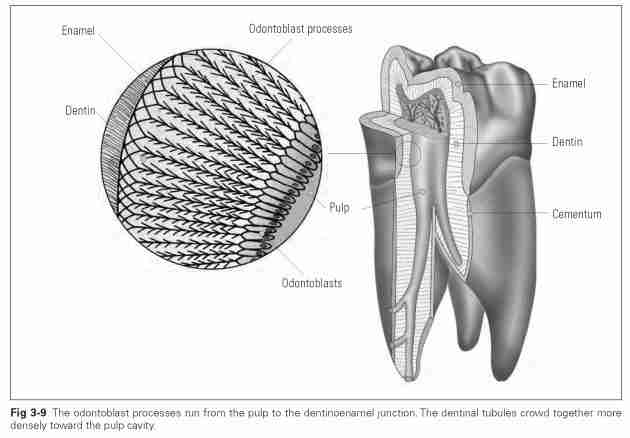
First some basic background so that we are all on the same page: the crowns of teeth are covered in an outer layer of enamel composed mostly of crystalline calcium phosphate without any living cells. Below that is a bone-like layer of dentin, which is also predominately calcium phosphate but without the prismatic alignment and with a higher fraction of organic material, including living odontoblast cells. The cell bodies of odontoblasts sit at the basilar surface of the dentin where they interface with nerves and blood vessels in the hollow pulp center of the tooth. From there they send odontoblast processes across the layer of dentin through tubules to the dentinoenamel junction. These processes transmit stimuli making dentin sensitive to touch, temperature, and chemical influences. The processes are also responsible for creating new dentin throughout the lifetime of the tooth. Despite the ability to produce secondary dentin in response to decay, dentin is not as resistant to caries as the enamel, and typically decay that reaches the dentin spreads to the pulp cavity. Because the odontoblast processes do not extend into the enamel, it is harder and less sensitive, but also lacks an equivalent method to create secondary enamel. So minerals from the blood can make it to the dentin but not the enamel. Instead remineralization can occur through ion deposition into enamel crystal voids on the tooth surface.
The biofilm of plaque excreted by bacteria on the surface of the teeth becomes acidic as a result of carbohydrate metabolism. This is the primary cause of dental carries. Saliva can act as a natural buffer to neutralize the pH and allow calcium and phosphate ions to remineralize the tooth. Mouth breathing can dry the mouth of saliva and exacerbate tooth decay.
So the principles of conventional dental hygiene focus on removal of plaque through brushing and flossing, limiting sugar in the diet that acidifies the plaque by feeding the bacteria, and fluoride therapy. The presence of fluoride in saliva speeds up the precipitation of new mineral crystals on the surface of the teeth, and creates a coating of enamel crystals that are more resistant to future carries attack because calcium fluorophosphate has a critical pH of 4.5 whereas calcium phosphate has a critical pH of 5.5 (so the plaque has to become more acidic to dissolve the crystaline structure containing fluoride). Fluoride ions are introduced through fluoridated drinking water, fluoridated toothpaste, and clinical fluoride varnishes.
I have never had significant tooth decay issues. I currently use a conventional commercial toothpaste, brush twice a day, and floss once a day. I think my diet low in refined sugars has limited my decay, but I do consume a lot of acidic foods and drinks including lemon juice, vinegar, fermented foods, etc. I worry that I am keeping the pH of my saliva dangerously low. In addition to limiting sugars, non-traditional dental hygiene (e.g. Weston Price Foundation) focuses on limiting phytic acid and receiving adequate intake of fat soluble vitamins. Phytic acid from grains, nuts, seeds, legumes, etc. prevents proper mineral absorption in the gastrointestinal tract. The fat soluble vitamins A, and D, and K2 are important for mineralization of bones and probably play a role in the creation of secondary dentin (but not enamel). Oil pulling is a practice that has limited scientific evidence but the internet is filled with anecdotal support for its use in reducing plaque and remineralizing the teeth. I tried it once, but it is time consuming and I worried that the swishing motion would prevent buccinator atrophy. While the conventional wisdom is that fluoride encourages remineralization and prevents demineralization, non-traditional "remineralizing" tooth pastes or powders avoid introducing fluoride to the enamel crystals. Maybe this is opening a can of conspiracy-theorizing worms, but I am curious to hear what people think about the utility of fluoride in preventing decay. @greensmoothies mentioned using one of these alternative toothpastes:
Posted by: Greensmoothies
If you get potholes calcium carbonate tooth paste helped me, I also hope my supplements will help prevent any damage and strengthen teeth
I have been supplementing with vitamin D, magnesium, K2, and a multivitamin (which contains A) mostly for my bones, but maybe they are also helping my teeth. @progress mentioned reversing cavities through K2 supplementation:
Posted by: Progress
I personally have not noticed much difference between not supplementing any and doing 45 mg / day for a while. I halted development of several cavities and coincidentally had slightly more energy, but that's about it.
So what do you think? Should I switch from my commercial toothpaste to a homemade powder? Should I take up oil pulling? Should I do more to avoid phytic acid in my diet? Should I incorporate fermented cod liver oil into my supplements? Do you have any other suggestions? Or should I just stick with the conventional wisdom that seems to be working fine for me.


Good thread and thanks for sharing your thoughts on this!
RE: alternative toothpaste - I started on this about 6 years ago after I was in a car crash and unbeknownst to me, developed night-time bruxism and ended up chipping a tooth. Actually, this car crash is what started me on this skull rebuilding and posture correction journey, as forward head posture took root which set off a whole cascade of negative effects. Anyway, so I looked in to tooth rebuilding tooth powders, purchased Uncle Harry's tooth remineralizing powder and have used it ever since. It made my teeth noticeably stronger and a little whiter, so I just keep using it. My teeth were so weak prior to switching that I couldn't even bite in to an apple without my teeth wobbling a little in their sockets. I think I was using Crest, or one of those standard ones.
RE: fluoride - Since my area doesn't fluoridate the water, I guess I'm completely free of that now. I do try to eat seafood for fluorine and some other things, and I'm looking in to making my own eggshell calcium with eggshell powder and apple cider vinegar/lemon (to make it calcium citrate), which should give me a more steady supply of this mineral as well as some others.
RE: pH - I hear you on the pH difficulties because I eat a lot of the same acidic foods. If I slacked on my dental regime at all, and kept consuming the apple cider vinegar, lemon, and sauerkraut, I'm sure I'd be in a world of trouble quite fast. Luckily, easy-to-implement practices like rinsing your mouth out with a swish of water after drinking staining things like coffee, tea and juice, or anything acidic, does seem to help. I'm inclined to believe that the baking soda in my tooth powder may help on this front as well. For supplements, it seems like K2, Vitamin D and magnesium have been the most helpful for my teeth.
RE: DIY toothpaste - I think DIY toothpaste can be difficult. When people make their own pastes with just some clay or baking soda, I think an opportunity is lost. The calcium carbonate in the toothpowder I use has really made a difference for me. The holes I bored in my teeth from chewing gum too much in my early 20s healed up once I began to use this tooth powder: not completely, but food used to routinely get stuck in the holes, now it happens maybe once a week. My dentist told me that he'd fill the holes if they ever got cavities, but it hasn't happened yet (I got these holes about 15 years ago). There's also a better taste to these powders you can buy which could be difficult to replicate even if you had some spearmint or some other essential oil on hand.
RE: Oil pulling - I've tried this a bit and like you, I didn't like the movement and how long it took, so I stopped. As well, I recently came across this video which delves in to the scientific studies on this practice and it doesn't seem especially promising. Oil pulling can whiten teeth if you add-in some spices which whiten/brighten like turmeric, cardamon and cinnamon, which I tried once and it seemed to help a little bit, but you could also just do an occasional brushing with charcoal powder.
Remember this pain... and let it activate you.

The sticking points with fluoride are its non-necessity and its tendency to prey on thyroid hormones & iodine (iodine being a heavier and less reactive halogen than fluoride means it tends to get replaced), leading to metabolic "confusion" of varying intensity. Ingesting a lot of fluoride is comparable to blindfolding the thyroid gland. This is not to say fluoride can't be valuable for dental health, but that you should respect it like you would respect fire. Fluoride toothpastes could be seen as a safeguard for those with insufficient quality of saliva for supporting internal tooth remineralization. For those whose biological mechanisms for tooth maintenance & remineralization are strong, fluoride may weaken teeth by interrupting this superior process of remineralization.
It should also be noted that dental health can serve as an indicator of the overall state of metabolism. Efficient metabolism is an efficient protector of teeth. Maximizing metabolic vigor however is a vast topic that can't be summarized into a single post. There are other online communities for this purpose.
For @greensmoothies and others interested in using calcium directly on teeth, https://www.calciumtherapy.com/ is worth checking out. They sell toothbrushes with a slab of calcium on the backside from which some will dissolve every time you brush. They also have zinc-calcium mouthwashes and other stuff. Both the brush and the mouthwash will last for at least a couple of months, so it's not a large investment.
If you really have been doing great on fluoride pastes so far, I would think twice before jumping in to experiment with something else. Experimenting is not that exciting when you have a lot to lose and little to gain.
@greensmoothies and @Yay, do you use the Uncle Harry's toothpaste for brushing, and then the Uncle Harry's remineralizing powder for swishing after meals, etc? Some homemade tooth powder recipes like this one ( https://wellnessmama.com/5252/remineralizing-tooth-powder/ ) contain calcium carbonate powder to help remineralize (in addition to other ingredients like bentonite clay and baking soda) but are intended to be used in place of toothpaste for brushing by wetting the brush and dipping it in the powder. I suppose I could continue to use my commercial fluoridated toothpaste for brushing and then use Uncle Harry's remineralizing powder to swish at other times during the day.
One of my incisors has a jagged edge that I think resulted from sleep bruxism a few years ago. I wonder if enhancing remineralization could help even out the flaws. I'm also concerned that the amount of acidic foods and drinks I consume could promote demineralization. I'm tempted to purchase the Uncle Harry's remineralization powder. It costs $8 plus $6 shipping through their website or $11 with free shipping on Amazon for a 1 oz bottle. The ingredients include: calcium carbonate, pink sea salt, bamboo silica, organic marshmallow root, alkalizing ionic minerals, purified ocean water, and magnetic earth. I recognize most of these ingredients, but I'm not sure what they mean by "magnetic earth." I'm guessing it is some type of clay. I wonder if "alkalizing ionic minerals" are essentially just sodium bicarbonate (baking soda). Silica from plants such as nettles, oatstraw, horsetail, or bamboo (as Uncle Harry's uses) is supposed to be important for the remineralization process, but I'm not sure of the mechanism. Marshmallow root powder is supposed to sooth mucous membranes. The instructions for Uncle Harry's remineralization powder read "Hold a pinch of powder in your mouth until wet with saliva. Swish with the alkaline saliva mixture for five minutes. Spit out. Rinsing not necessary. Use frequently, especially after meals." The homemade remineralization powders I have found online are recommended as a replacement for toothpaste to be used with a brush, rather than just swishing with the powder for a few minutes, but many of the ingredients are equivalent to the Uncle Harry's powder. I think I might purchase the ingredients to make my own. It would be more expensive than a single bottle of Uncle Harry's but it would be cheaper per ounce in the long run if I decide to keep using it.
One of my incisors has a jagged edge that I think resulted from sleep bruxism a few years ago. I wonder if enhancing remineralization could help even out the flaws. I'm also concerned that the amount of acidic foods and drinks I consume could promote demineralization. I'm tempted to purchase the Uncle Harry's remineralization powder. It costs $8 plus $6 shipping through their website or $11 with free shipping on Amazon for a 1 oz bottle. The ingredients include: calcium carbonate, pink sea salt, bamboo silica, organic marshmallow root, alkalizing ionic minerals, purified ocean water, and magnetic earth. I recognize most of these ingredients, but I'm not sure what they mean by "magnetic earth." I'm guessing it is some type of clay. I wonder if "alkalizing ionic minerals" are essentially just sodium bicarbonate (baking soda). Silica from plants such as nettles, oatstraw, horsetail, or bamboo (as Uncle Harry's uses) is supposed to be important for the remineralization process, but I'm not sure of the mechanism. Marshmallow root powder is supposed to sooth mucous membranes. The instructions for Uncle Harry's remineralization powder read "Hold a pinch of powder in your mouth until wet with saliva. Swish with the alkaline saliva mixture for five minutes. Spit out. Rinsing not necessary. Use frequently, especially after meals." The homemade remineralization powders I have found online are recommended as a replacement for toothpaste to be used with a brush, rather than just swishing with the powder for a few minutes, but many of the ingredients are equivalent to the Uncle Harry's powder. I think I might purchase the ingredients to make my own. It would be more expensive than a single bottle of Uncle Harry's but it would be cheaper per ounce in the long run if I decide to keep using it.
It may help and I know these remineralising powders can help prevent further damage at least, I've also had some remineralisation over the years for sure using the Uncle Harry's tooth powder for brushing. I think given the amount of acidic foods & drinks I eat to improve my digestion now, I could use this sort of product (remineralising powder to add more "oomph" to my post-meal swishes) too and plan to get it. I also want to help protect against damage from increased chewing. Making your own could be good, if not better because things like bamboo extract for silica, calcium carbonate and ionic minerals (do these come in powder form?) have a dual purpose as supplements. Some people use clay internally, and externally it can be used as a facial mask. Marshmallow, I seem to recall it has some digestion benefits and use as a hair detangler. Just my experience but horsetail is extremely dehydrating, not ideal for a source of silica especially if it may promote dry mouth.
Not sure how you get the alkalizing ionic minerals in there, but looking at the product page they list "calcium, magnesium, and phosphorus for strengthening teeth, and promoting an alkaline pH of the mouth". I guess you'd need to find these minerals in ionic and I guess powder form (if that's possible?) and make sure they all have an alkaline pH? Magnetic earth is probably a type of clay, my guess would be it's Calcium Bentonite/Montmorillonite. Seeing the colour of the powder could provide a helpful clue here. I plan to get this product with my next online shopping order so I'll let you know what colour the clay seems to impart. If there's a greenish colour then it's likely calcium bentonite. I got their tooth paste for kids and they list bentonite clay on the ingredients, and it has a green colour.
Remember this pain... and let it activate you.
Not sure how you get the alkalizing ionic minerals in there, but looking at the product page they list "calcium, magnesium, and phosphorus for strengthening teeth, and promoting an alkaline pH of the mouth". I guess you'd need to find these minerals in ionic and I guess powder form (if that's possible?) and make sure they all have an alkaline pH? Magnetic earth is probably a type of clay, my guess would be it's Calcium Bentonite/Montmorillonite. Seeing the colour of the powder could provide a helpful clue here. I plan to get this product with my next online shopping order so I'll let you know what colour the clay seems to impart. If there's a greenish colour then it's likely calcium bentonite. I got their tooth paste for kids and they list bentonite clay on the ingredients, and it has a green colour.
Yep that's the tooth powder I've used to brush my teeth for a while. And that was my plan as well, to purchase that remineralization powder and compare it with one I'll make. I wonder what type of phosphate and magnesium should be used? And I'd imagine it either has baking soda or it should be added to raise the pH.
Remember this pain... and let it activate you.

It's embarrassing to admit, but I tried countless things over a period of 5 years and probably spent around $1000 on infinite products without getting any results. This includes all of the megadoses of vitamins, silica, various tooth powders, xylitol, comfrey root, Bio-Dent, and much more.
Due to a fear of the dentist, I figured cavity prevention would be in my best interest to limit how many times I'd have to visit one. Prevention turned into a few pinhole cavities, which lead to buckling down further and trying more solutions to fix them. Nothing worked, and my teeth were gradually getting worse until everything snowballed. New teeth were getting new cavities, and one somehow lost a big chunk overnight and eventually turned black. My mouth looked like that of a drug addict. The paranoia was real, so I spent increasingly more money and probably over 100 hours studying everything I could find about healing cavities. None of it worked, so in December 2017, I bit the bullet and saw my usual dentist for the first time since 2012. He berated me for letting it get so bad and warned me of needing a "mouthful of dentures by age 30" if I didn't start taking care of my teeth, as if I wasn't already trying to do that. I saw another dentist who said the tooth with a black hole needed to be extracted. I thought he was being dramatic because it was fully functional and painless, so I went to one more dentist who ended up being pretty good. He kept saying it could be fixed with a mere filling and that the other two dentists were being hyperbolic. I had ~9 fillings spaced out over 2 months am glad I went through with it. I know they aren't actually "fixed", the decay just got filled in but they look and feel a lot better than before.
It's unlikely anyone else here would be dumb enough to keep ignoring rapidly decaying teeth, but I wanted to give out a cautionary tale about being too extreme with the whole "dentists are the devil, they're all money hungry parasites who ruin teeth and don't tell you they can heal" philosophy that a lot of sites seem to preach in their articles about cavities. I certainly fell into that mindset, and it oddly got stronger as my teeth became worse. Teeth should be able to heal, why they supposedly can't doesn't make much sense, but I let mine get way out of control. Good luck to anyone else trying to find a solution, I think it's definitely possible. Just stating the obvious to not do what I did and double down on DIY cures if it's getting that bad.

On the topic of salivary pH: I'll be brief but it's paradoxical. Acidic foods actually raise your salivary pH in the long run by alkalizing your body while foods like refined table sugar lead to a more acidic salivary pH. It has less to do with the actual pH of the food you are eating and more to do with how it effects your body's mineral balances. If you search around for an 'acid/alkaline food chart' you can take a quick look and see what I mean. Of course if you are eating raw lemons and drinking vinegar then you should rinse your teeth afterwards, but other than that it's actually good for you.
And your mention of fluoride isn't a conspiracy, it's actually been proven that even though yes fluoride deposits onto teeth that need minerals, it actually makes them more brittle and is not ideal. It's like a band-aid and not a real fix. I don't use any in my toothpaste and my teeth are fine, I've been doing it this way for years as well, so it's not some random thing that I am experimenting with. But if a person's diet is poor then fluoride would probably be beneficial for them. So I can't just give a blanket statement to everyone to cut it out of their products.
But basically from everything I have read and experienced it all comes down to having a good diet full of everything that bones need to be healthy, avoiding bad foods like sodas and refined table sugars, and keeping your teeth flossed and well brushed. I follow something like that and my teeth haven't given me issues yet even though I went through periods when I really abused them.
I made a homemade remineralizing tooth powder this evening. I eat a lot of local, pasture-raised chicken eggs and I always think I should use the shells to make calcium powder, but never tried it until tonight. I had 6 egg shells. Once emptied, I baked them in the oven briefly to dry them out and then pulsed them thoroughly in my spice grinder. This gave me approximately 2 tablespoons of eggshell powder. To that I added 2 tablespoons of calcium bentonite clay, 2 teaspoons of baking soda, and 2 teaspoons of cinnamon. I combined it in a small ball jar. To brush, I wet my toothbrush and dipped it into the powder mixture. I was surprised that it didn't feel too dry in my mouth. I'm really pleased with the taste, and the clean feeling. I have to decide if I am going to switch from my conventional commercial toothpaste to the tooth powder entirely or maybe brush with one in the morning and the other at night. My understanding is that, although fluoride lowers the critical pH of the enamel, preventing demineralization, it might also restrict remineralization by disrupting the crystalline structure. So maybe I should stop using the fluoride toothpaste altogether. Unfortunately, I am probably getting a pretty significant dose of fluoride each day by drinking a lot of tap water and using it to make tea and coffee. I certainly don't have the resources currently to purchase a fancy filter.
My first batch of homemade tooth powder is almost gone. It has lasted over three months. I have to confess that I haven't seen much remineralization at the sites where I have some minor chipping on my upper incisors. I wonder if the fluoride in my tap water is disrupting the crystaline structure from depositing. That being said, I'm happy with how my teeth feel, and I think this is a healthier option than traditional toothpaste, so I went ahead and made another batch today. I had a few more egg shells this time so I made 1.5x the recipe, and this batch should last me a little longer.

I haven't been to a dentist in several years, but the last time I went, I had been using magnesium oil regularly as my sole "toothpaste" (a couple squirts on my Dr. Perio's soft toothbrush) for well over a year or two, and they were impressed with how clean my teeth were and said they barely had to do anything during the cleaning.
I have some MI Paste that I use once in a while. Fluoride-free. The "Plus" version has fluoride. I avoid that. You just put a pea size amount on your finger, wipe it around your teeth and then let your saliva do the rest. Keep it in your mouth for at least 5 minutes before spitting, and don't rinse out afterwards. Supposedly it has bio-available calcium and phosphate and helps regular pH in the mouth. Very good to take at bedtime after brushing.
I've been flossing daily. It really is important. I neglected that for a long time and had a lot more sensitivity and bleeding. Regular flossing is a must .
I also have Novamin toothpaste. It does have fluoride in it, which I generally try to avoid, but I heard so many good things about Novamin I decided to try some out. I haven't noticed any outstanding results from it but I think as far as fluoridated toothpastes go, that one might actually be worth it, at least for occasional use. I bought two bottles over a year and a half ago and still have most of one bottle left, so I don't use it that regularly.
Magnesium oil is still my go-to, and the softest bristled toothbrushes I can find.
There was a study about oil pulling that showed pulling with distilled water in the same manner had identical results. Someone can fact-check that if they want. Just going by memory. Oil pulling is inconvenient and can get messy and is a general pain, but I did do it for a couple years with coconut oil. I may start again at some point, but generally it's just too much of a hassle for me.
Oral probiotics have been a godsend for me. Mostly for immunity, but I think they can have a lot of benefits for tooth health as well. I've been using NOW Foods Oralbiotic lozenges for over a year now. I tried one other brand with multiple strains. Finished the whole bottle and I'm pretty sure it was regularly giving me diarrhea. Very hard to pinpoint that but my stomach did not seem to react so well to the multi-strain oral probiotics.
I'll try another brand with multiple strains and see if that works. But the NOW foods one only has l. salivarius and I have had zero such issues with it. Nothing but positive results. Taking these, especially when I'm around people that are sick, has resulted in the first time in my entire life (I'm almost 30) that I didn't get sick immediately after being around someone with a sickness. I was completely amazed and that made me a real believer in this stuff.
It directly acts to help crowd out harmful bacteria in the mouth. Good. I've tried a ton of supplements, and oral probiotics are close to the top of the list for me of indispensable supplements.
I do take K2 somewhat regularly. Carlson brand, 5mg of the MK4 variety.
I was doing shilajit for quite a while as well. I may just start that up again. Concentrace minerals can be nice too. There are some nice multi-mineral fulvic acid supplements (basically based on shilajit) that look good too. Purity can be an issue with shilajit so I'd go for one that is lab-tested in the USA for being heavy-metal free or within established limits.
I've been absolutely loving digestive enzymes lately as well. I imagine those could help with mineral absorption just as a byproduct of making digestion easier. I use two brands: MRM digest-all, and NOW foods Super Enzymes. The NOW foods I take as a general purpose, the MRM I use specifically with the pea and rice protein shakes I make (I open the caps and pour the powder out into the shake before I blend it). Supposedly helps protein uptake after workouts, but also eliminates the horrible gas and bloating I otherwise get from pea/rice protein.
Daily flossing and brushing, and oral probiotics are the current "plan" I'm on, with MI paste once in a while. I use the paste whenever my teeth are feeling sensitive, or after a day where I bit down on something that hurt my tooth. I am always the poor sap who finds tiny bone shards in meats, or glass in a cherry pie for no reason.
Maybe my bad luck there is genetically inherited? My dad has the same issue ;)
Recap:
-Magnesium Oil
-Oral probiotics
-Daily flossing/brushing
-Tongue scraping (forgot to mention this one but I think it can help)
-MI Paste (non-fluoridated regular version)
-K2 (D3 and calcium co-administered is probably good as well, of course)
One last note: I am a fan of using medical tape over my lips at night. Haven't done this in a while, but having the mouth drop open when we're sleeping can't be good. The mouth very easily could get dry and lose the protection of saliva, allowing damage to the teeth.
Keep in mind "Shut Your Mouth and Save Your Life" by George Caitlin was written before tape was invented. He believed in keeping your mouth shut during the night simply with willpower. Chew on that ;)

Something I've been wondering for a while is whether hard chewing could accelerate tooth remineralization. As far as evolutionary needs for remineralization go, it's been said that evolution didn't prepare us for caries but it must've prepared us to combat tooth wear to some extent. During a heavy chewing session I feel pretty intense soreness at the roots of my teeth that lingers on for minutes. I find it believable that stressing the teeth would signal the rest of the body to deploy more minerals there. Of course if you're dealing with weakened enamel this seems counterintuitive but I think it's something to consider if the decay is at an early stage.

I have some MI Paste that I use once in a while. Fluoride-free. The "Plus" version has fluoride. I avoid that. You just put a pea size amount on your finger, wipe it around your teeth and then let your saliva do the rest. Keep it in your mouth for at least 5 minutes before spitting, and don't rinse out afterwards. Supposedly it has bio-available calcium and phosphate and helps regular pH in the mouth. Very good to take at bedtime after brushing.
I will second the MI Paste. It's hard to buy, but I did find some on Bonanza. It works fairly well for making the tooth feel clean. It did little to remineralize the tooth. But I think I was hoping for too much.
I've since moved on to Apagard Premio toothpaste. I switch off between that and the Sensodyne with Novamin. Both seem to work very well. But these days I mostly use the Apagard. I've read a study where they said that both novamin and nanohydroxyapatite are equal in their effects. No statistically significant difference.
The way you use it is brush your teeth normally first, and rinse, then brush again with the special toothpaste, and leave it on your teeth. Do not rinse at all after applying this stuff.
Much better results than the MI Paste. The MI paste made me feel better psychologically, but with this stuff I notice an actual difference. The key is consistent daily use. I was using it once in a while and expecting miracles, but it doesn't work that way. Gotta stay consistent.
Recently thought I cracked a tooth. Was having severe pain upon eating sweets. Severe, severe pain. And anything cold or hot. It was after biting down onto a piece of salami and it had a bone in it or something. Went on for days.
Started cleaning my teeth more regularly and using this method. After a few weeks, absolutely no more pain. It started gradually subsiding, and then disappeared altogether. I was also experiencing pain with brushing, and that's gone away too.
I'm not sure about the toothpaste actually remineralizing the tooth permanently. But it does remineralize it temporarily. If you brush once a day anyway, applying this stuff daily should be no big deal. Even if it's "artificially" maintaining your enamel, seems a lot better to me as a daily practice than letting the tooth demineralize further. The studies show that the mineral complexes do attach to the teeth. They wear off eventually but they hang in there for a while and reinforce and protect/seal the tooth. Only "downside" is you need to reapply it regularly, but most people brush their teeth at least once a day. I just use it nightly before bed.
I recently got a Burst Oral Care toothbrush as well. I love it. I also love the floss they provide. It's awesome. Electric toothbrushes seem to clean much, much more thoroughly. My teeth feel much cleaner and smoother with the Burst.
Also, been drinking a lot more whole milk lately, after going back on a Ray Peat kick. I was always into his work but started taking his ideas more seriously now. Been having at the very least a quart of milk a day, and have been taking 5mg - 10mg daily of K2. Now that it's warming up outside, I'm also getting plenty of sunlight. The extra calcium from the milk and the use of K2 probably also helped heal my tooth, as I started doing that around the same time I started using the special toothpaste more regularly.
I also use a couple mouthwashes occasionally. A "Dentist Formulated Nano Silver with Xylitol" and one called "Uncle Harry's Miracle Mouthwash." I prefer the Nano Silver one because it's not as harsh and seems to leave my mouth feeling cleaner for longer. I was using these more extensively at first, but now just once in a while.
They can be a powerful tool to raise the pH in your mouth and stabilize your teeth. Acid produced by bacteria will just erode the enamel further. So minimizing that can go a long way in protecting the teeth.
I do think elevated calcium intake from dairy, and high doses of K2 (I take the MK-4 form), can likely go a long way in helping restore mineralization in our teeth. It's just a hunch though. If the placebo effect can help with the process, then I'm all for it :)

These topics have been mentioned in passing on the forum, and I realize that they are secondary to our focus on facial structure, but I have done some research into maintaining the function and appearance of the teeth themselves, and I suspect members of our holistic community would have knowledge to contribute or would be interested to learn.
First some basic background so that we are all on the same page: the crowns of teeth are covered in an outer layer of enamel composed mostly of crystalline calcium phosphate without any living cells. Below that is a bone-like layer of dentin, which is also predominately calcium phosphate but without the prismatic alignment and with a higher fraction of organic material, including living odontoblast cells. The cell bodies of odontoblasts sit at the basilar surface of the dentin where they interface with nerves and blood vessels in the hollow pulp center of the tooth. From there they send odontoblast processes across the layer of dentin through tubules to the dentinoenamel junction. These processes transmit stimuli making dentin sensitive to touch, temperature, and chemical influences. The processes are also responsible for creating new dentin throughout the lifetime of the tooth. Despite the ability to produce secondary dentin in response to decay, dentin is not as resistant to caries as the enamel, and typically decay that reaches the dentin spreads to the pulp cavity. Because the odontoblast processes do not extend into the enamel, it is harder and less sensitive, but also lacks an equivalent method to create secondary enamel. So minerals from the blood can make it to the dentin but not the enamel. Instead remineralization can occur through ion deposition into enamel crystal voids on the tooth surface.
The biofilm of plaque excreted by bacteria on the surface of the teeth becomes acidic as a result of carbohydrate metabolism. This is the primary cause of dental carries. Saliva can act as a natural buffer to neutralize the pH and allow calcium and phosphate ions to remineralize the tooth. Mouth breathing can dry the mouth of saliva and exacerbate tooth decay.
So the principles of conventional dental hygiene focus on removal of plaque through brushing and flossing, limiting sugar in the diet that acidifies the plaque by feeding the bacteria, and fluoride therapy. The presence of fluoride in saliva speeds up the precipitation of new mineral crystals on the surface of the teeth, and creates a coating of enamel crystals that are more resistant to future carries attack because calcium fluorophosphate has a critical pH of 4.5 whereas calcium phosphate has a critical pH of 5.5 (so the plaque has to become more acidic to dissolve the crystaline structure containing fluoride). Fluoride ions are introduced through fluoridated drinking water, fluoridated toothpaste, and clinical fluoride varnishes.
I have never had significant tooth decay issues. I currently use a conventional commercial toothpaste, brush twice a day, and floss once a day. I think my diet low in refined sugars has limited my decay, but I do consume a lot of acidic foods and drinks including lemon juice, vinegar, fermented foods, etc. I worry that I am keeping the pH of my saliva dangerously low. In addition to limiting sugars, non-traditional dental hygiene (e.g. Weston Price Foundation) focuses on limiting phytic acid and receiving adequate intake of fat soluble vitamins. Phytic acid from grains, nuts, seeds, legumes, etc. prevents proper mineral absorption in the gastrointestinal tract. The fat soluble vitamins A, and D, and K2 are important for mineralization of bones and probably play a role in the creation of secondary dentin (but not enamel). Oil pulling is a practice that has limited scientific evidence but the internet is filled with anecdotal support for its use in reducing plaque and remineralizing the teeth. I tried it once, but it is time consuming and I worried that the swishing motion would prevent buccinator atrophy. While the conventional wisdom is that fluoride encourages remineralization and prevents demineralization, non-traditional "remineralizing" tooth pastes or powders avoid introducing fluoride to the enamel crystals. Maybe this is opening a can of conspiracy-theorizing worms, but I am curious to hear what people think about the utility of fluoride in preventing decay. @greensmoothies mentioned using one of these alternative toothpastes:
Posted by: Greensmoothies
If you get potholes calcium carbonate tooth paste helped me, I also hope my supplements will help prevent any damage and strengthen teethI have been supplementing with vitamin D, magnesium, K2, and a multivitamin (which contains A) mostly for my bones, but maybe they are also helping my teeth. @progress mentioned reversing cavities through K2 supplementation:
Posted by: Progress
I personally have not noticed much difference between not supplementing any and doing 45 mg / day for a while. I halted development of several cavities and coincidentally had slightly more energy, but that's about it.
So what do you think? Should I switch from my commercial toothpaste to a homemade powder? Should I take up oil pulling? Should I do more to avoid phytic acid in my diet? Should I incorporate fermented cod liver oil into my supplements? Do you have any other suggestions? Or should I just stick with the conventional wisdom that seems to be working fine for me.
Tideglusib, it was created as an Alzheimer drug, regrows dentin.
It appears you have to drill down to the pulp for it work. Or at least the pulp needs to be exposed. It's still in animal trials, because the drug approval process is a glacial one. But they'll get around to humans, sooner, rather than later.

Anyone have experience with xylitol/erythritol?
Xylitol is taught to all dentists in school but for some reason it's rarely recommended in practice here in the US. Lots of PubMed studies out there about its efficacy against cavity-causing bacteria.
I buy xylitol/erythritol powder from the grocery store and swish about a teaspoon after every meal for 2-3 minutes. Haven't been to the dentist since I started doing it though so I'm not sure how effective it'll be for me.
@drunkwithcoffee I've swished with xylitol after eating anything every day for over 3 years. Unfortunately, my review of it is hard to trust as I initially started out of desperation to heal a bunch of severe cavities that I eventually learned were caused by acid reflux while asleep. Xylitol didn't do anything for them, probably because the erosion continued every night and also because one of the cavities was black with a giant chunk of tooth missing. After those teeth were filled and the reflux had abated, I've still had small cavities but my teeth never hurt. Admittedly, my swishing technique is sometimes lazy if I don't think about it, which makes a huge difference. Rinsing with xylitol is a good habit to keep up with even if it's not a cure-all. The thought of not doing it after eating and having the taste of a bunch of old food particles in your mouth all day is disgusting.

When I was young, I used a homemade paste made by my dentist. I don't know the recipe, which is sad, because I will never have such healthy teeth.
In general, this is an interesting story. That woman always looked bright and airy, fed the homeless animals and took care of the homeless. She always said, grinning, that she was doing magic, and that her paste worked so well not only because of its composition (which, she said, included such exotic ingredients as basilisk claw, spider genitals and bat wing of course), but and because of the magic spells she cast while making the paste. It worked anyway.
Now my brother recommended these guys to me - https://smileworkshop.com/locations/amarillo-general/ and he says they are amazing. Going to try, although I don't think they have bat wings.

I’ve been diving into the nitty-gritty of dental health recently and found some fascinating stuff about tooth structure and care. For example, while enamel is tough, it doesn’t regenerate like dentin, which can create challenges when dealing with decay.

